

 Contact Us
Ansys EMAG 302: Ansys PI – Power Integrity Analysis
Course Overview:
This course walks engineers through designing and validating Power Distribution Networks using Ansys SIwave — from DC voltage drop and decoupling capacitor selection to AC impedance analysis and transient simulation. Workshops built around real PDN design patterns give students a repeatable process they can take back to their own projects. By the end, engineers have the skills to deliver clean, stable power from first design through pre-fab verification.
Who should take this course:
- PCB Designers
- Hardware Design Engineers
- PCB Layout Engineers
- Electronics Simulation Engineers
- High-Speed Digital Design Engineers
- System Architects
Core proficiencies:
- Understand the fundamental principles of Power Integrity and PDN design, including DC and AC power delivery, target impedance, and common failure modes.
- Configure and run Power Integrity analyses in Ansys SIwave across DCIR, AC impedance, resonant mode, and transient co-simulation workflows.
- Build and validate Power Trees; define voltage regulators, current loads, and boundary conditions for accurate DC analysis.
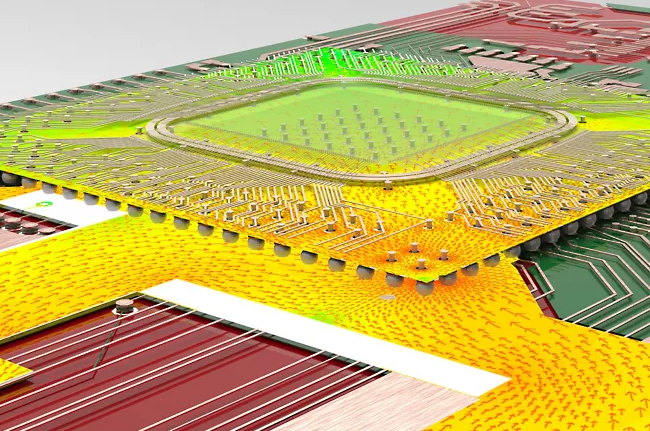
- Interpret voltage drop and current density results; identify current bottlenecks, dead copper, crowding, and inefficient power paths.
- Analyze PDN impedance profiles (Z11/Z21), identify resonances and anti-resonances, and verify target impedance across frequency.
- Visualize and interpret resonant mode field distributions and evaluate their impact on power integrity and EMI.
- Select, place, and optimize decoupling capacitors using PI Advisor; balance performance, cost, and board area.
- Analyze transient PDN behavior — droop, overshoot, ripple, and load-step response — and validate designs across DC, frequency-domain, and time-domain results.
Contact for EMAG 302 Training
Course Agenda | EMAG 302
Module 1: DCIR Analysis
- Why DC Power Integrity matters; DCIR Wizard and manual setup
- Voltage source and current load configuration; solver setup
- Power Tree construction and validation
- Results: voltage drop (IR drop) contour plots and current density distribution
- Results: element resistance, via loading, plane loading, and path resistance
- Identifying delivery issues: current bottlenecks, voltage cliffs, dead copper, poor return paths
- PCB layout optimization for IR drop and current distribution
- Tools: Padstack Modify, Plane Boundaries, Pin Groups, Via Management
Module 2: PI Design
- Power Integrity fundamentals and target impedance
- Power Tree creation and power rail planning
- PCB stackup design and power/ground plane optimization
- Decoupling capacitor selection: capacitance, ESR, ESL, and self-resonant frequency
- Vendor model assignment and capacitor placement strategies
- Designing for low PDN inductance; preparing the design for verification
- Tools: Capacitor & Inductor Library Browser, Vendor Component Manager, Stackup Editor, Power Tree Manager
Module 3: PI Analysis
- Why AC Power Integrity analysis matters; target impedance review
- Port placement, excitation setup, and AC solver configuration
- Results: Z11 input impedance profile and Z21 transfer impedance
- Resonance and anti-resonance identification
- Decoupling capacitor contribution and effectiveness analysis
- PDN impedance optimization and target impedance verification
- Tools: PDN Channel Builder, Capacitor Library Browser, Vendor Model Assignment, Port Configuration
Module 4: Resonant Modes
- Cavity resonance fundamentals in PCB power and ground planes
- Resonant mode solver setup and frequency sweep configuration
- Results: resonant mode identification and resonant frequency analysis
- Electric field, magnetic field, and surface current visualization
- Impact on Power Integrity, Signal Integrity, and EMI
- Resonance suppression techniques and plane geometry optimization
- Tools: Mode Browser, Field Visualization, Report Generation
Module 5: PI Advisor
- PI Advisor workflow and defining optimization goals
- Configuring automated decoupling capacitor optimization
- Capacitor library and vendor model selection
- Results: capacitor recommendations, placement optimization, and PDN impedance improvement
- Cost vs. performance trade-offs and what-if scenario analysis
- Exporting optimized recommendations for PCB implementation
- Tools: Capacitor Library Browser, Optimization Settings, Design Constraints Manager, What-If Analysis
Module 6: PI Transient
- Transient PI fundamentals and PDN circuit model construction
- VRM modeling, IC die network modeling, and decoupling capacitor integration
- Transient current profile configuration (PWL and measured waveforms)
- Results: voltage ripple, droop, overshoot, and load-step response
- VRM and decoupling capacitor performance assessment
- PDN optimization for transient specifications
- Correlation with DCIR and AC impedance results
- Tools: PDN Channel Builder, VRM Modeling, IC Die Network Modeling, Circuit Co-Simulation