

 Contact Us
Unlike conventional computing platforms, quantum hardware operates at extreme physical limits. Even micron‑ or nanometer‑scale motion can directly disrupt qubit coherence. This blog highlights how engineers can use predictive simulation workflows to mitigate NVH-driven performance risks in quantum systems.
Why Quantum Hardware Is Exceptionally Sensitive to Vibration
Quantum computers do not rely on classical transistors operating in binary on/off states. Instead, they use qubits, which leverage quantum mechanical behavior at extremely small spatial and energy scales. These states are inherently fragile.
Most qubit technologies operate inside dilution refrigerators at millikelvin temperatures, approaching absolute zero. At these temperatures:
- Mechanical vibration couples directly into the qubit environment
- Structural motion introduces decoherence, causing qubits to lose stored information
- Even extremely small displacements, on the order of microns or nanometers, become performance limiting
From an engineering perspective, vibration is not a secondary concern. It is a direct failure mode that affects coherence time, gate fidelity, and measurement accuracy.
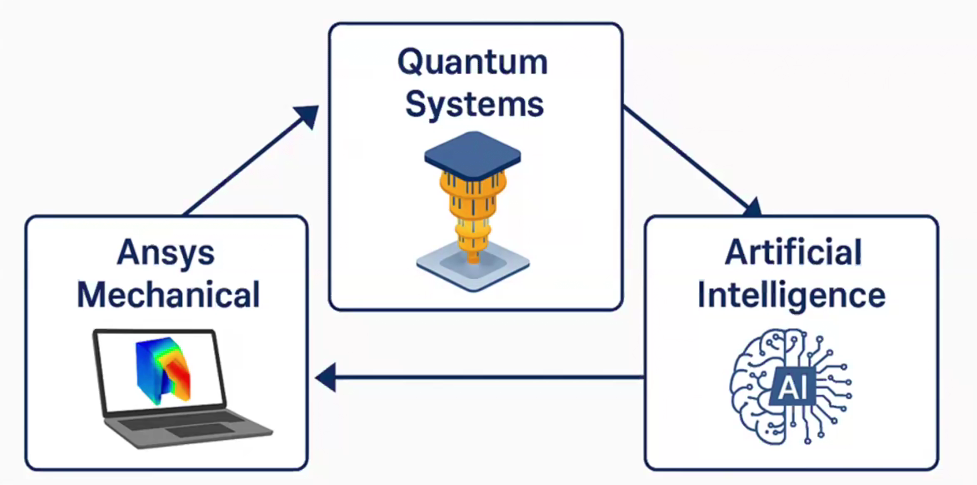
NVH in Quantum Systems: A Different Design Paradigm
In traditional industries such as automotive or aerospace, NVH is commonly associated with comfort, perception, or fatigue life. In quantum hardware, the role of NVH is fundamentally different.
Here:
- Noise represents unwanted system disturbances
- Vibration must be minimized or isolated to protect qubit states
- Harshness correlates directly to computational performance degradation
In other words, NVH is not about user experience. It is about whether the system can compute reliably at all.

Like what you’re reading? Watch the quantum hardware NVH on-demand webinar.
Explore how simulation can help reduce vibration-driven performance risk in quantum systems with our on-demand webinar, “NVH Solutions for Quantum Computing Using Ansys Mechanical” This session highlights how engineers can use Ansys Mechanical to evaluate mechanical vibration, isolation strategies, noise transmission, and acoustics-induced effects across cryogenic and support structures to improve quantum hardware stability and reliability.
Environmental and Internal Sources of Vibration
Even inside controlled laboratory environments, vibration is unavoidable. Low‑level excitation originates from:
- Foot traffic and building motion
- HVAC airflow and nearby infrastructure
- Elevators, traffic, and external ground motion
Within the quantum system itself, vibration is also introduced by:
- Pumps and compressors
- Cryogenic support hardware
- Cabling, mounting structures, and thermal stages
Complicating matters, buildings and support structures can amplify vibration through structural resonance, reshaping the frequency content that reaches the quantum device.
Because vibration sources are both external and self‑generated, purely reactive mitigation strategies are insufficient. Predictive simulation becomes essential.
Structural Dynamics Challenges of Dilution Refrigerators
The iconic “chandelier‑like” structure of many quantum computers is not aesthetic—it reflects the complex mechanical requirements of dilution refrigeration.
These systems are characterized by:
- Tall, multi‑stage structures
- Non‑uniform stiffness across stages
- Numerous joints, brackets, mounts, and interfaces
- Thermal stages that add both mass and compliance
Each of these factors introduces potential bending modes and local resonances. Environmental excitation frequencies can easily align with these modes, amplifying motion where stability is critical.
Using Ansys Mechanical, engineers can apply traditional structural dynamics analyses, such as:
- Modal analysis
- Harmonic response
- PSD‑based random vibration
to identify problematic resonances and evaluate design tradeoffs between thermal performance, stiffness, and vibration isolation before hardware is built.
Passive vs. Active Vibration Control
Passive Isolation
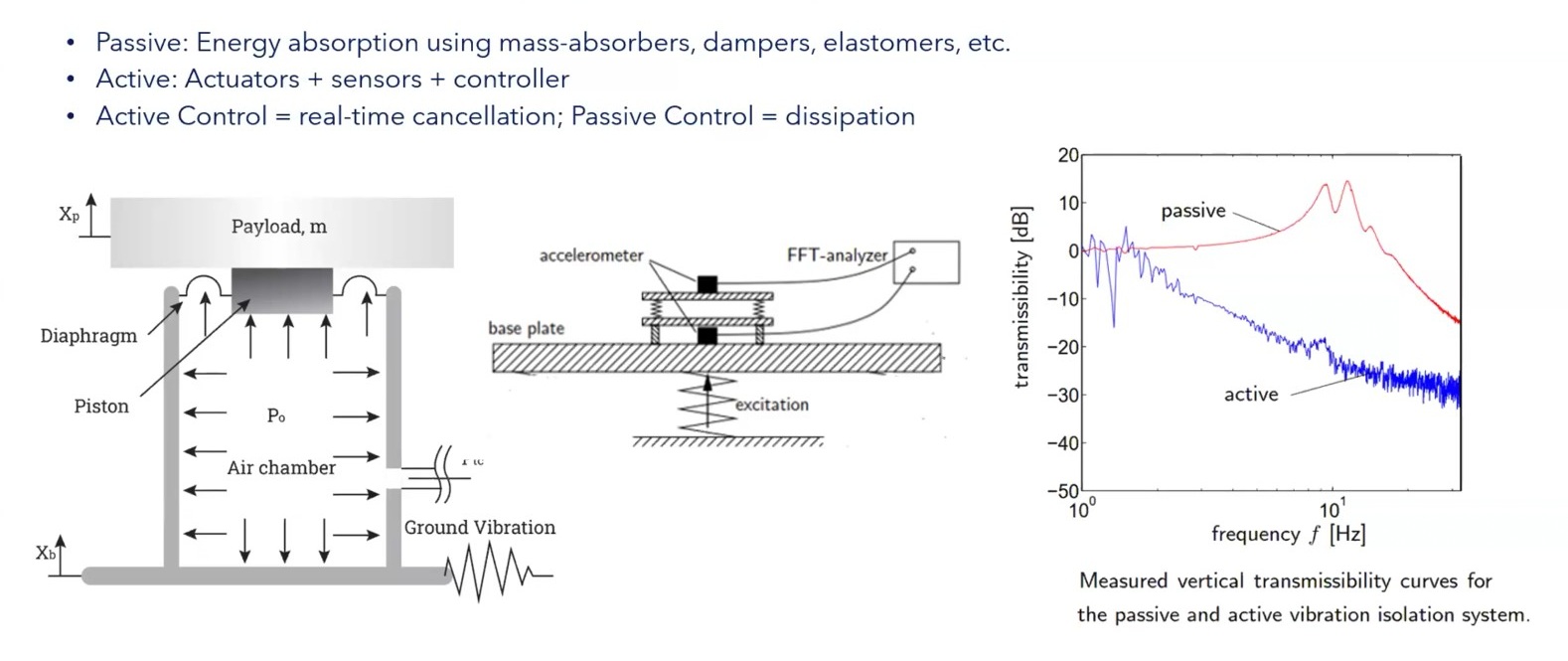
Passive approaches rely on elements such as dampers, elastomers, mass loading, or pneumatic isolation tables. These methods dissipate energy but inherently introduce resonant behavior.
For quantum systems operating at extremely low frequency ranges, passive isolation alone often leaves unacceptable transmissibility near resonance.
Active Vibration Control
Because quantum hardware operates at the “faintest whisper” of physical signals, active control strategies become viable, and often necessary. Active systems incorporate:
- Sensors to measure response
- Controllers to compute corrective action
- Actuators to apply counter‑vibration forces
The objective is real‑time cancellation, reducing transmitted vibration by driving an equal‑and‑opposite response—often close to 180° out of phase.
Transmissibility analyses presented in the webinar showed that active systems can significantly reduce vibration levels near resonance compared to passive approaches, even when accounting for actuator‑induced noise.
Model-Based Active Control Using Ansys Twin Builder
ANSYS enables active vibration control workflows by combining structural dynamics and control simulation.
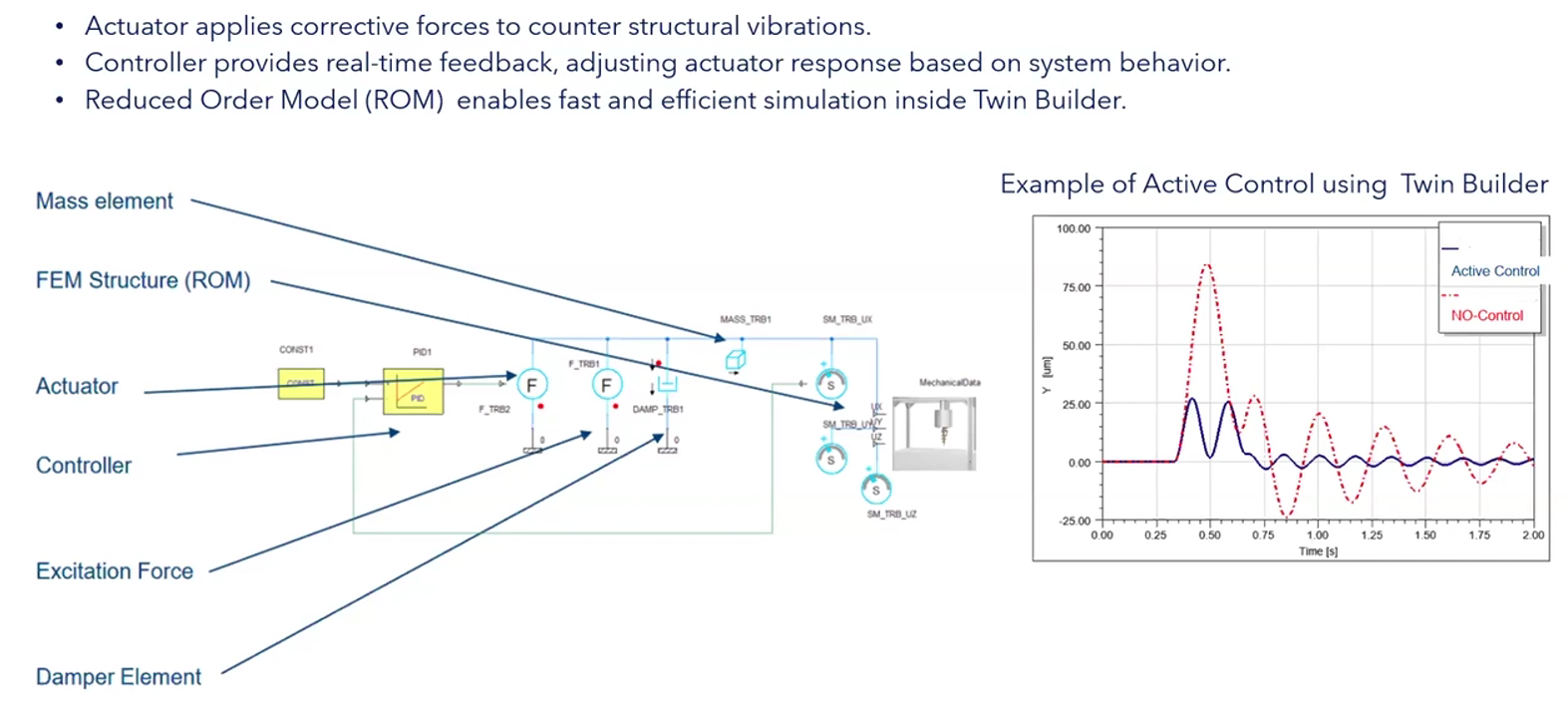
The process begins with modal analysis in Ansys Mechanical, where key resonant modes are identified. The model is then:
- Exported in state‑space form (mass, stiffness, damping matrices)
- Reduced into a Reduced Order Model (ROM)
- Imported into Ansys Twin Builder
Within Twin Builder, engineers can integrate:
- Actuators
- Sensors
- Control logic (e.g., PID control)
This allows closed‑loop simulation of vibration control strategies before hardware deployment, enabling engineers to evaluate performance, stability, and response suppression at critical frequencies.
Random Vibration and Signal Coherence
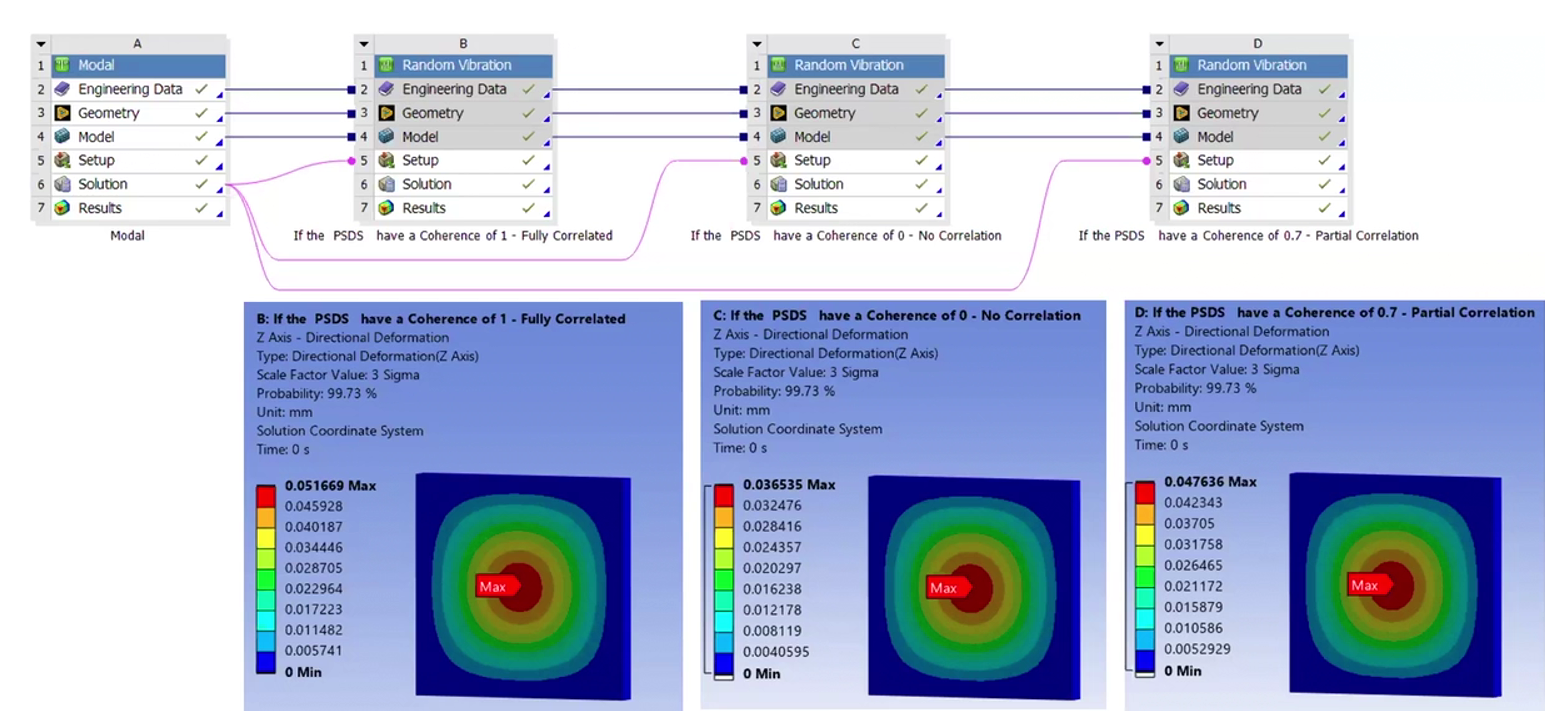
Quantum systems experience multiple simultaneous disturbance sources, many of which are partially correlated rather than fully independent. Traditional random vibration analysis often assumes uncorrelated PSD inputs. However, correlated excitation can significantly alter response amplitudes—especially critical when operating at nanometer‑scale tolerances.
The webinar highlighted:
- Use of PSD pressure loading to represent distributed excitation
- Inclusion of cross‑spectral terms to represent partial coherence
- Evaluation of coherence as a signal‑to‑noise metric
Even modest correlation levels that may be acceptable in conventional mechanical systems can introduce unacceptable response variation in quantum hardware.
Scaling Quantum Systems: Why NVH Matters More Over Time
As quantum systems scale in qubit count, hardware complexity increases:
- More wiring
- More cryogenic interfaces
- Taller and more flexible structures
Each addition increases the risk of resonance, amplification, and coupling between subsystems. Without predictive NVH modeling, these effects compound, leading to data errors, downtime, and reduced scalability.
Simulation-driven design enables engineers to manage these risks early, before physical complexity becomes unmanageable.
Key Takeaways for Quantum Hardware Engineers
- Quantum systems are extremely vibration-sensitive by nature
- NVH is a performance limiter, not a secondary concern
- Dilution refrigerator structures introduce complex dynamic behavior
- Passive isolation alone is often insufficient
- Active vibration control enables real‑time mitigation
- Ansys Mechanical and Twin Builder enable integrated NVH and control workflows
- Early, predictive simulation is essential for scalable quantum hardware
As quantum computing continues to mature, NVH engineering is transitioning from a niche consideration to a core enabling discipline.

Ben Benjamin, Ph.D., Mechanical Engineering
Senior Staff Engineer, SimuTech Group
With 13 years at SimuTech Group and more than 20 years of experience in NVH simulation and testing, Balaji supports customers across vibration and acoustics workflows, including noise source evaluation, correlation to test data, and performance-driven design refinement. He holds a Ph.D. in Mechanical Engineering from the State University of New York at Binghamton.


