 Contact Us
Introduction to AI Flow Field Prediction
In the previous blogs of this series, we built a comprehensive workflow for analyzing the aerodynamics of a space capsule during re-entry. We started by developing a high-fidelity CFD model in Ansys Fluent, capturing the complex flow physics associated with range of supersonic conditions. We then expanded this model using Ansys optiSLang to perform sensitivity analysis and design exploration, where Angle of Attack (AoA) and Mach number (Ma) were used as input parameters, and drag and lift forces were evaluated as key performance outputs.
In this blog, we take the next step by introducing SimAI Pro to enable AI-driven field prediction. Instead of predicting only scalar quantities, SimAI Pro allows us to learn from existing simulation data and directly predict full-field results—such as pressure, velocity, and temperature distributions—across the computational domain.
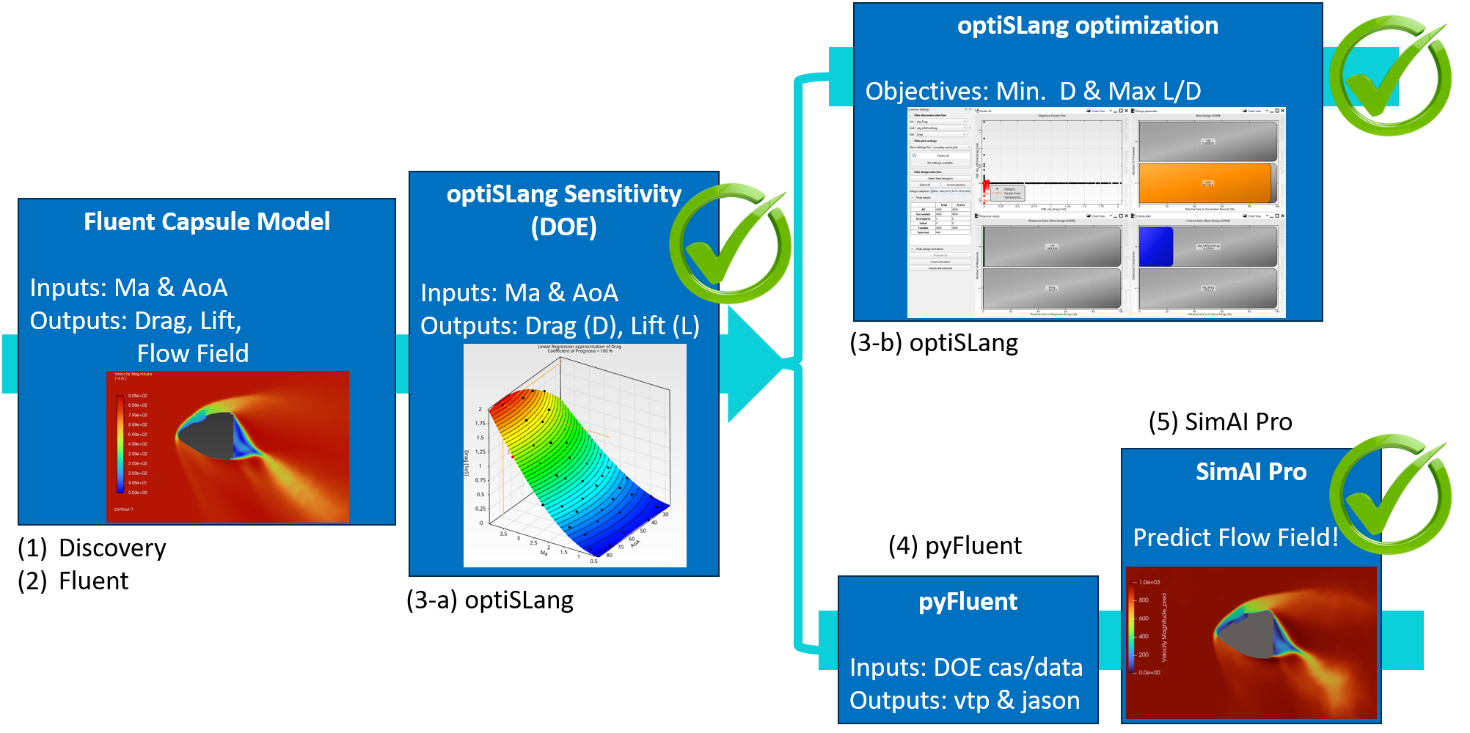
Figure 1 illustrates the overall workflow developed across the blog series. It begins with the Fluent capsule model, where Mach number (Ma) and Angle of Attack (AoA) are defined as inputs, and both global quantities (drag and lift) and flow field data are obtained. This model is then integrated into optiSLang for sensitivity analysis using a Design of Experiments (DOE), where the influence of Ma and AoA on drag and lift is systematically explored. Building on this, an optimization study is performed to minimize drag while maximizing lift-to-drag ratio. The resulting simulation database—consisting of multiple Fluent case and data files—is then processed using pyFluent, converting the results into formats suitable for machine learning (e.g., VTP and JSON). Finally, SimAI Pro leverages this structured dataset to train an AI model for AI flow field prediction, generating rapid, high-fidelity results directly from input parameters without requiring additional CFD simulations.
To efficiently handle and prepare the simulation data for AI training, pyFluent plays a key role in automating the data extraction and transformation process. One of the main benefits of using pyFluent is its ability to programmatically access Fluent case and data files, eliminating the need for manual post-processing. This ensures consistency across all design points generated during the optiSLang sensitivity analysis while significantly reducing preprocessing time. Additionally, pyFluent provides flexibility in selecting specific surfaces or regions of interest, enabling targeted extraction of relevant flow field quantities for AI model training.
In this workflow, a Python script leveraging pyFluent is used to systematically read each Fluent case and data file generated during the DOE study. For every design point, the script extracts the surface flow field data and exports it in VTP format, which is well-suited for visualization and machine learning pipelines. At the same time, optiSLang already generates JSON files containing the input parameters (Ma and AoA) and associated scalar outputs during the sensitivity analysis. The pyFluent script further processes and reformats these JSON files to make them fully compatible with SimAI Pro requirements. As part of this automated pipeline, the code creates a new directory structure, where each design point is stored in its own subfolder containing the corresponding VTP and JSON files, ensuring a clean, organized dataset ready for AI training.
Setting Up AI Flow Field Prediction in SimAI Pro
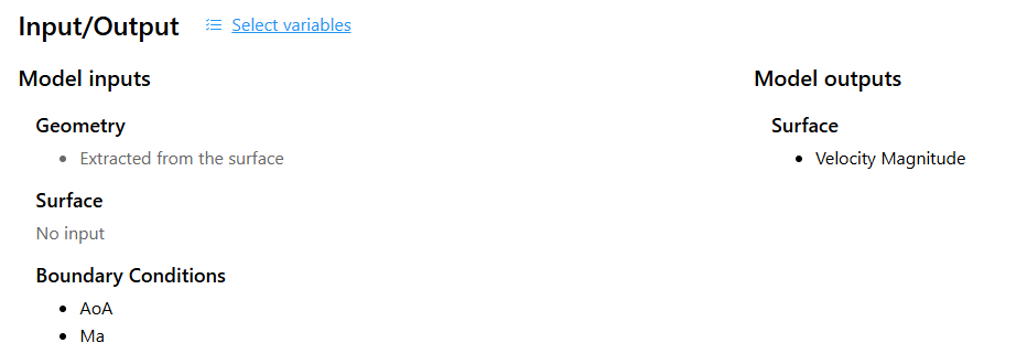
After preparing the dataset, the next step is to leverage SimAI Pro to build a predictive model for the flow field. The workflow starts by importing the structured data folder generated in the previous step. Within the SimAI Pro interface, the relevant input variables—Mach number (Ma) and Angle of Attack (AoA)—are defined using the information stored in the JSON files, while the output variable is selected from the VTP field data.
In this example, the focus is on predicting the velocity field on the symmetry plane, which captures key aerodynamic features such as flow acceleration, separation, and wake structures. Once the inputs and outputs are configured, SimAI Pro is used to train a machine learning model that learns the mapping between the operating conditions (Ma, AoA) and the corresponding flow field distribution. After training, the model can rapidly infer the velocity field for new input combinations, providing near real-time access to high-resolution flow predictions without requiring additional CFD simulations.
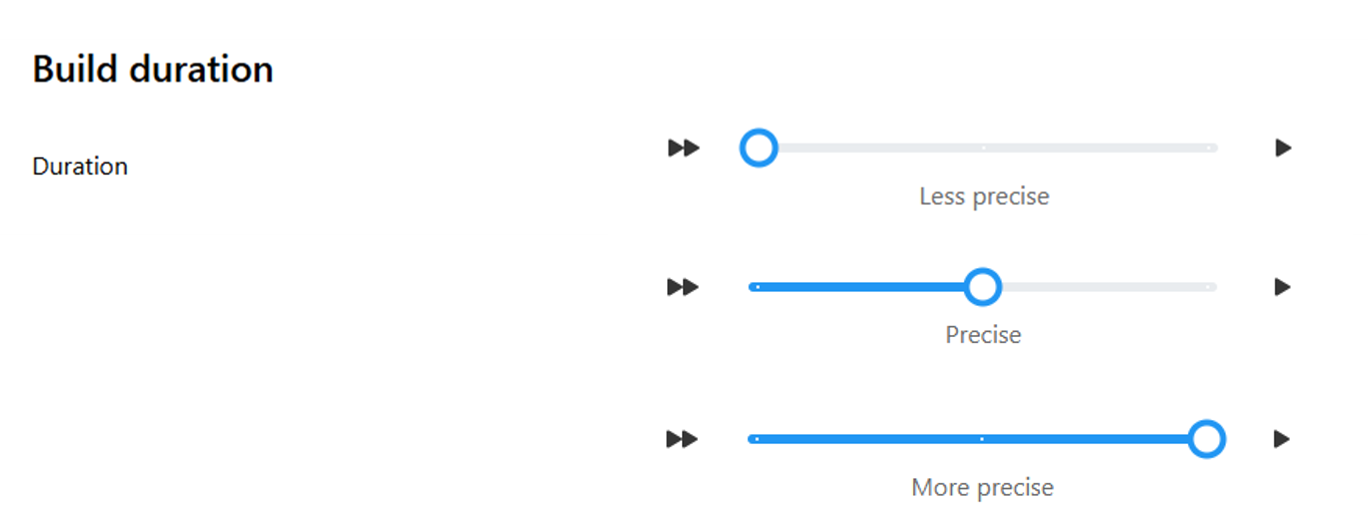
Figure 2 illustrates the selected input and output variables used for model training in SimAI Pro. Figure 3 presents the available training configurations, ranging from faster, lower-fidelity options to more computationally intensive settings that provide increased accuracy.
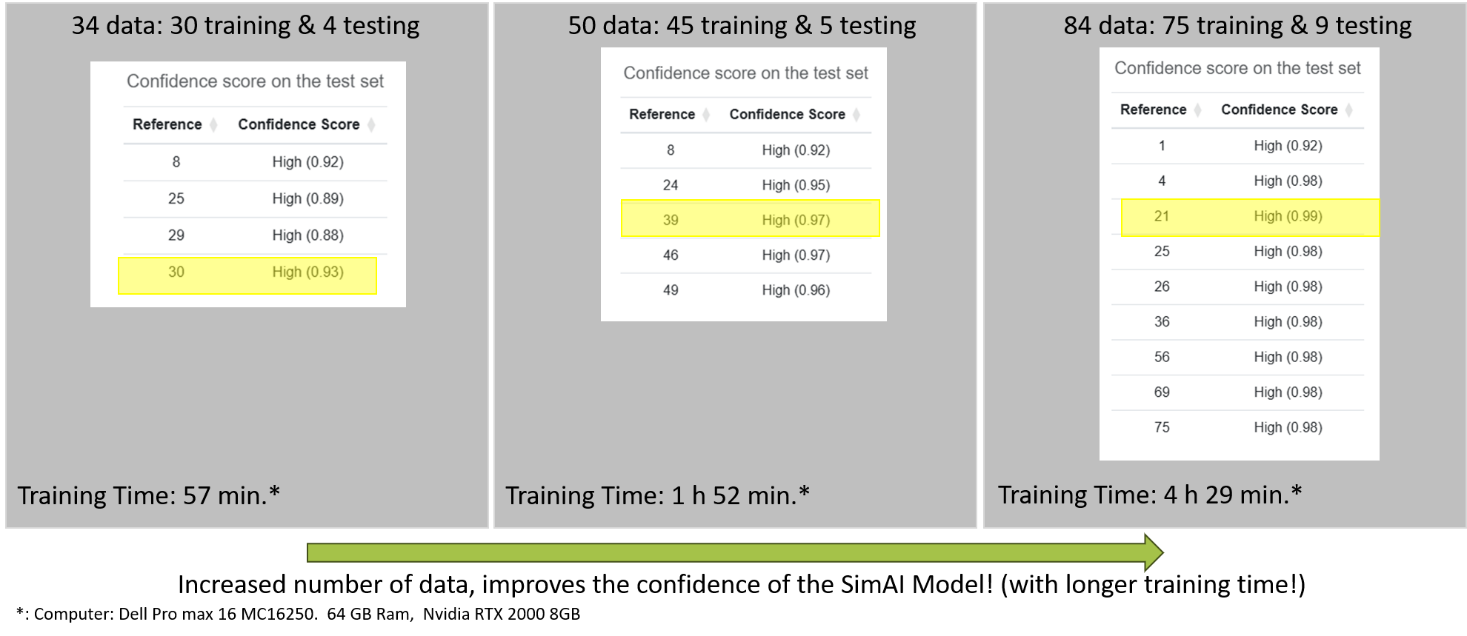
The impact of training dataset size on model performance and training time in SimAI Pro, presenting three scenarios with progressively increasing amounts of data: 34, 50, and 84 samples. Each case clearly shows how the dataset is split into training and testing subsets, along with the corresponding confidence scores on the test set and total training time (Figure 4).
A key observation is that as the number of training samples increases—from 30 training cases (34 total) to 75 training cases (84 total)—the model consistently achieves higher confidence scores on the test data. In the smallest dataset, confidence scores range approximately from 0.88 to 0.93, whereas for the medium dataset they improve to around 0.92–0.97, and for the largest dataset they reach up to 0.99. This trend highlights the benefit of providing more diverse training data, allowing the model to better capture the relationship between input parameters (Mach number and AoA) and the resulting flow field.
However, this improvement in predictive confidence comes with a clear trade-off in computational cost. The training time increases significantly—from 57 minutes for the smallest dataset to 1 hour 52 minutes for the medium case, and up to 4 hours 29 minutes for the largest dataset. Note that all the trainings were performed with a computer having NVIDIA RTX 2000 GPU card with 8GB ram.
In addition, the largest dataset (84 samples) was also tested on a NVIDIA RTX Pro 6000 Blackwell GPU with 96 GB memory, where the training time was significantly reduced from 4 hours 29 minutes to approximately 40 minutes, highlighting the strong impact of modern GPU acceleration on AI model training efficiency.
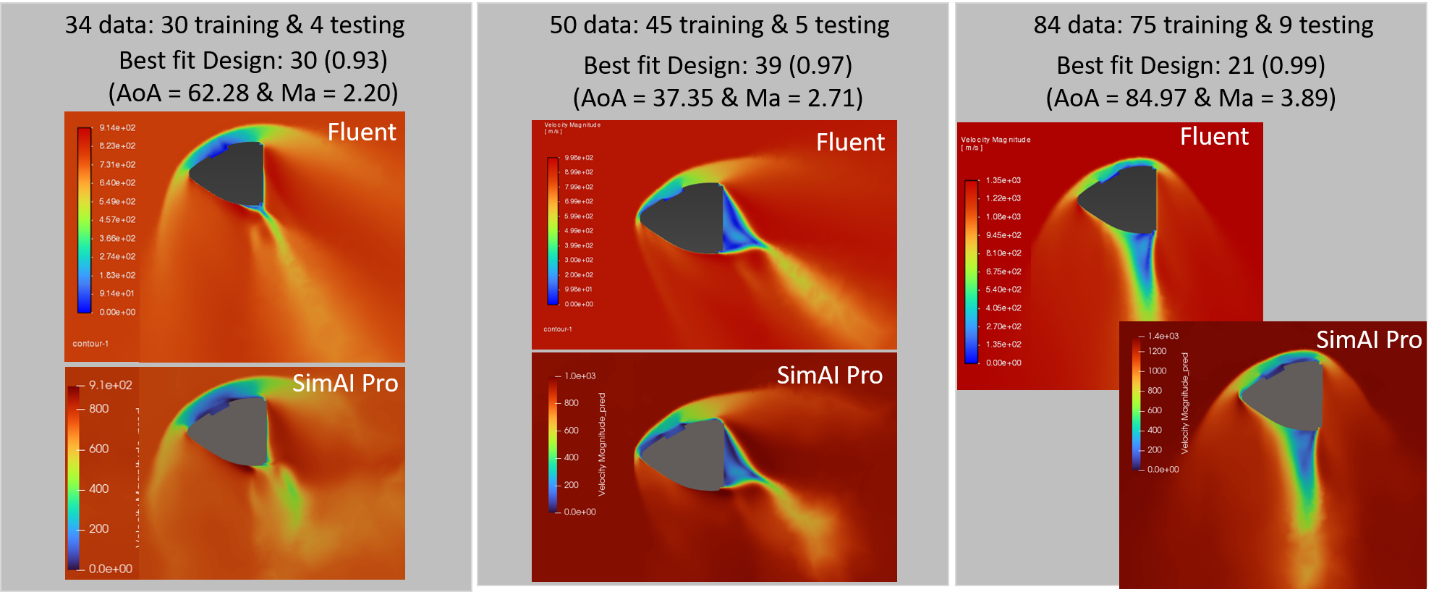
A qualitative comparison between Fluent CFD results and SimAI Pro predictions for three different dataset sizes is provided in Figure 5, highlighting how increasing the training data improves the fidelity of the AI-predicted flow field.
For each case, the “best fit design” from the test set is shown, including the corresponding AoA, Mach number, and confidence score. The top image in each column shows the Fluent reference solution, while the bottom image shows the SimAI Pro prediction of the velocity magnitude field.
A clear trend emerges as the dataset size increases. In the smallest dataset (34 samples), the SimAI Pro prediction captures the general flow features—such as the bow shock and wake region—but shows noticeable deviations in the wake structure and velocity gradients downstream of the capsule. For the medium dataset (50 samples), the agreement improves significantly, with better representation of the shear layer and wake spreading. In the largest dataset (84 samples), the SimAI Pro prediction closely matches the Fluent solution, accurately capturing key flow physics including the shock location, boundary layer behavior, and wake structure. This improvement is also reflected in the increasing confidence scores, from 0.93 to 0.99.
All results presented here were obtained using the “less precise” training option in SimAI Pro, which prioritizes faster model development while maintaining good predictive capability. To further assess the impact of training settings, the more precise option was also evaluated across the different dataset sizes. It was observed that the benefit becomes negligible as the dataset size increases. For the largest dataset, the model already achieves high accuracy and confidence using the less precise option, indicating that data richness has a greater impact on model performance than increased training precision in this context.
Conclusions
In this blog, we demonstrated how SimAI Pro can be effectively integrated into a simulation-driven workflow to enable rapid and accurate AI-based flow field prediction for space capsule re-entry applications. Building on the Fluent model and optiSLang-generated datasets, we showed how automated data preparation using pyFluent allows seamless transition from CFD to AI. The results highlight that as the size and diversity of the training dataset increase, the predictive capability of the model improves significantly—both in terms of quantitative confidence scores and qualitative agreement with high-fidelity CFD results. While training time increases with dataset size, the use of modern GPU hardware can dramatically reduce this cost, making the approach practical for engineering applications. Furthermore, the study shows that beyond a certain point, data richness becomes more influential than higher training precision settings, emphasizing the importance of a well-designed dataset.
Overall, this workflow highlights a powerful paradigm shift enabled by Ansys SimAI Pro, where advanced AI capabilities are seamlessly integrated with traditional CFD and optimization processes. By leveraging SimAI Pro for AI flow field prediction, engineers can generate near real-time, high-fidelity results, significantly accelerating design exploration while maintaining strong physical accuracy. This integration demonstrates how SimAI Pro transforms simulation workflows into efficient, data-driven pipelines for complex aerospace applications.
The detailed application workflow and results are further illustrated in the video provided below. Special thanks to Tiago Fernandes Lins for the pyFluent application and Alex Pickard for the GPU testing.
Turn Simulation Data into Near Real-Time Predictions
See how Ansys SimAI Pro can help you build AI models from Fluent data, predict high-fidelity flow fields for new operating conditions, and accelerate aerospace design exploration. Discover SimAI Pro Capabilities
Explore More in the Series
Follow the full workflow from high-fidelity CFD through design optimization and AI-driven prediction. Explore the other articles in this series to see how Ansys Fluent, optiSLang, and SimAI Pro work together to accelerate space capsule re-entry analysis.

Ertan Taskin, Ph.D., Chemical Engineering
Principal Engineer, SimuTech Group
Ertan is a Principal Engineer with more than two decades of experience in CFD, fluid-structure interaction, and biomedical device design. He has advanced ventricular assist devices, transcatheter heart valves, and artificial lungs through hydraulic optimization, in vitro validation, predictive modeling, and AI-driven data analysis. His recent work integrates machine learning for performance prediction and design optimization. His career includes senior engineering roles at Medtronic, HeartWare, Roketsan, and Ozen Engineering, where he led projects spanning medical devices and aerospace propulsion. Ertan’s expertise includes blood damage modeling, uncertainty quantification, integrated thermo-fluid systems, and AI-assisted simulation workflows. He holds a Ph.D. in Chemical Engineering from Worcester Polytechnic Institute, along with Master’s and Bachelor’s degrees in Chemical Engineering from Middle East Technical University.