 Contact Us
Understanding RMS Wavefront Error in Optical Design
In optical system design, aberration is a key factor in evaluating image quality. Common metrics for image quality assessment include MTF and aberration plots. When quantifying aberration, various methods may be used depending on the application. For example, in telescope systems where the source is a point, root mean square (RMS) wavefront error is often preferred for evaluating image quality.
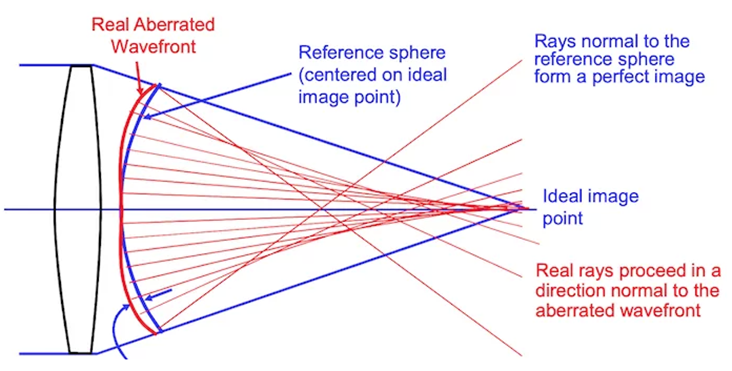
Figure 1: Wavefront error illustration
RMS wavefront error quantifies wavefront aberration. While a spherical wavefront is ideal, real light waves often deviate in ways that reveal system characteristics. Detailed wavefront behavior is covered in textbooks and is not addressed here. The figure above compares these morphological differences. Conceptually, RMS wavefront error is the square root of the difference between the mean of squared wavefront deviations and the square of the mean deviation. This value represents the statistical deviation from a perfect reference sphere, averaged over the wavefront, and provides a comprehensive measure of aberration by treating light as an electromagnetic wave.
As shown in Figure 1, the reference sphere is centered on the expected image location, which is usually the image surface location of the chief ray. A different reference sphere will fit the actual wavefront. If the center of the better-fitting reference sphere is at a different axial location than the expected image location, there is a focus error in the wavefront. If the center of the better-fitting reference sphere is at a different lateral location than the expected image location, there is a tilt error in the wavefront.
Evaluating RMS Wavefront Error in a Double Gaussian Lens with Zemax
This lens features a 28-degree (±14) field, as shown in Figure 2. The design operates across the visible spectrum (400 nm–700 nm). Geometric MTF values, calculated at 20 lp/mm, all exceed 0.65 (see Figure 3). Figure 4 presents spot diagrams for all three sampled fields and wavelengths.
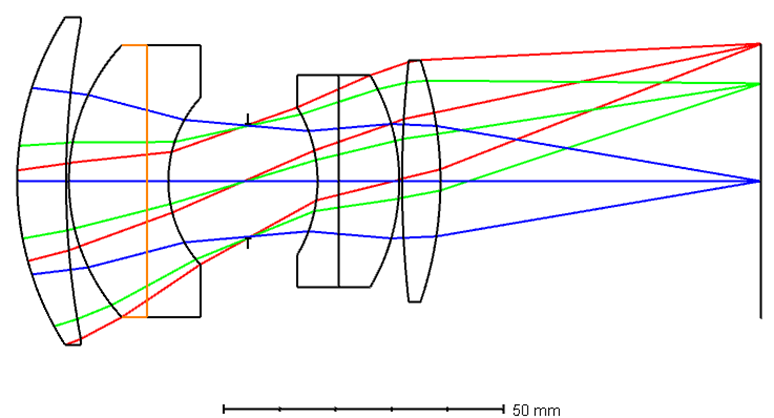
Figure 2: Layout of the lens
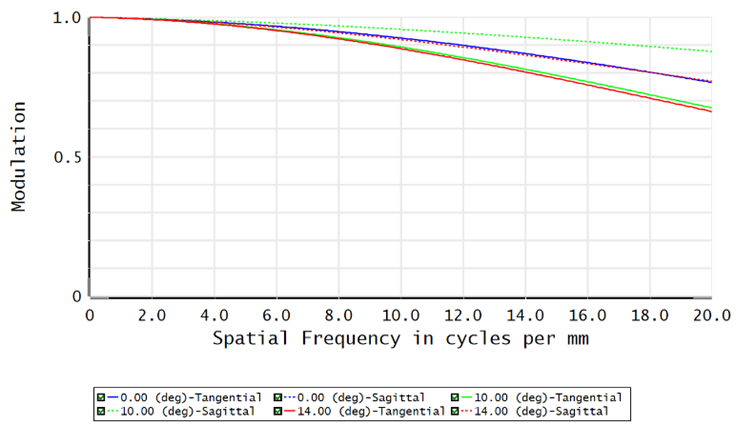
Figure 3: Geometric MTF up to 20 lp/mm
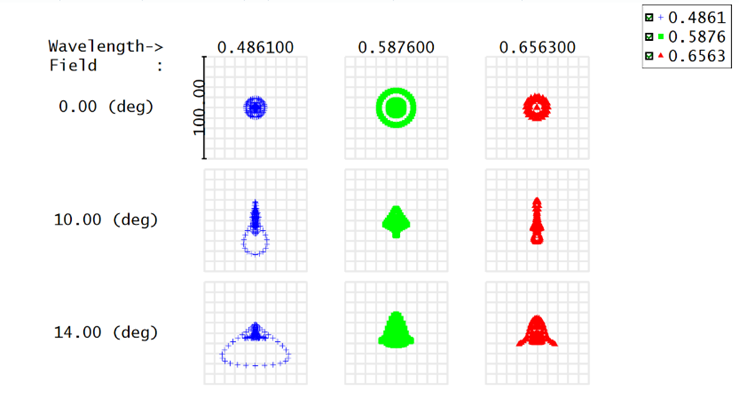
Figure 4: Spot diagram
Ansys Zemax OpticStudio reports wavefront errors at the Exit Pupil of a system. The errors are the difference between the actual wavefront and the ideal spherical wavefront converging on the image point. In an aberrated system, rays from different positions within the exit pupil may miss the ideal image position by different amounts when they reach the image plane. Zemax uses a geometric relationship between ray errors and wavefront errors to calculate the wavefront error map. Since rays are always perpendicular to wavefronts, a wavefront tilt error corresponds directly to a transverse ray error (TRA) at the image plane. By tracing rays through the pupil and measuring the TRA of each, we can get the slope of σ; then, by numerical integration, we can find the wavefront aberrations, σ.
For RMS wavefront computations, OpticStudio always subtracts out a reference sphere. RMS wavefront error with the mean subtracted is computed as follows. where Wn is the optical path difference (OPD) at a given point in the pupil, and Wn is the weighting at that point in the pupil.

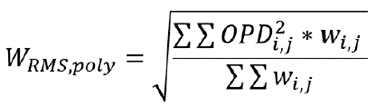
If a polychromatic computation is performed, the RMS polychromatic value is calculated simultaneously across all wavelengths and across the full pupil. The RMS polychromatic value is computed as follows:
- OPDi2,j is the optical path difference of each ray at each wavelength. The OPD value will differ depending on the reference (centroid or chief ray).
- Wi,j is the weight of each ray at each wavelength.
- i is the index for the field and pupil position of each ray.
- j is the index for the wavelength used to trace each ray.
Interpreting Wavefront Error vs. Field, Wavelength, and Focus
display RMS wavefront error as a function of field, wavelength, and focus range for the lens in Figure 2. These plots highlight where wavefront error is greatest: at specific field angles in Figure 5 (colors indicate wavelength) and at certain wavelengths in Figure 6 (colors indicate field). Figure 7 shows wavefront errors across a narrow depth of focus.
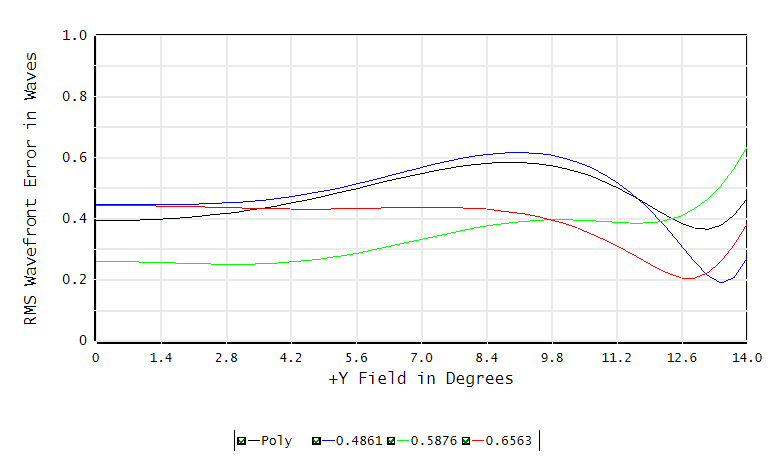
Figure 5: RMS wavefront error vs field, color indicates wavelength
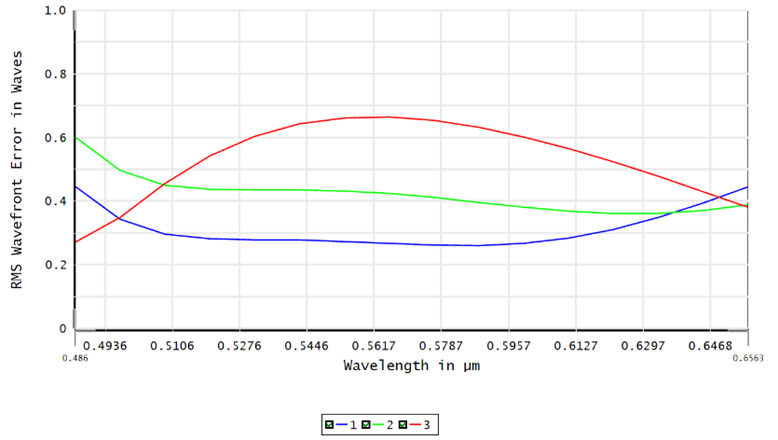
Figure 6: RMS wavefront error vs wavelength, color indicates field
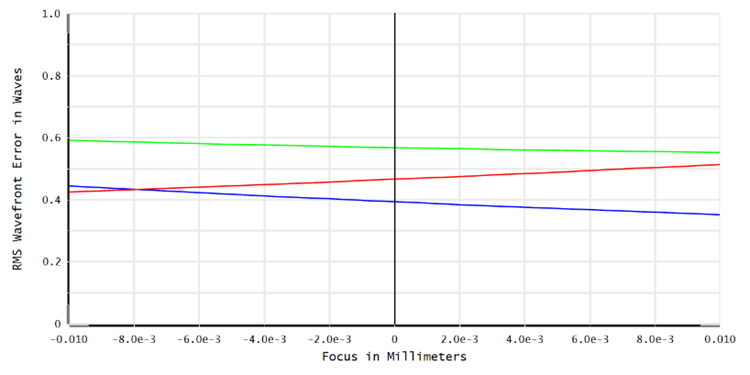
Figure 7: RMS wavefront error vs focus range, color indicates field
Want to sharpen your Zemax skills? SimuTech Group’s Zemax 101 training course covers optical design fundamentals, including aberrations, optimization, and tolerancing. For a broader look at what Zemax can do, check out our guide to maximizing optical workflows with Ansys Zemax. Contact us to get started.