
 Contact Us
Introduction to Ansys Harmonic Acoustics
Acoustic testing remains an important part of product development, certification, and regulatory compliance. Acoustics engineers frequently rely on anechoic and semi-anechoic chamber measurements to determine sound power levels, evaluate sound pressure levels, and verify compliance with customer, industry, and governmental requirements. Numerous international standards define how these measurements are performed, including methodologies for sound power determination, microphone placement, acoustic post-processing, and far-field sound pressure evaluations used in environmental noise assessments and pass-by noise testing.
While these measurements provide valuable insight into product performance, they are often performed late in the development cycle after physical hardware has been built. If unacceptable noise levels are discovered at that stage, design modifications can become costly, time consuming, and potentially disruptive to project schedules.
Modern simulation tools now make it possible to evaluate many of these same acoustic measurements before a prototype exists. By combining Ansys Harmonic Vibration Response Analysis with Ansys Harmonic Acoustics, NVH simulation engineers can predict sound power levels, evaluate virtual microphone measurements, identify acoustic directivity patterns, and investigate far-field noise behavior using a completely virtual workflow. Harmonic Vibration Response Analysis provides the structural vibration and surface velocity information responsible for structure-borne noise generation, while Harmonic Acoustics uses those surface velocities to calculate the resulting acoustic radiation and sound field.
The true value of this approach is not simply generating acoustic contour plots. The real value lies in reproducing the same quantities that engineers ultimately measure during physical testing. By creating a direct connection between structural vibration and acoustic radiation, the coupled Harmonic Vibration Response and Harmonic Acoustics workflow enables engineers to evaluate sound power levels, microphone responses, acoustic directivity, and far-field sound pressure levels early in the design process, reducing development risk while improving confidence in final acoustic performance.
This article highlights several Harmonic Acoustics capabilities within Ansys that enable engineers to predict test-relevant acoustic quantities before a prototype is built. Through examples of sound power calculations, acoustic directivity, virtual microphone measurements, and far-field acoustic evaluations, the article demonstrates how simulation can be used to assess acoustic performance using the same metrics commonly evaluated during laboratory testing, product certification activities, and regulatory compliance assessments. By identifying potential acoustic issues earlier in the development cycle, engineers can make more informed design decisions and improve confidence that acoustic requirements will be satisfied before final validation testing.
Structural Vibration as the Source of Airborne Noise
Successful acoustic analysis begins with an understanding of the mechanisms responsible for noise generation. While acoustic measurements ultimately quantify radiated sound, the source of that sound is often structural vibration.
Dynamic forces acting on a structure cause components and surfaces to vibrate. These vibrating surfaces create pressure fluctuations in the surrounding air, generating acoustic waves that propagate away from the product and are ultimately perceived as noise. As a result, understanding the structural response is often the first step in understanding acoustic performance.
For many engineering applications, the dominant excitation mechanisms include electromagnetic forces, rotating imbalance, pressure pulsations, reciprocating components, dynamic structural loading, and gear meshing effects. Although these excitation mechanisms may differ, they ultimately produce a structural response that can contribute to airborne noise radiation.
Because acoustic radiation is directly influenced by the motion of vibrating surfaces, accurately predicting structural vibration is a critical step in evaluating structure-borne noise. Ansys Harmonic Vibration Response Analysis provides a means of calculating the frequency-dependent response of a structure subjected to dynamic loading, allowing engineers to identify vibration levels across the operating range.
One of the most important outputs from Harmonic Vibration Response Analysis is surface velocity. Surface velocity describes how the vibrating structure interacts with the surrounding fluid medium and serves as one of the primary quantities used in acoustic radiation calculations. Regions exhibiting elevated surface velocities often contribute significantly to the radiated acoustic field.
In addition to evaluating vibration at individual operating conditions, Harmonic Vibration Response Analysis can be performed across an RPM range. This capability is particularly valuable for rotating machinery and vehicle run-up studies, where vibration behavior evolves as operating speed changes. The structural response can be evaluated at any combination of frequency and RPM, providing the surface velocity information required for subsequent acoustic analysis. Because the complete harmonic solution is available across the operating range, engineers can investigate vibration behavior at specific frequencies and operating speeds and use those results as the foundation for acoustic radiation predictions.
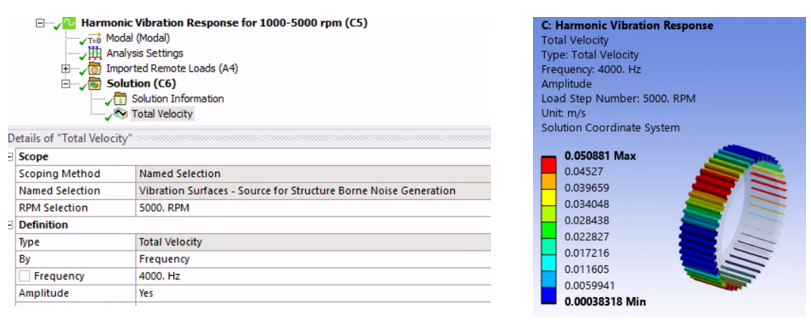
The velocity distribution shown on the selected vibration surfaces represents the structural response used to drive the subsequent acoustic analysis. Evaluated at 4000 Hz and 5000 RPM, the result highlights the areas of the structure contributing most strongly to structure-borne noise generation. These calculated surface velocities form the link between Harmonic Vibration Response Analysis and Harmonic Acoustics, providing the excitation source used to predict the resulting sound field.
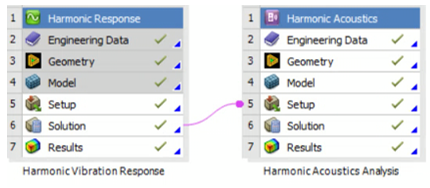
Once the structural velocity field has been calculated, it can be transferred onto a separate acoustic domain within Ansys Harmonic Acoustics. Unlike the structural model, which evaluates vibration within the solid components, the acoustic model represents the surrounding fluid medium where sound propagation occurs. This relationship between structural vibration and acoustic radiation forms the foundation of the vibroacoustic workflow, enabling engineers to evaluate sound power levels, sound pressure levels, virtual microphone responses, and far-field acoustic behavior prior to physical testing.
Ansys Harmonic Acoustics: From Structural Vibration to Acoustic Radiation
Unlike Harmonic Vibration Response Analysis, which evaluates the dynamic behavior of the structural components, Harmonic Acoustics requires a separate acoustic domain representing the surrounding propagating medium. This acoustic domain provides the space through which acoustic waves propagate and enables the evaluation of quantities such as sound power levels, sound pressure levels, virtual microphone responses, and far-field acoustic behavior.
To establish the acoustic model, a dedicated acoustic domain is created around the vibrating structure. The surface velocities calculated from the Harmonic Vibration Response Analysis are transferred into the Harmonic Acoustics model, establishing the link between structural vibration and acoustic radiation. These calculated velocities serve as the acoustic excitation source used to predict the resulting sound field.
Evaluating Acoustic Performance Across an Operating Speed Range
Many products operate across a range of speeds, causing both structural vibration and radiated noise to vary significantly with RPM. By performing Harmonic Vibration Response and Harmonic Acoustics analyses across multiple operating conditions, engineers can evaluate how acoustic performance evolves throughout the operating range.

This capability is particularly valuable for rotating machinery, electric motors, fans, pumps, compressors, and vehicle run-up studies where excitation frequencies change with operating speed. Rather than evaluating a single operating condition, engineers can investigate acoustic behavior throughout the complete operating envelope and identify operating speeds associated with elevated noise levels.
Simulating Acoustic Measurements
With the structural response transferred into Harmonic Acoustics, the next step is evaluating the acoustic quantities commonly measured during product testing, certification activities, and regulatory compliance assessments.
While Harmonic Vibration Response Analysis provides insight into the vibration mechanisms responsible for structure-borne noise generation, Harmonic Acoustics extends the analysis into the acoustic domain, allowing engineers to predict how those vibrations propagate through the surrounding medium as sound.
To perform these calculations, a separate acoustic domain is created to represent the surrounding propagating medium. In this example, a spherical acoustic domain is used to provide the computational space in which acoustic waves are generated, propagated, and are subsequently evaluated.
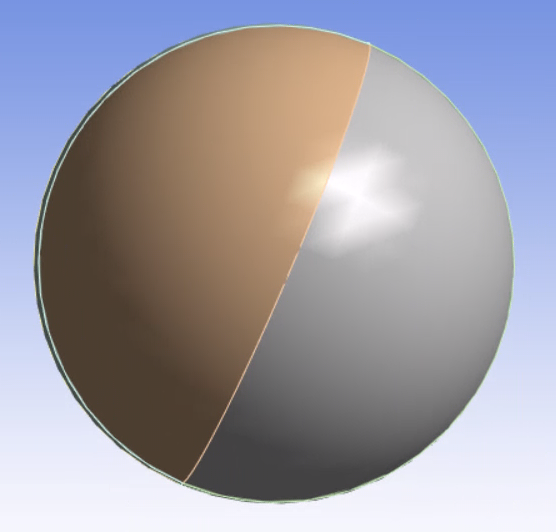
While a spherical acoustic domain is used in this example, the domain geometry can be adapted to suit the application being evaluated. The selection of the acoustic domain is influenced by the geometry of the structure, the acoustic quantities of interest, and the desired evaluation methodology. The spherical domain was selected here because it provides an efficient and intuitive environment for evaluating radiated sound and far-field acoustic behavior.
The acoustic domain serves as the computational space through which sound waves propagate. Unlike the structural model, which captures the vibration response of the structural components, the acoustic domain represents the surrounding propagating medium through which the generated sound travels.
An important observation is that the size of the acoustic domain does not necessarily correspond to the final measurement distance. In this example, the acoustic domain is intentionally kept compact to improve computational efficiency. However, acoustic quantities can still be evaluated at observation locations significantly farther from the structure, allowing engineers to predict far-field acoustic behavior without requiring an excessively large model.
Once the acoustic domain has been established, the structural velocity field calculated from Harmonic Vibration Response Analysis is imported into the Ansys Harmonic Acoustics model and applied to the acoustic boundary surfaces.
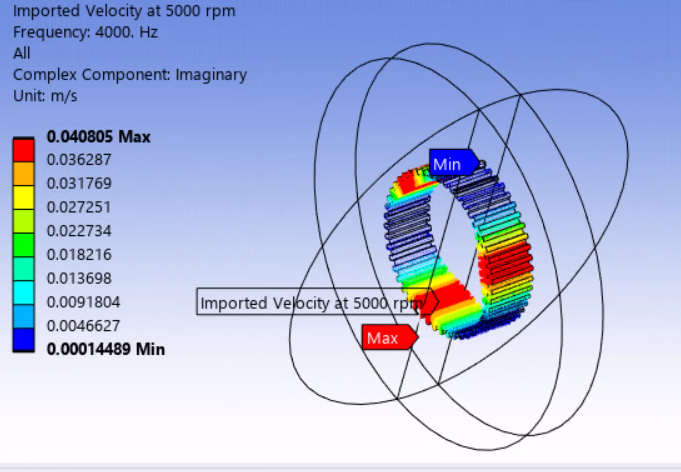
These imported surface velocities serve as the acoustic excitation source for the Harmonic Acoustics simulation. As the vibrating surfaces interact with the surrounding propagating medium, pressure fluctuations are generated within the acoustic domain and radiate away from the structure as sound waves.
By directly utilizing the calculated structural response, the simulation preserves the physical relationship between structure-borne vibration and airborne noise generation. Rather than relying on assumed sound sources or simplified loading conditions, the resulting acoustic field is driven by the actual vibration behavior of the structure.
This approach establishes the foundation for evaluating acoustic quantities such as Sound Power Level (Lw), Sound Pressure Level (SPL), acoustic directivity, and virtual microphone responses that are commonly used during laboratory testing and acoustic validation.
Representing Free-Field Acoustic Conditions
An important consideration in acoustic simulation is the treatment of the outer boundary of the acoustic domain.
If acoustic waves reflect from the boundary and propagate back toward the source, the resulting sound field can contain artificial reflections that do not represent free-field radiation conditions. Since many acoustic standards and laboratory measurements are performed under free-field or near free-field environments, the simulation model must account for this behavior.
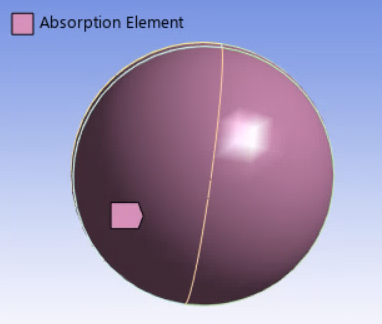
These absorption elements allow acoustic energy to leave the computational domain while minimizing reflected energy returning toward the source. Their function is conceptually similar to the sound-absorbing wedges used in anechoic chambers, where reflected sound is minimized to ensure accurate acoustic measurements.
Other acoustic domain configurations may utilize alternative techniques such as Perfectly Matched Layers (PMLs) or other radiation boundary treatments to achieve a similar free-field representation. Regardless of the specific implementation, the objective remains the same: accurately representing sound radiation in an unbounded acoustic environment.
With appropriate boundary treatment applied, the model provides a reliable foundation for evaluating sound power levels, sound pressure levels, acoustic directivity, virtual microphone responses, and far-field acoustic behavior.
Virtual Acoustic Measurements
With the acoustic solution established, engineers can begin evaluating the same acoustic quantities commonly measured during laboratory testing.
Many acoustic standards utilize prescribed microphone locations positioned around the product to measure the resulting sound field. These measurements are subsequently used to calculate sound power levels and verify acoustic performance requirements.
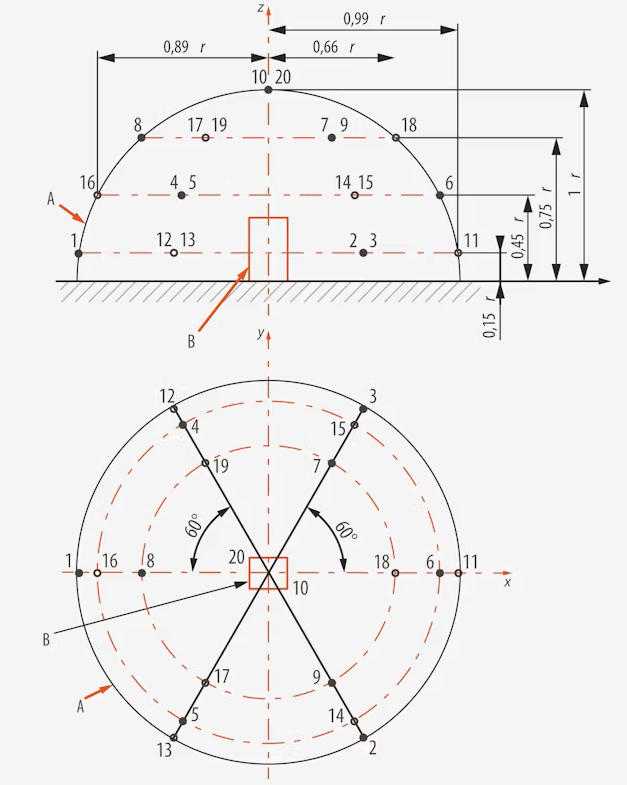
Similar microphone arrangements are defined in several acoustic testing standards and are commonly used for sound power determination, product qualification, and acoustic performance evaluation.
Engineers familiar with acoustic testing will immediately recognize the similarity between this measurement methodology and the simulation workflow. Rather than positioning physical microphones around a prototype, Ansys Harmonic Acoustics allows virtual observation locations to be placed anywhere within the acoustic field.
The resulting acoustic response can then be sampled at these locations to obtain the same quantities traditionally measured during laboratory testing. This creates a direct bridge between simulation and physical validation, allowing acoustic performance to be assessed long before hardware is available.
Once the acoustic model has been established, the resulting sound field can be interrogated in a variety of ways to better understand product acoustic performance.
Predicting Acoustic Directivity Using Ansys Harmonic Acoustics
Once the acoustic model has been established, the resulting sound field can be interrogated in a variety of ways to better understand product acoustic performance.
One advantage of a virtual acoustic environment is the ability to evaluate how sound is distributed around the source. Unlike physical testing, where obtaining a complete representation of the radiated sound field may require multiple microphone locations and repeated measurements, Harmonic Acoustics provides direct access to the acoustic response throughout the entire domain.
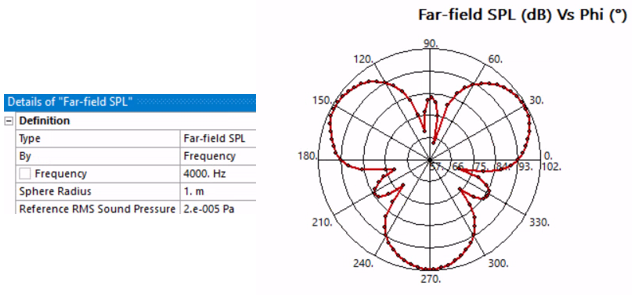
Directivity results provide insight into how acoustic energy is distributed around the source and help answer an important question:
Where is the product loudest?
Two products may radiate similar sound power levels while producing very different acoustic experiences depending on how the radiated sound is distributed in space. Understanding these directional characteristics can help engineers identify dominant radiation paths, evaluate shielding concepts, and investigate how installation environments may influence perceived noise levels.
The ability to evaluate acoustic directivity early in the design process using Ansys Harmonic Acoustics provides valuable insight that would otherwise require significant physical testing effort and allows engineers to better understand how noise propagates away from the source.
Predicting Sound Power Level
While directivity describes how sound is distributed spatially, Sound Power Level provides a measure of the total acoustic energy radiated by the source.
Sound Power Level remains one of the most widely used acoustic metrics for product certification, acoustic validation, and regulatory compliance. Unlike sound pressure measurements, which depend on observation location, sound power is an intrinsic property of the source and provides an overall measure of acoustic performance.
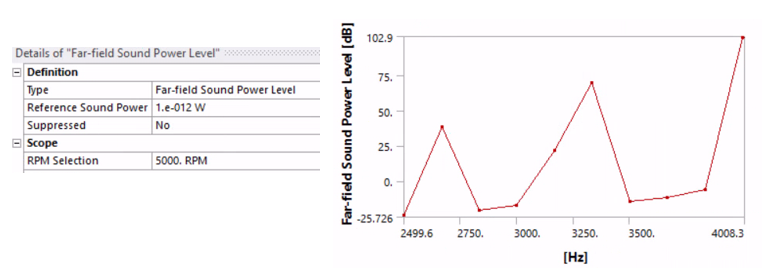
The sound power spectrum identifies the dominant frequencies contributing to acoustic radiation and provides engineers with a convenient means of comparing alternative designs, evaluating potential noise-reduction strategies, and assessing overall acoustic performance.
Because many acoustic specifications and regulatory requirements are expressed in terms of sound power, the ability to predict this quantity before physical testing can significantly reduce development risk and improve confidence in final product performance.
In addition to supporting product qualification activities, sound power predictions can help engineers identify dominant noise-producing frequencies, understand the contribution of individual operating conditions to overall acoustic radiation, and evaluate the effectiveness of potential design modifications before physical prototypes become available.
By predicting Sound Power Level within the simulation environment, engineers can assess acoustic performance using the same metric commonly employed during laboratory testing, providing a direct connection between simulation and acoustic validation.
Predicting Virtual Microphone Measurements
While Sound Power Level provides an overall measure of acoustic performance, engineers are often interested in a more practical question:
What will a microphone measure at a specific location?
Harmonic Acoustics allows engineers to evaluate Sound Pressure Levels (SPL) at user-defined observation locations throughout the acoustic field. In addition to near-field evaluations, far-field acoustic quantities can be calculated at observation points located well beyond the physical acoustic domain, enabling the prediction of sound levels at distances representative of laboratory measurements, customer evaluation points, and other real-world monitoring locations.
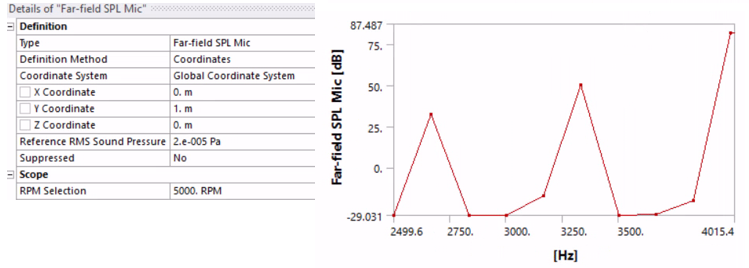
In this example, the microphone location is positioned at a one-meter observation distance, even though the acoustic domain itself is considerably smaller. Using far-field acoustic calculations, Harmonic Acoustics can evaluate the radiated sound field at locations beyond the acoustic domain boundaries without requiring a significantly larger model.
This capability creates a direct connection between simulation and the measurements commonly collected during acoustic validation programs. Virtual microphone results can be used to evaluate expected sound levels at test locations, operator positions, customer evaluation points, and other observation locations of interest.
The ability to evaluate far-field Sound Pressure Levels is particularly valuable for applications involving environmental noise assessments, regulatory compliance studies, and pass-by noise evaluations where sound levels must be predicted at locations remote from the source. By evaluating Sound Pressure Level at specific observation points, engineers can compare simulation predictions with future test measurements using consistent acoustic metrics.
Ansys Harmonic Acoustics in Conclusion
Testing with Ansys Harmonic Acoustics will continue to play an essential role in product validation, certification, customer acceptance, and regulatory compliance. However, modern simulation tools now allow engineers to predict many of the same acoustic quantities traditionally measured during laboratory testing.
By combining Ansys Harmonic Vibration Response Analysis with Ansys Harmonic Acoustics, NVH simulation engineers can establish a direct relationship between structural vibration and acoustic radiation. The resulting workflow enables engineers to move beyond identifying vibration issues and begin predicting how those vibrations influence overall acoustic performance.
The workflow and results presented in this article demonstrate how Harmonic Acoustics can be used to evaluate acoustic directivity, predict Sound Power Levels, and calculate virtual microphone measurements using the same metrics commonly employed during testing and acoustic validation activities. From understanding how sound is radiated around a product to quantifying total radiated acoustic energy and predicting Sound Pressure Levels at user-defined observation locations, Harmonic Acoustics extends simulation beyond vibration analysis and into the realm of test-relevant acoustic performance prediction.
Perhaps most importantly, these capabilities allow engineers to evaluate the same quantities commonly measured during acoustic testing using a completely virtual workflow. Whether the objective is product qualification, regulatory compliance, customer acceptance testing, environmental noise assessment, or pass-by noise evaluation, simulation can provide valuable insight long before physical prototypes become available.
The true value of Harmonic Acoustics is not simply generating acoustic contour plots. The value lies in predicting the measurements that ultimately determine acoustic performance. By bringing these evaluations into the simulation phase, engineers can make more informed design decisions, reduce development risk, identify potential noise issues earlier in the development cycle, and improve confidence in final product performance before a prototype ever enters the test chamber.
Need help predicting acoustic performance before physical testing?
SimuTech Group’s NVH and acoustics engineers can help your team use Ansys Harmonic Acoustics to evaluate sound power, sound pressure levels, acoustic directivity, structure-borne noise, and other test-relevant acoustic behavior earlier in the design process. Connect with SimuTech Group to discuss your acoustic simulation goals.

Balaji Benjamin, Ph.D., Mechanical Engineering
Senior Staff Engineer, SimuTech Group
With 13 years at SimuTech Group and more than 20 years of experience in NVH simulation and testing, Balaji supports customers across vibration and acoustics workflows, including noise source evaluation, correlation to test data, and performance-driven design refinement. He holds a Ph.D. in Mechanical Engineering from the State University of New York at Binghamton.