 Contact Us
Introduction: DesignXplorer vs optiSLang
Engineering design optimization has evolved significantly over the past decade. As simulation models grow more complex and design spaces expand, engineers need optimization tools that are not only powerful, but also efficient, scalable, and easy to deploy within existing CAE workflows.
For many years, Ansys DesignXplorer (DX) filled this role. Today, however, Ansys optiSLang has emerged as the next‑generation platform—offering advanced algorithms, automation, and faster convergence to optimal designs. In this blog, we compare the optimization capabilities of DesignXplorer and optiSLang, explain key methodological differences, and walk through a bracket optimization case study that highlights why optiSLang is increasingly replacing DesignXplorer.
Overview of Engineering Design Optimization
At its core, engineering design optimization seeks to answer a fundamental question:
What is the best possible design that satisfies all performance requirements while minimizing cost, weight, or other objectives?
Simulation‑driven optimization uses CAE solvers—such as structural, thermal, or CFD analyses—to evaluate performance as design variables change. Modern optimization workflows typically involve:
- Defining design variables (geometry, material, loads, etc.)
- Running parametric simulations
- Evaluating objectives and constraints
- Iteratively improving the design using mathematical or statistical algorithms
The effectiveness of this process depends heavily on the optimization engine driving it. That is why choosing the right optimization platform matters, and why a practical DesignXplorer vs optiSLang comparison can help engineering teams understand which tool better supports efficient, scalable design exploration.
Limitations of DesignXplorer
DesignXplorer’s optimization capabilities are constrained by both algorithmic breadth and workflow scalability.
First, DX is limited in the number of parameters, objectives, and constraints that can be used in an optimization process. The limits on each of these features are:
- Up to 10 parameters
- Up to 5 constraints
- Up to 2 objectives
These limitations strictly limit the ability of DX to be used in complex problems.
Second, DX relies on a limited set of optimization algorithms, such as Adaptive Single-Objective (ASO) and gradient-based methods like NLPQL. These approaches can work well for smooth, convex problems but struggle when faced with:
- Highly nonlinear responses
- Multiple local optima
- Noisy solver outputs
- Strong interactions between design variables
As a result, DX often requires significantly more solver evaluations to reach an acceptable solution, especially when the initial design is far from optimal.
Third, DX offers minimal automation and intelligence in its optimization workflows. Engineers are responsible for:
- Selecting the right algorithm
- Manually tuning parameters
- Choosing DOE sizes and response surface settings
This places a heavy burden on user experience and makes optimization success highly dependent on expert judgment. For less experienced users, it is easy to oversample the design space, miss global optima, or terminate studies prematurely.
Additionally, DX response surface methods are mostly static and inflexible. Sampling strategies are typically fixed upfront, meaning:
- Poor early sampling can degrade surrogate accuracy
- Additional solver runs are often required to recover accuracy
- Refinement is manual and reactive rather than adaptive
Finally, DX was never designed as a full process integration and optimization (PIDO) platform. Its ability to manage large workflows, multiple solvers, robustness studies, and uncertainty quantification is limited, making it less suitable for modern, system-level optimization problems.
How optiSLang Addresses These Gaps
Ansys optiSLang was developed specifically to overcome these limitations.
Unlike DX, optiSLang provides a broad portfolio of advanced optimization algorithms, including global, local, surrogate-based, and Bayesian approaches. This allows the software to intelligently explore complex design spaces and avoid getting trapped in local optima. Additionally, optiSlang is not limited in the number of parameters, constraints and objectives like DX is.
A major differentiator is optiSLang’s adaptive intelligence. Sampling and optimization strategies are continuously refined based on incoming results, enabling:
- Faster convergence
- Reduced solver evaluations
- Improved robustness to noisy or nonlinear responses
Features such as the One-Click Optimizer encapsulate best practices into automated workflows, removing much of the guesswork that DX requires. This not only improves efficiency but also democratizes optimization for a wider range of users.
In a DesignXplorer vs optiSLang workflow comparison, response surface modeling is another area where optiSLang clearly surpasses DX. optiSLang automatically:
- Selects appropriate surrogate models
- Identifies regions of interest
- Refines sampling where it matters most
This results in more accurate metamodels built with fewer simulations.
Most importantly, optiSLang was designed from the ground up as a scalable PIDO platform. It seamlessly supports large workflows, multi-physics coupling, robustness analysis, and uncertainty quantification—capabilities that go far beyond the original scope of DesignXplorer.
Direct Optimization vs. Response Surface Optimization
One of the key differences between DX and optiSLang lies in how optimization problems are solved.
Direct Optimization
Direct optimization evaluates the solver model at each iteration and uses the results to guide the next design point. This approach:
- Works directly with high‑fidelity simulation results
- Can be computationally expensive
- Is sensitive to noise and local minima
Both DX and optiSLang support direct optimization, but in a DesignXplorer vs optiSLang comparison, optiSLang offers more advanced global strategies and automated tuning.
Response Surface Optimization
Response surface methods (RSM) build a surrogate model that approximates the simulation response across the design space. Optimization is then performed on this surrogate rather than the full solver.
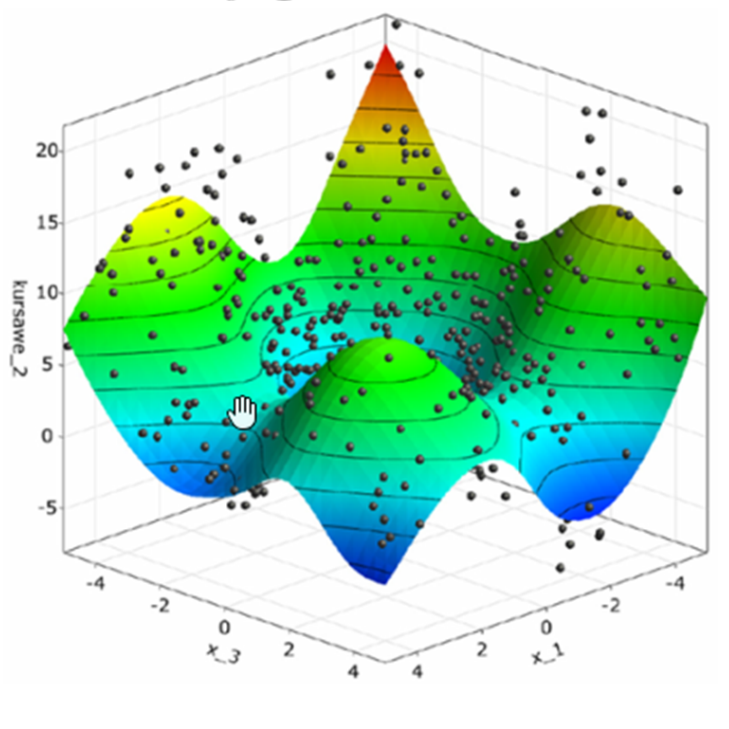
Advantages include:
- Fewer expensive solver runs
- Faster optimization cycles
- Better global insight into the design space
optiSLang excels here by combining adaptive sampling, machine‑learning‑based metamodels, and intelligent refinement—resulting in more accurate response surfaces with fewer simulations.
Case Study: Structural Optimization of a Bracket
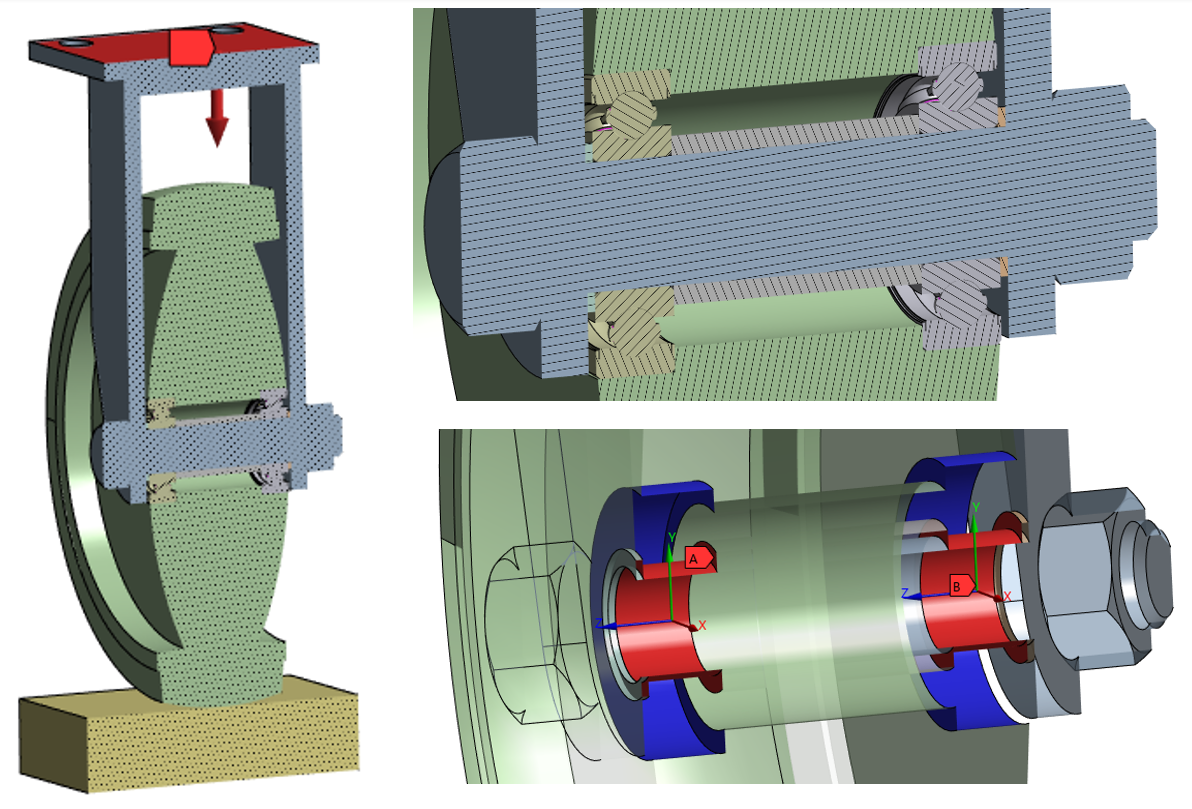
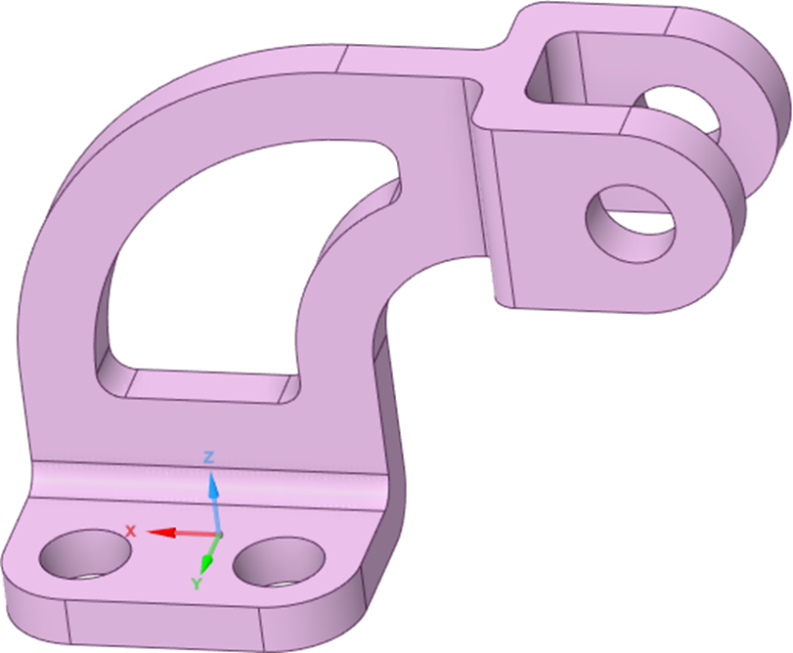
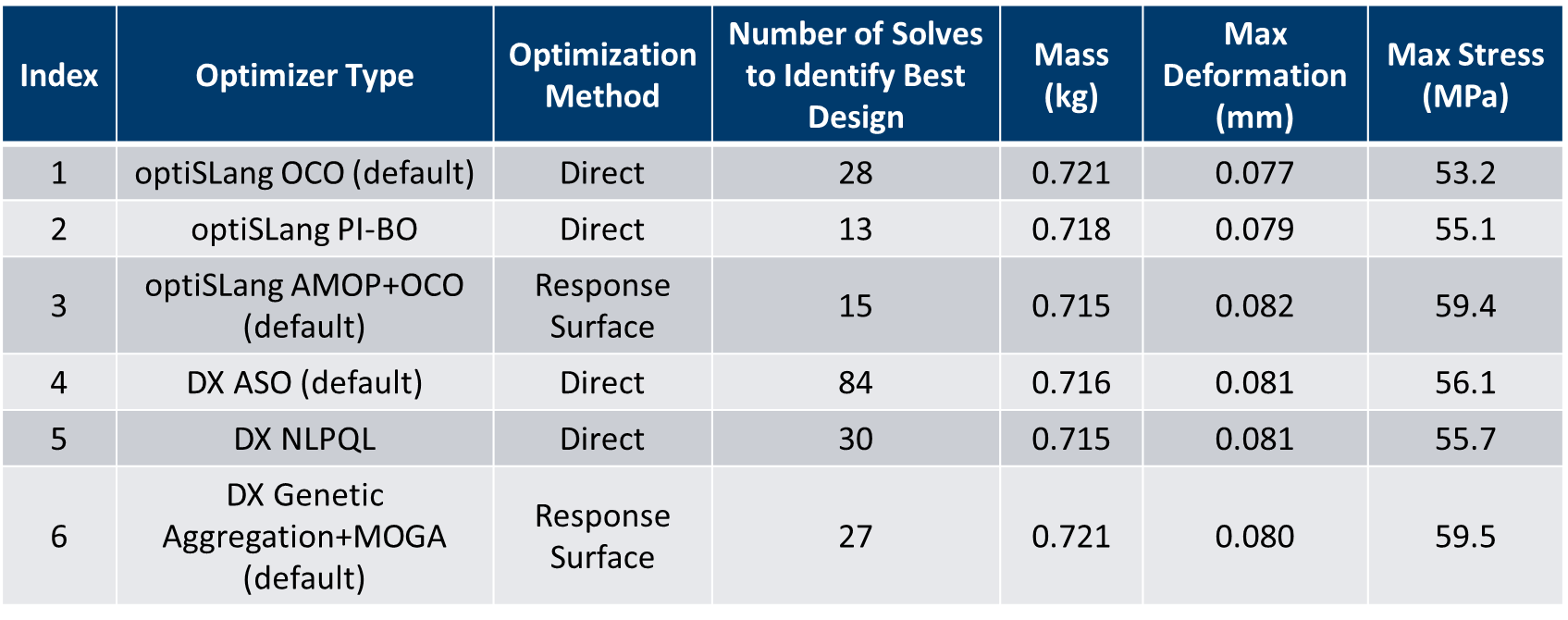
To compare performance, a structural bracket optimization problem was solved using both DesignXplorer and optiSLang. Six geometry parameters were altered to find the optimum design. The objective was to minimize mass while meeting stress (< 60 MPa) and displacement (< 0.08 mm) constraints. Identical design variables, constraints, and solver settings were used for all methods.
DesignXplorer vs optiSLang: Optimization Results
The table below summarizes the number of solver evaluations required to reach the optimal design:
Key Observations
- optiSLang consistently reached the optimal design with significantly fewer solver runs
- PI-BO (Probabilistic Inference for Bayesian optimization) in optiSLang found the solution in less than half the solutions required by DX’s best-performing method
- Even response surface approaches were more efficient in optiSLang due to smarter sampling and refinement strategies
For computationally expensive simulations, this reduction in solve count directly translates to reduced turnaround time and engineering cost.
Why optiSLang is Replacing DesignXplorer
The results of this study reinforce a broader industry trend:
- optiSLang converges faster
- optiSLang scales better to complex problems
- optiSLang automates tasks that previously required expert tuning
- optiSLang supports modern workflows including robustness and uncertainty analysis
While DesignXplorer remains useful for simple parametric studies, optiSLang has become the preferred solution for serious optimization work.
DesignXplorer vs optiSLang: In Summary
Engineering design optimization is no longer just about finding a feasible solution—it’s about finding the best solution as efficiently as possible.
In this comparison:
- optiSLang outperformed DesignXplorer across all optimization methods
- Advanced algorithms and adaptive sampling reduced solver runs dramatically
- Faster convergence makes optiSLang better suited for large, real‑world problems
For engineers looking to modernize their optimization workflows, optiSLang represents the future of simulation‑driven design within the Ansys ecosystem.
Modernize Your Engineering Optimization Workflow
SimuTech Group can help you evaluate whether Ansys optiSLang is the right next step for your simulation-driven design process, including workflow automation, parameter studies, response surface optimization, and more efficient design exploration.

Eric Alana
Senior Staff Engineer, SimuTech Group
Eric Alana is a Senior Staff Engineer at SimuTech Group and a finite element analysis specialist with a Bachelor’s in Mechanical Engineering from Georgia Institute of Technology. His experience includes nonlinear analysis, fatigue, material selection, seismic evaluation, pressure-system analysis, and thermal-structural simulation for electronics and aerospace applications.