 Contact Us
Mesh Fusion technology in Ansys Icepak
In a previous blog, I introduced Mesh Fusion technology in Ansys Icepak and applied it to a simple cooling problem with coarse features. In that case, Mesh Fusion offered no advantage over the default slider bar meshing approach, in which the PCB was modeled as a single block without resolving its individual layers.
Here, I examine a model with resolved PCB layers, shown below, along with complex CAD geometry used as the heat source. For this type of geometry, Mesh Fusion is expected to provide a clear benefit because it can resolve layered details more effectively while keeping the overall mesh count under control.
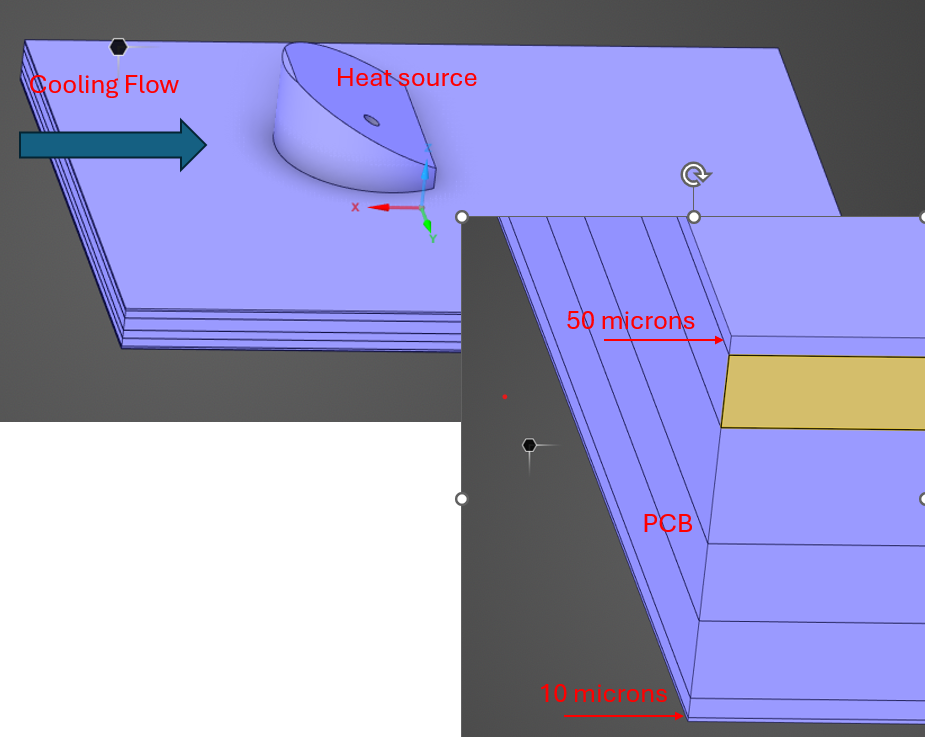
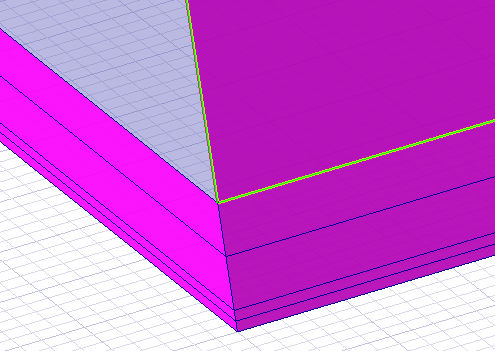
Four meshes were generated, with and without Mesh Fusion, using the global Level 4 and Level 5 slider bar settings. Without Mesh Fusion, neither the Level 4 nor Level 5 mesh resolves the bottom PCB layer.
Figure 2 shows a close-up of that layer. The Mesh Fusion Level 4 case captures the 10-micron thickness with two cells across the layer, demonstrating how Mesh Fusion technology in Ansys Icepak can preserve thin geometric features that the default approach fails to resolve.
The table below shows that Mesh Fusion preserves acceptable overall mesh quality while successfully resolving the layered PCB cases that fail with the default approach.
| Meshing approach | Mesh count | Face alignment | Skewness |
|---|---|---|---|
| Slider Bar Level 4 | Failed | — | — |
| Slider Bar Level 5 | Failed | — | — |
| Mesh Fusion Level 4 | 128k | 0.286 | 0.061 |
| Mesh Fusion Level 5 | 348k | 0.243 | 0.032 |
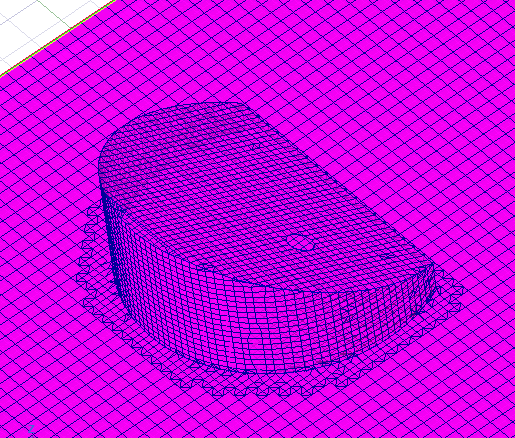
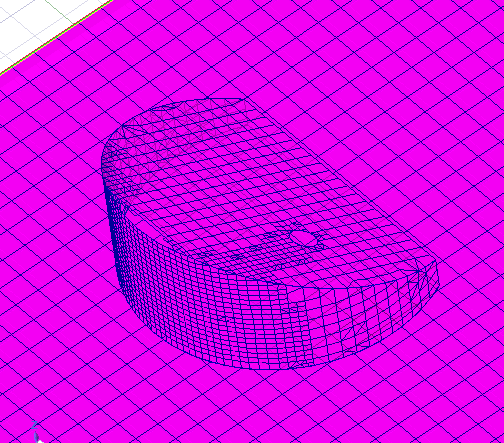
The two figures below compare the mesh near the heat source with and without Mesh Fusion technology. The default slider bar method produces a conformal mesh between the object and the PCB, whereas Mesh Fusion uses a nonconformal meshing strategy.
By placing different parts in separate mesh regions and meshing them independently, Mesh Fusion reduces mesh count while preserving resolution where it matters most. It also refines the mesh near curved features and allows cells to grow away from those regions. In contrast, the default method maintains a more uniform cell size around the geometry.
These results show that Mesh Fusion technology in Ansys Icepak is particularly advantageous when a model contains thin PCB layers, complex curved geometry, or components that require different local mesh resolutions. For simpler models with coarse features, the default slider bar approach may still provide sufficient accuracy without the added setup.
Improve Electronics Cooling Models with Ansys Icepak
Need help resolving detailed PCB layers or complex geometry without creating an unnecessarily large mesh? SimuTech Group’s electronics cooling experts can help you apply Ansys Icepak meshing tools, including Mesh Fusion, to build efficient and accurate thermal simulation workflows.

Mert Berkman, PhD Aerospace Engineering
Lead Engineer – Fluids, SimuTech Group
Mert Berkman is an aerospace engineer with a PhD in Aerospace Engineering and extensive experience in computational fluid dynamics, combustion, thermal-fluid analysis, and advanced engineering simulation. At SimuTech Group, he supports customers across complex fluids applications, helping engineering teams model challenging flow behavior, evaluate thermal and combustion performance, and apply simulation more effectively to real-world design decisions. His background spans aerospace research, automotive systems, power generation, turbomachinery, and technical consulting, giving him a broad perspective on how CFD can be used to understand performance, improve reliability, and reduce development risk across highly engineered systems.