 Contact Us
Introduction to Liver-on-a-Chip Simulation
The liver is a crucial indicator of toxicity in the human body. Silver nanoparticles, which are commonly used for drug delivery, have also been found to be toxic to the liver in animal test subjects. Silver nanoparticles need to be tested on HepG2 human liver cells to determine the amount tolerated by the cells to maintain healthy liver function. This can be accomplished by seeding a microfluidic chip with these human liver cells and conducting microfluidic tests on this liver-on-a-chip. To support the design of the chip, Ansys Fluent simulation was used to investigate the maximum wall shear of several shapes of microfluidic chambers. These shapes were circular, elliptical and hexagonal. The three shapes were analyzed for wall shear stress. High wall shear stress on the liver cells in the microfluidic chamber could cause unwanted cell death, so the wall shear stress must be below the maximum allowable for liver cells. The Fluent analysis is critical for choosing the optimal microfluidic chamber shape and for determining the maximum liquid flow rate to keep the wall shear stress below the maximum allowable value that could kill liver cells.
Geometry Creation
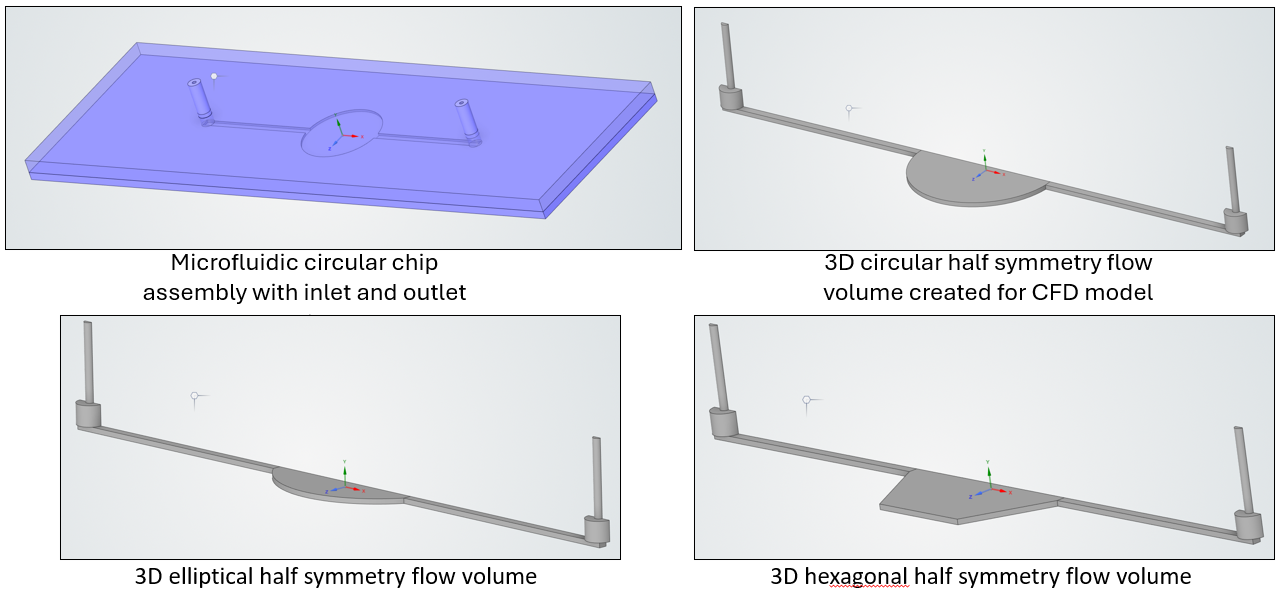
Ansys Discovery was used to create the flow volumes of the three microfluidic chamber shapes. For these geometries, one can take advantage of half symmetry.
Mesh Creation
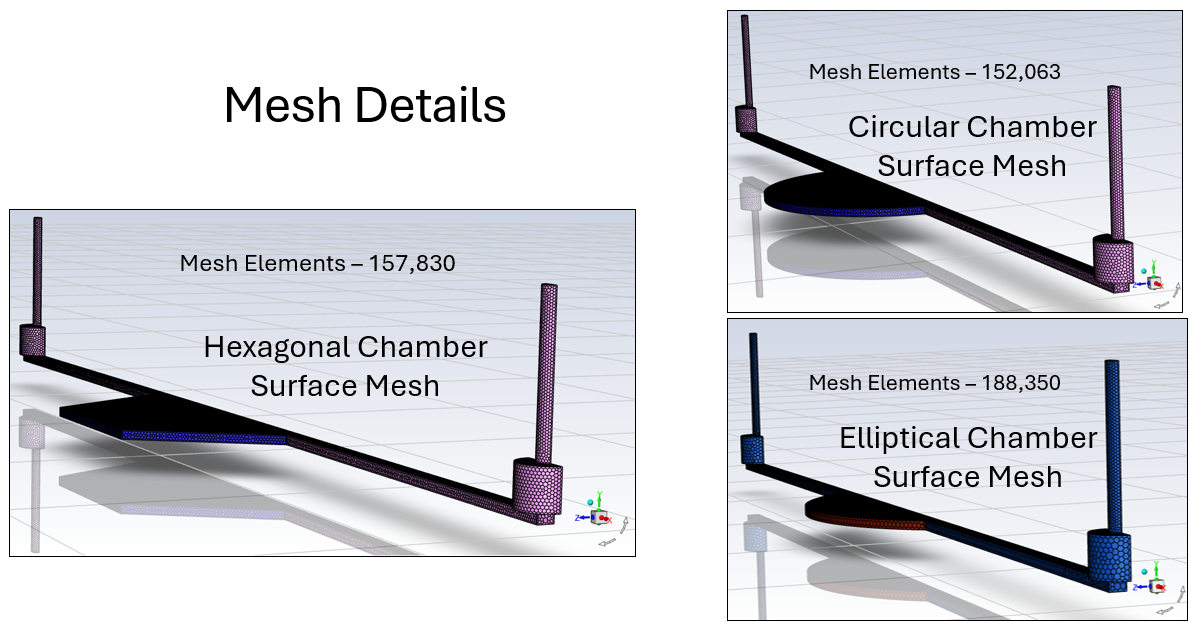
The mesh for our liver-on-a-chip simulation was created using Fluent meshing. The liquid flow is definitely laminar, but boundary layer mesh elements were used to capture the velocity gradients and wall shear. The volume mesh is polyhedral elements with polyhedral prism elements in the boundary layer mesh.
Model Setup
For organ-on-a-chip microfluidic devices, a liquid named EMEM (Eagle’s Minimum Essential Medium) is often used to help keep the cells alive. EMEM is a synthetic cell culture medium used to support the growth and maintenance of a wide variety of human and mammalian cell lines in vitro. Developed by Harry Eagle, it is one of the most commonly used media, providing a balanced mixture of essential nutrients, salts, amino acids, and vitamins necessary for cell metabolism and proliferation, and that is the liquid that is being modeled in the simulation.
Here is the liver-on-a-chip model setup in Ansys Fluent:
- Steady-state
- Single liquid, EMEM at 37 C
- Density = 993 kg/m3, Dynamic Viscosity = 0.0007 Pa*s
- Laminar flow
- Smooth walls with surface tension
- Half symmetry
- Inlet volumetric flow of 3, 10 and 15 ml/min (in Fluent a mass flow inlet was used with values of 2.48E-08, 8.28E-08 and 1.24E-07 kg/s)
- Outlet boundaries were set to atmospheric pressure
Liver-on-a-Chip Simulation Results
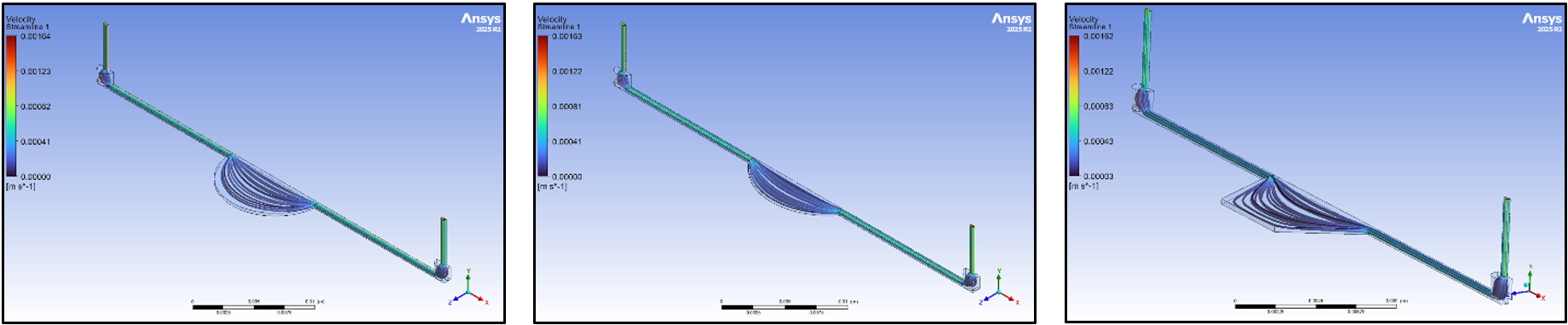
For this type of microfluidic device, a maximum wall shear of 0.03 dynes/cm2 (0.003 Pa) is suggested to prevent cell damage and death. Each of the three microfluidic chamber shapes was run under with the three volumetric flow rates. Here are some pictures of the resulting streamlines in each of the chamber shapes.
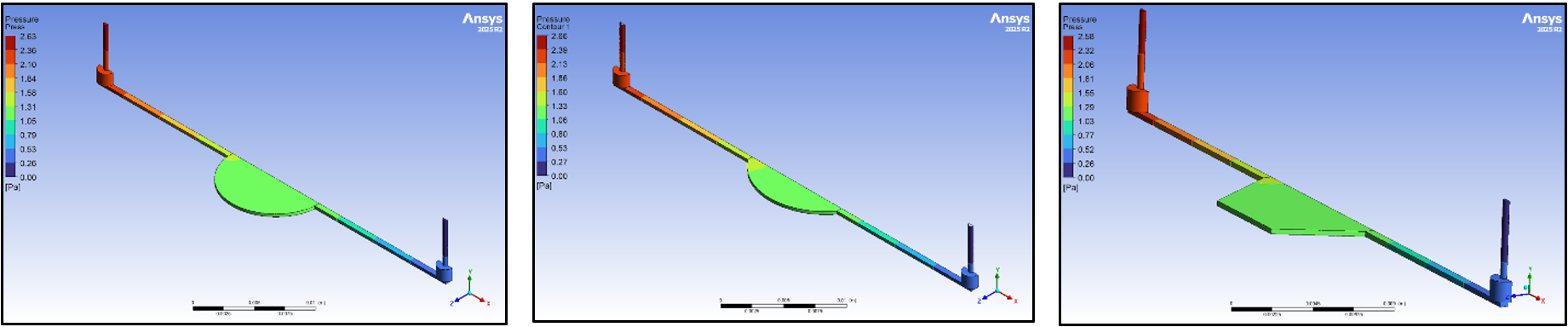
Here are some pictures of the resulting pressure contours in each of the chamber shapes.
Finally, here is a table of the resulting wall shear:
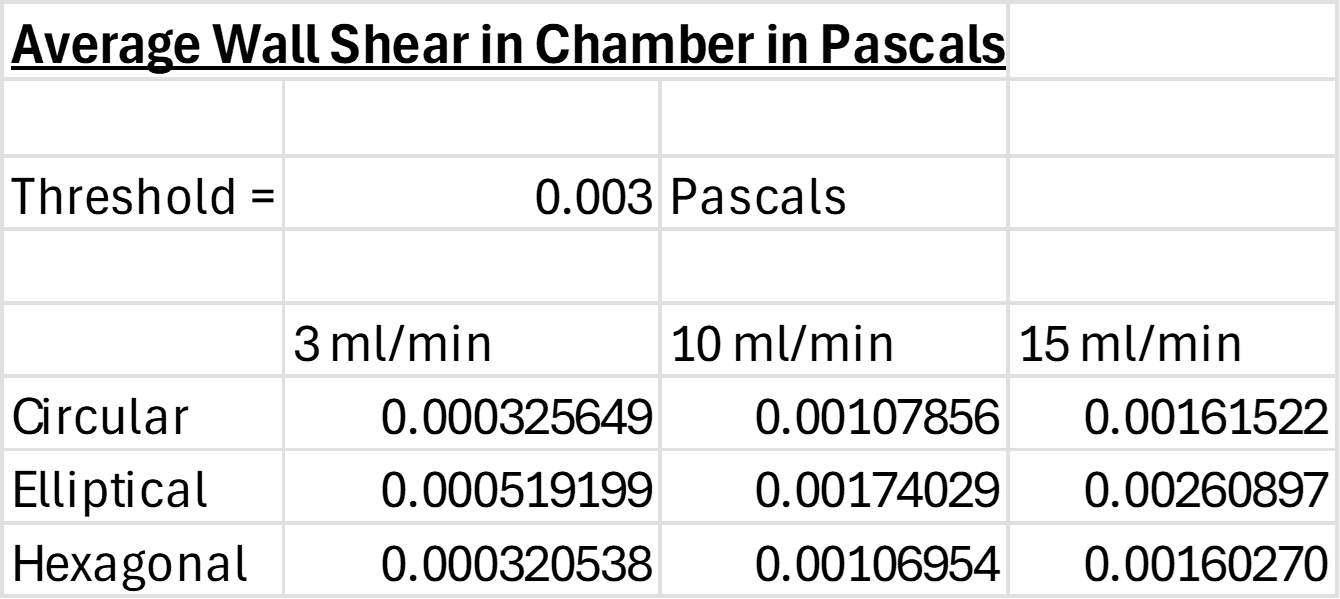
According to our liver-on-a-chip simulation analysis, the elliptical shaped chamber has the highest wall shear occurring on the chamber walls. The circular and hexagonal shaped chambers showed similar wall shear values. The threshold wall shear value of 0.003 Pascals was never exceeded in any of the model runs. Based on these results, any of these chamber shapes could be used for testing with an EMEM liquid flowing up to 15 ml/min. A conservative approach to wall shear might include not using the elliptical chamber shape.
Applying CFD Simulation to Cell-Safe Microfluidic Design
Liver-on-a-chip platforms depend on carefully controlled flow conditions. While sufficient fluid movement is needed to support testing, excessive wall shear stress can damage or kill the liver cells seeded inside the microfluidic chamber.
This Ansys Fluent analysis shows how CFD can support early design decisions by comparing chamber geometry, flow behavior, pressure distribution, and wall shear stress before physical testing. In this example, the circular, elliptical, and hexagonal chamber designs all remained below the suggested wall shear threshold at flow rates up to 15 ml/min, while the elliptical chamber produced the highest wall shear values overall. For a conservative design approach, the circular or hexagonal chamber may provide a more favorable starting point.
Continue the Liver-On-A-Chip Analysis
See how Ansys Fluent is used to evaluate liquid filling and air entrapment in circular, elliptical, and hexagonal microfluidic chamber designs.
Read Part 2: Liquid Filling in a Liver-On-A-Chip Platform →
Need Help with Microfluidic or Biomedical CFD Simulation?
SimuTech Group helps engineering teams use Ansys Fluent to evaluate flow behavior, pressure drop, wall shear stress, and design performance in biomedical applications.
Connect with our CFD experts to improve confidence in your microfluidic device design before physical testing.

Michael Showalter
Lead Engineer – Fluids
Michael Showalter is Lead Engineer – Fluids at SimuTech Group, with over 35 years of experience applying CFD software to the design and analysis of complex products and systems. His work includes extensive biomedical and microfluidic applications, including capillary filling of a microfluidic biochip, angioplasty balloon inflation, thermal balloon catheter heat transfer, and wicking blood samples into a glucose monitor. He has also applied CFD to respiratory airflow studies, including analysis of how mandibular repositioning devices may affect the airway of patients with sleep apnea.