
 Contact Us
Overview
Phased antenna array systems are used everywhere, from defense radar applications to commercial 5G applications. Designing these antenna arrays involves complex mathematics that requires full-wave simulation. Ansys HFSS, a full-field 3D electromagnetic simulation software, can simulate a complex phased array antenna system in a reasonable amount of time and at low computational cost while considering the effects of complex excitations, the environment (i.e., nearby antennas), and the platform on its performance. This blog illustrates different approaches to efficiently simulate a phased antenna array. Below is a brief overview of the different simulation approaches, and a full demonstration is provided in the video link.
Ansys HFSS offers four different phased antenna array simulation approaches:
1) Unit Cell Infinite Array Method
This method is a useful tool for antenna array analysis, however, the analysis can yield incorrect results if used improperly. An HFSS single-array-element solution generally does not account for the effects of the element’s hypothetical neighbors. It assumes that all elements are identical and the element pattern doesn’t depend on the location in the array. If these impacts are significant, then this method will be invalid.
In this method, HFSS meshes/simulates a unit cell with primary/secondary or lattice pair boundaries to enforce the infinite periodicity. Once the single element radiation pattern is simulated, HFSS mathematically calculates the array factor and gets an approximate finite array pattern, ignoring edge effects.
2) Explicit Finite Array Method
The explicit finite array simulation approach is the traditional method to analyze the entire array. HFSS meshes/simulates the entire structure and includes edge effects, non-uniform array elements, and any geometric arrangement of elements. For large arrays, the meshing process will be complex and require substantial computational resources.
3) Finite Array Domain Decomposition Method (FADDM)
In this method (FADDM), and simulates a unit cell and duplicates the mesh to the other array elements (no further adaptive meshing is required). This dramatically reduces the meshing time and memory footprint, enabling the simulation of much larger arrays on the same hardware. The mesh periodicity reinforces the array’s periodicity, thereby improving simulation accuracy. Domain decomposition (DDM) is also implemented to distribute the mesh and access distributed RAM throughout a network. DDM distributes a model’s mesh and solution across several computers by distributing the RAM, and solves the model’s full behavior as if it were run on a single computer.
4) 3D Component Array Method (CADDM)
uses an efficient domain-decomposition-based finite element technique to model finite semi-periodic structures with non-identical unit cells, thereby increasing flexibility. Compared to FADDM, unit cells in this method must be defined as 3D components. This simulation technique enables faster simulation and less memory usage compared to FADDM, distributed computing resources. The overall workflow begins by importing the 3D components into HFSS, which represent different unit cells in the model. Then the array is created similarly to creating a finite array from a unit cell. However, this method lists all unit cell components and allows any arrangement of those unit cells within the array dimensions defined by the user.
To use the 3D Component Finite Array workflow with non-identical unit cells, the unit cells must meet the following requirements:
- Unit cells must be defined as 3D Components
- Dimensions of unit cells’ bounding boxes must be identical
- Appropriate Lattice Pairs and boundary conditions must be defined on the surfaces of unit cells
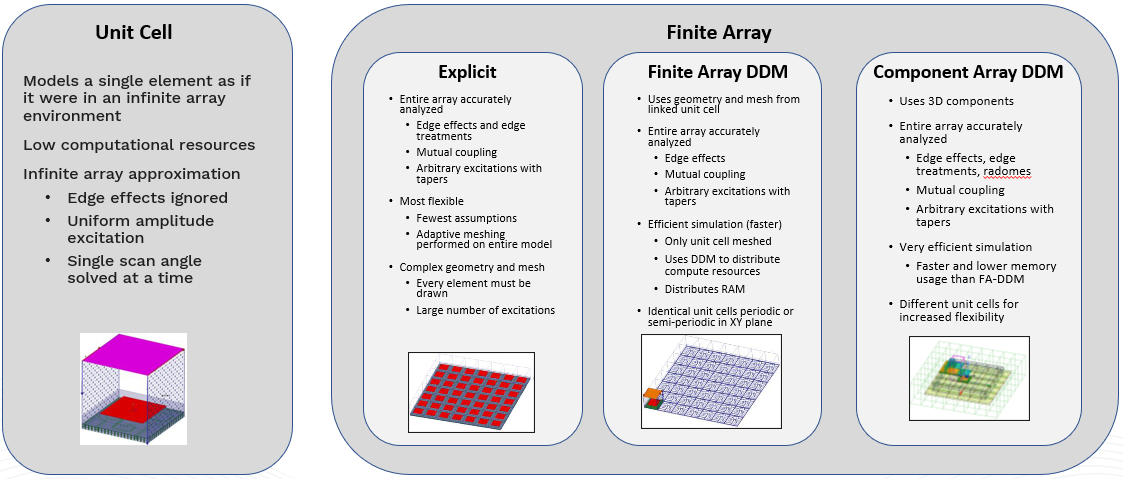
Figure 1: Comparison of the Different Array Analysis Approaches
Patch Array Example and Video Demonstration
Patch Array Example
A complete demonstration is provided in the video below:
Designing phased array antennas for your next project? SimuTech Group offers Ansys HFSS training and expert consulting to help you select the right simulation approach for your array design. For a walkthrough of antenna design fundamentals in HFSS, see our guide on antenna design using Ansys HFSS. Contact us to get started.
{{cta(‘190121812997′,’justifycenter’)}}