
 Contact Us
What is Multipaction?
RF systems extensively tested on Earth may unexpectedly fail for the first time in space when exposed to vacuum conditions. This critical failure mode is known as multipaction. Under the right conditions, RF systems can trigger an electron resonance effect in vacuum, causing an avalanche of free electrons that results in a corona discharge. The aftermath of this discharge can cause signal distortion or permanent component damage. Its prediction and mitigation are essential for satellite communications, radar systems, and other space applications where repair is impossible.
Understanding Multipaction
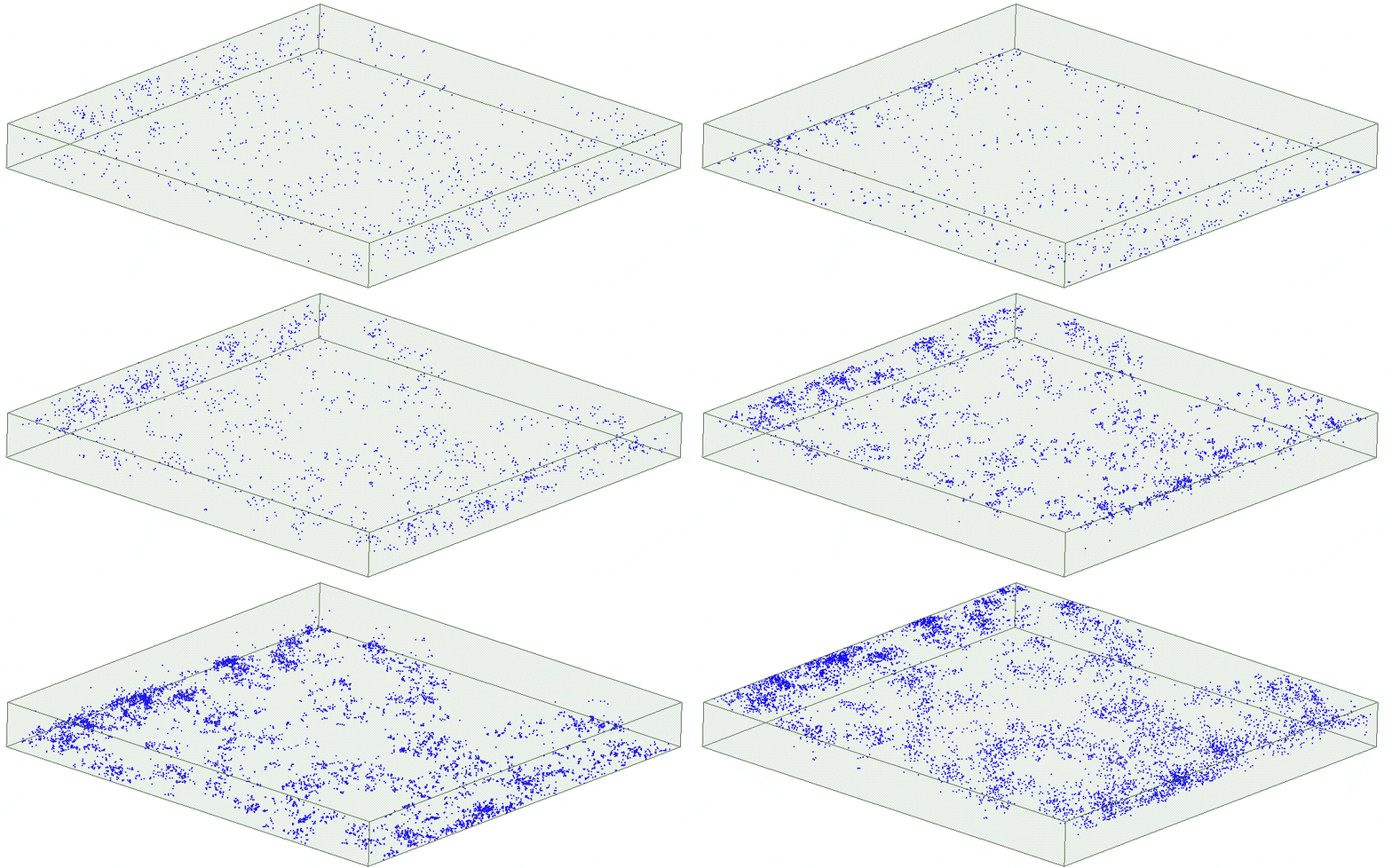
Multipaction occurs when free electrons in a vacuum-filled RF component are accelerated by electromagnetic fields and impact metal surfaces with sufficient energy to release secondary electrons. Under specific conditions of applied RF power, frequency, and geometry, these secondary electrons can be synchronized with the field phase, creating an exponential multiplication effect. The avalanche develops rapidly: electrons released from one surface impact an opposing surface in phase with the applied field, resulting in each impingement producing more electrons than the last.
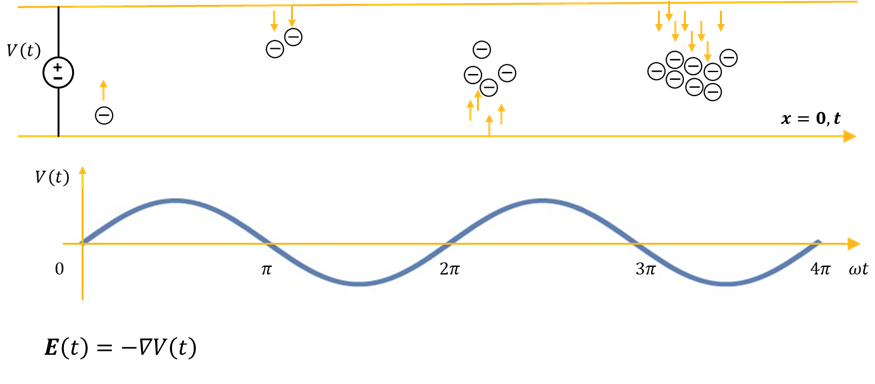
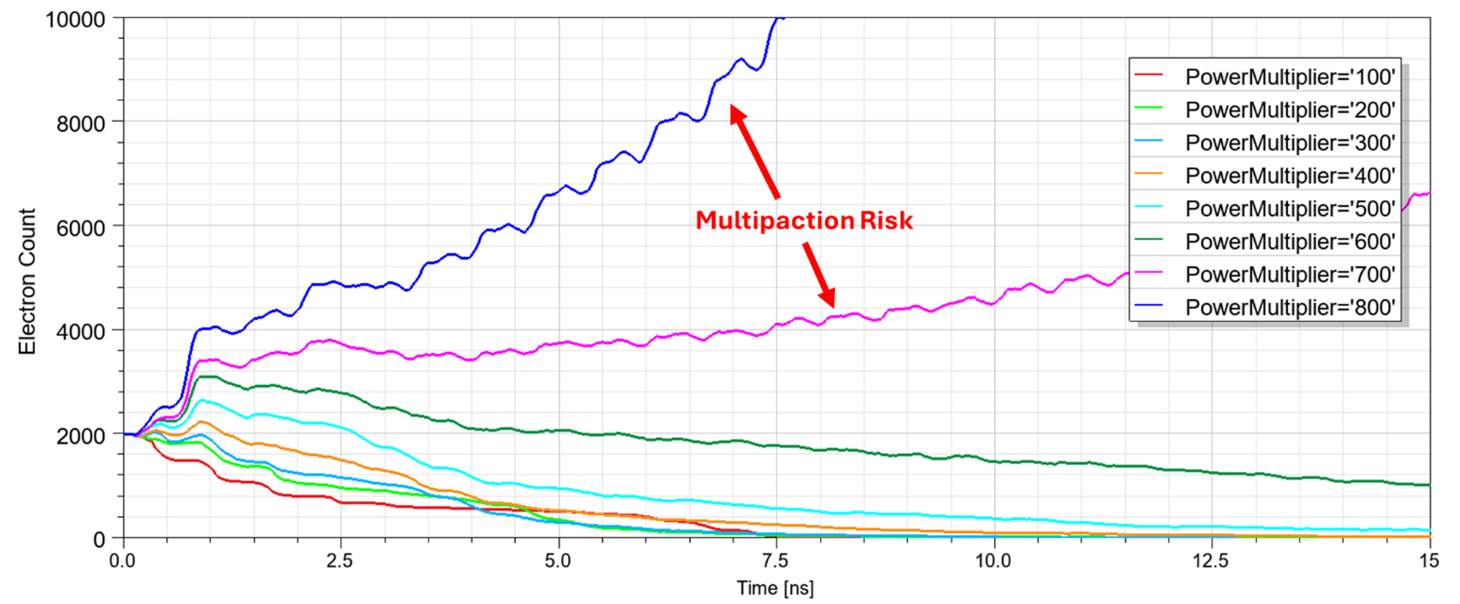
The phenomenon is especially concerning because it is self-sustaining once initiated. The electron cloud absorbs power, causing signal degradation, increased reflected power, and potentially permanent damage from localized heating and outgassing of surface contaminants. In space applications where vacuum conditions are permanent and repair is either exorbitantly expensive or impossible, even a single multipaction event can result in the failure of a mission.
Necessary Conditions for Multipaction
For multipaction to occur, four specific conditions must exist simultaneously.
- Electron mean free path must be much greater than the spacing between opposing surfaces. This requirement is inherently satisfied in space vacuum environments, where the absence of gas molecules allows electrons to traverse gaps without collisions.
- Secondary emission yield (SEY) must be greater than 1.0, meaning each impacting electron produces, on average, more than one secondary electron.
- Time between electron impingements on surfaces must equal odd multiples of half-periods of the applied RF voltage, ensuring electrons always encounter accelerating fields. This phase synchronization is what makes multipaction a resonant phenomenon, specific frequency and gap spacing combinations create perfect timing for electron multiplication.
- Free electrons must be available to initiate the cascade. In space, cosmic rays and naturally occurring ionization provide seed electrons, though often only a single electron is needed to trigger an avalanche under susceptible conditions.
Understanding these four conditions provides insight into mitigation strategies: while vacuum conditions cannot be changed in space, surface treatments can reduce SEY below unity, geometric design can disrupt phase synchronization, and operational procedures can limit time at vulnerable power levels.
Primary Causes and Contributing Factors
The likelihood of multipaction depends on several interdependent parameters beyond the four necessary conditions. The secondary emission yield of surface materials is fundamental. Clean metal surfaces typically exhibit SEY values between 1.5 and 3.0, with aluminum, silver, and copper being particularly susceptible. Surface contamination, oxidation, and deliberate coatings can dramatically alter SEY characteristics.
Geometry plays a crucial role in determining multipaction susceptibility. Parallel plate configurations, common in waveguides and coaxial lines, create ideal conditions for single-surface and two-surface multipaction modes. Gap spacing relative to RF wavelength determines the electron transit time and phase synchronization. RF power levels and frequency establish the electric field strength and electron oscillation periods. Space environments introduce additional complications: temperature extremes affect material properties, radiation can alter surface characteristics over time, and the hard vacuum ensures no damping of electron motion.
Design Pitfalls and Risk Areas
Several design features commonly introduce multipaction vulnerabilities. Sharp transitions in impedance or geometry create field concentrations that lower multipaction thresholds. Waveguide filters, directional couplers, and rectangular-to-circular transitions are common regions of concern. Coaxial interfaces and connector gaps provide parallel surfaces with dimensions that often fall within critical multipaction spacing ranges. Windows and dielectric-loaded sections introduce complex field distributions and surface charging effects. Components that test successfully at atmospheric pressure may fail in orbit, as gas molecules provide electron damping that disappears in vacuum.
Material selection errors compound these geometric risks. Choosing high-SEY materials such as bare silver or aluminum without protective treatments invites multipaction. Insufficient attention to surface finish, cleanliness, and handling procedures during manufacturing can leave residual contaminants that increase SEY or create localized field concentrations.
Simulation with Ansys HFSS
Ansys HFSS provides comprehensive multipaction analysis capabilities that enable engineers to identify and mitigate risks during the design phase. The software combines electromagnetic field solutions with particle tracking and secondary emission physics to predict multipaction thresholds across the operational bandwidth.
The multipaction analysis in HFSS begins by computing the steady-state electromagnetic fields of the structure at the frequency or frequency sweep of interest. These fields are then linked to a particle-tracking simulation in which secondary electron emission (SEE) properties are assigned to relevant surfaces using built-in or user-defined SEY models. Seed electrons are emitted and their trajectories are calculated under the influence of the precomputed RF fields, with impact energy and angle used to determine secondary emission. Multipaction susceptibility is identified when resonant electron motion combined with a secondary electron yield greater than unity results in sustained electron multiplication.
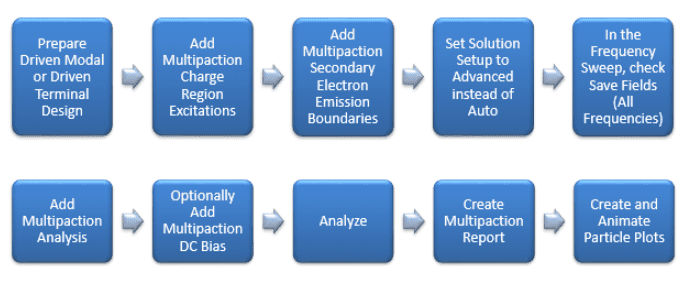
Some of the key outputs is the prediction of multipaction onset or susceptibility, SEY plots, and particle animations where electron multiplication occurs. HFSS identifies specific locations where multipaction initiates, allowing engineers to correlate geometric features with risk areas. Parametric sweeps enable rapid evaluation of design modifications: varying gap dimensions, testing different surface treatments, or assessing the benefits of geometry optimization.
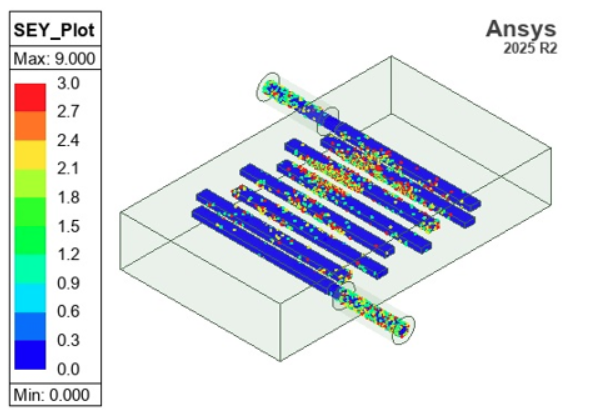
Advanced capabilities include multi-carrier excitation analysis and stochastic initial electron seeding to represent random ionization sources. The solver captures both single-surface and two-surface resonant multipaction modes, including parallel-plate-type phenomena.
Conclusion
Multipaction remains a primary concern for space RF systems, but modern simulation tools have transformed it from an unpredictable threat into a manageable design constraint. Ansys HFSS enables engineers to predict multipaction susceptibility, evaluate mitigation strategies virtually, and optimize designs prior to hardware fabrication. When combined with appropriate material selection, surface treatments, and design practices informed by simulation results, multipaction risk can be systematically reduced, supporting reliable RF performance throughout the duration of the mission.
To learn how SimuTech Group supports RF, electronics, and mission-critical space system design, explore our space simulation solutions.

Alex Pham
Sr. Staff Engineer
Alex Pham is a Sr. Staff Engineer – High Frequency at SimuTech Group, where he supports customers working with RF, microwave, antenna, wireless, and electromagnetics simulation workflows. His work helps engineering teams better understand high-frequency behavior, evaluate electromagnetic performance, and apply Ansys simulation tools to complex RF and multiphysics design challenges.

Tyler Harper
Enterprise Account Engineer
Tyler Harper is an Enterprise Account Engineer at SimuTech Group, where he helps customers connect Ansys simulation tools with practical engineering and product development workflows. With experience in FEA and design engineering, his work includes supporting simulation-driven analysis, structural evaluation, and customer workflows that help engineering teams improve design confidence and performance before physical testing.
- Ansys HFSS Multipaction Analysis Help
https://ansyshelp.ansys.com/public/account/secured?returnurl=/Views/Secured/Electronics/v252/en/Subsystems/HFSS/HFSS.htm%23HFSS/HFSSMultpactionAnalysis.htm?TocPath=HFSS%2520Help%257CHFSS%2520Multipaction%2520Analysis%257C_____0 - PASJ 2018 Proceedings: WEP113
https://www.pasj.jp/web_publish/pasj2018/proceedings/PDF/WEP1/WEP113.pdf - Ansys Learning Hub Multipaction Course/Module
https://learninghub.ansys.com/learn/courses/561/ansys-hfss-multipaction-and-rf-discharge - CERN/HiLumi Presentation: Carbon Coatings
https://indico.cern.ch/event/647714/contributions/2633173/attachments/1559499/2454409/7thHiLumi_pedro_carbon_coatings.pdf - Philips Technical Review Archive
https://pearl-hifi.com/06_Lit_Archive/02_PEARL_Arch/Vol_16/Sec_53/Philips_Tech_Review/PTechReview-03-1938-080.pdf - A New Examination of Secondary Electron Yield Data
https://psec.uchicago.edu/Papers/A_new_examination_of_secondary_electron_yield_data.pdf - JACoW Proceedings: THXF102
https://proceedings.jacow.org/e00/PAPERS/THXF102.pdf - Wikipedia: Multipactor Effect
https://en.wikipedia.org/wiki/Multipactor_effect