 Contact Us
Not every engineering project starts in a lab or on a job site. Sometimes it starts at home. In this piece, Strategic Account Engineer Zac Reed walks through how he used topology optimization to design and 3D print a lightweight barbell holder. It’s a simple project, but one that highlights the power of simulation-driven design.
Introduction to Topology Optimization Using Ansys Discovery
Structural support brackets are commonly used to efficiently transfer loads between components and mounting interfaces. Traditionally, these brackets are manufactured from steel or other metals using bending or machining processes due to their high strength and low cost.
With additive manufacturing, engineers now have the opportunity to create complex, organic geometries that are not feasible with traditional fabrication methods. This project explores how topology optimization can be used to guide the development of a lightweight, 3D-printed polymer bracket subjected to a static cantilever load. The objective was to use simulation as a physics-based design exploration tool to inform geometry development completely within Ansys Discovery.
System Description and Engineering Challenge
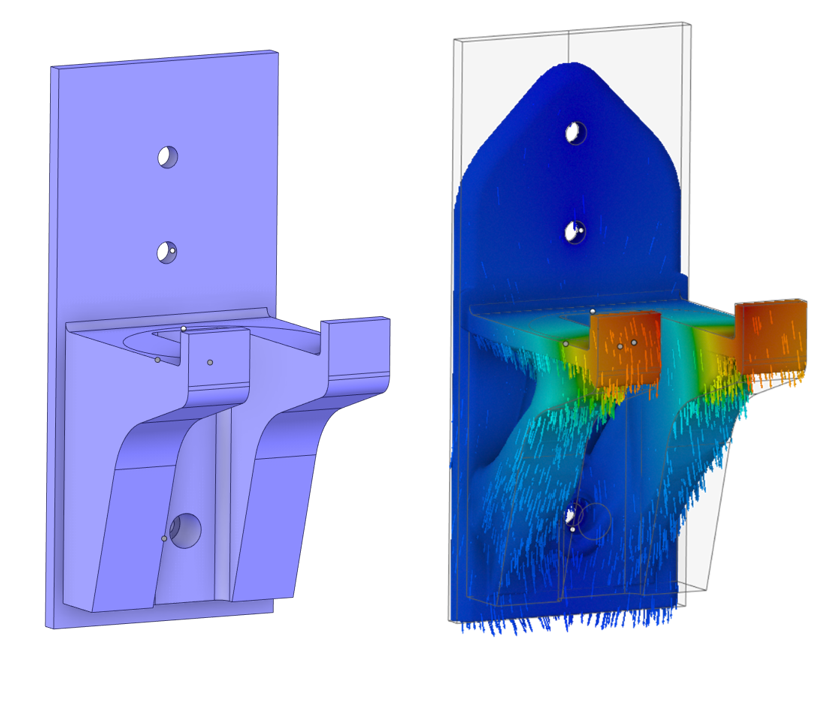
The component analyzed is a wall-mounted bracket designed to support a vertically hanging barbell under static load. The bracket attaches to a wall using three vertically spaced fasteners and supports the load at a cantilevered distance from the mounting surface.
A static load was applied at the bar support interface, with additional margin to account for both normal use and the transient load of placing the bar onto the bracket. Fixed support boundary conditions were applied at the mounting interfaces to represent wall attachment. Material properties were defined using data provided by the filament supplier for the selected 3D printing material.
The target for this study was a 70% material reduction relative to the initial fully solid geometry. While a specific stiffness target could have been used to drive the optimization, this study focused on volume reduction while maintaining acceptable structural behavior.
Unlike traditional steel brackets, 3D-printed polymer components require careful consideration of stiffness and load path continuity due to lower modulus and strength. The engineering challenge was not simply determining whether a geometry would survive the applied load, but also understanding how material should be distributed within the design space to achieve structural efficiency.
Simulation and Optimization Approach
To explore material distribution, a structural model was developed representing the available design space for optimization. Loading, boundary conditions, and material properties were applied to reflect the expected service conditions.
The analysis included:
- Linear static structural physics
- Fixed support boundary conditions at the wall interface
- A cantilever load applied at the bar support location
- Linear elastic material properties representative of the selected 3D-printed polymer
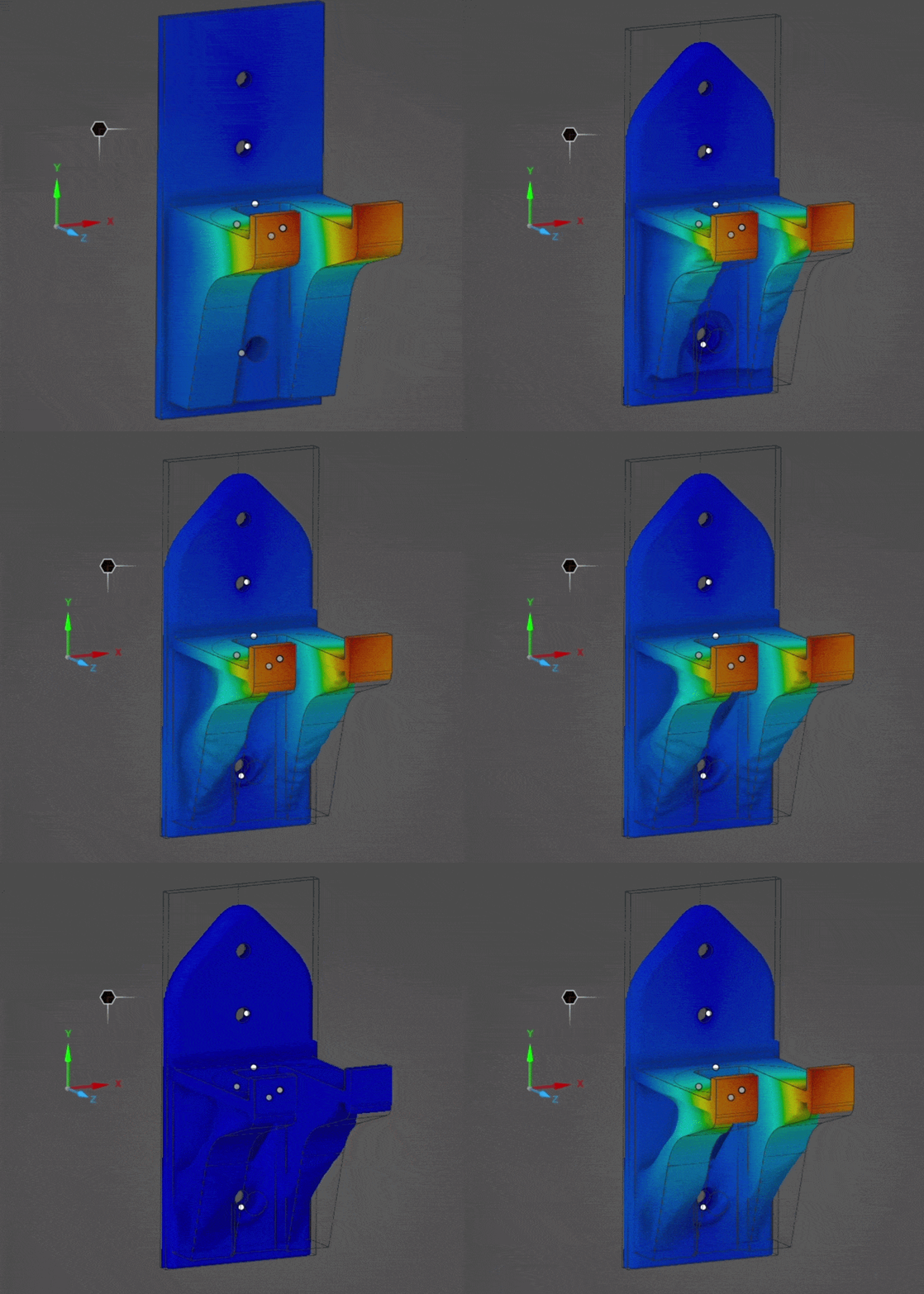
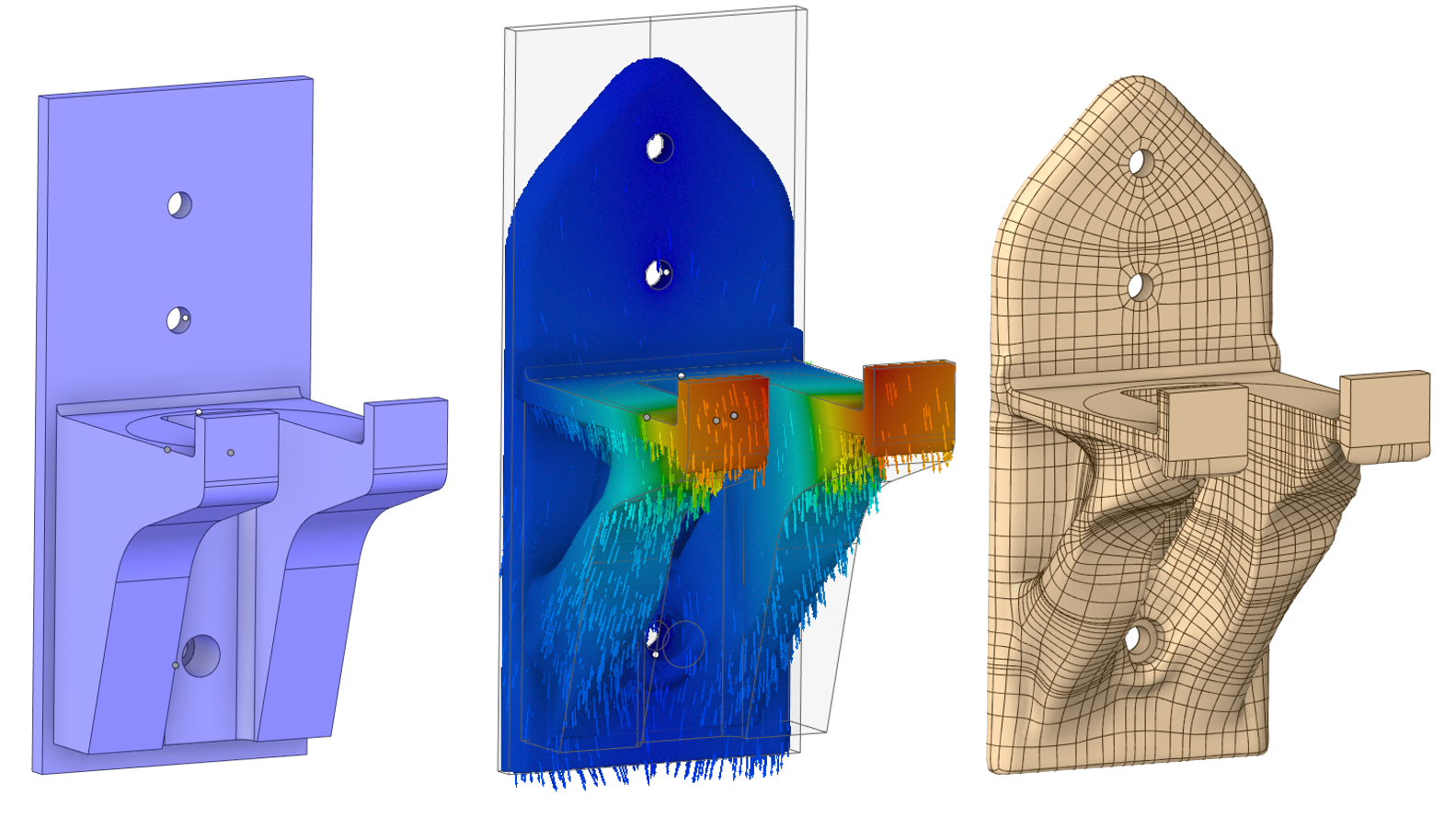
A fully solid baseline geometry was first evaluated to establish initial stiffness behavior within the defined design space. A topology optimization region was specified, identifying the portions of the geometry eligible for material removal. The optimization was then iterated to determine the most efficient material distribution while preserving structural performance.
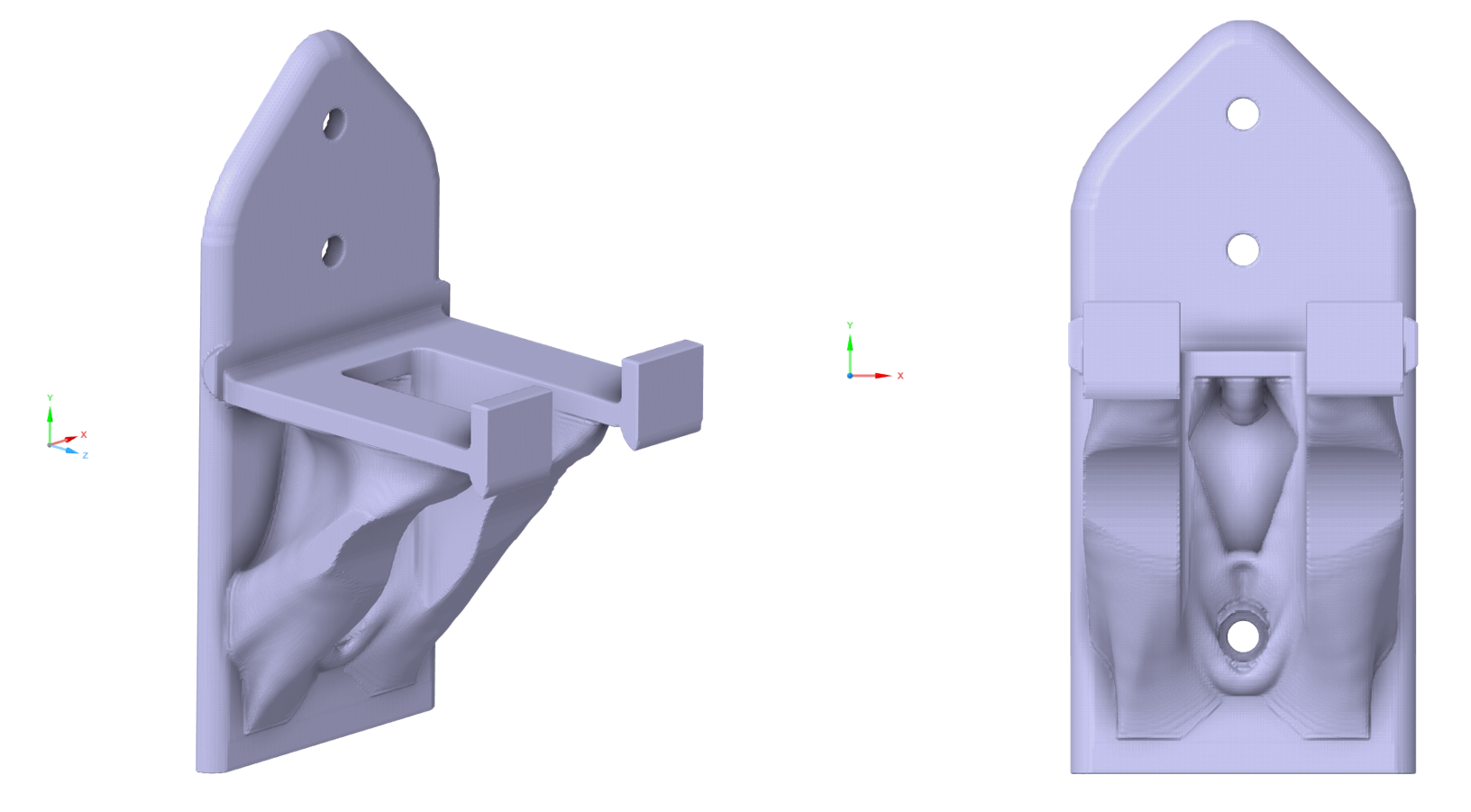
The optimization objective was to reduce total volume while preserving structural stiffness. Using the Ansys Discovery GPU solver, optimized geometry was generated rapidly (in under 5 minutes, in this case), revealing an organic structure shaped by the underlying load paths. The resulting form resembled naturally efficient structures where material is concentrated only along the critical path.
Engineering Insight
The topology optimization results revealed that structural behavior was dominated by a small number of primary load paths connecting the load application region to the mounting interfaces.
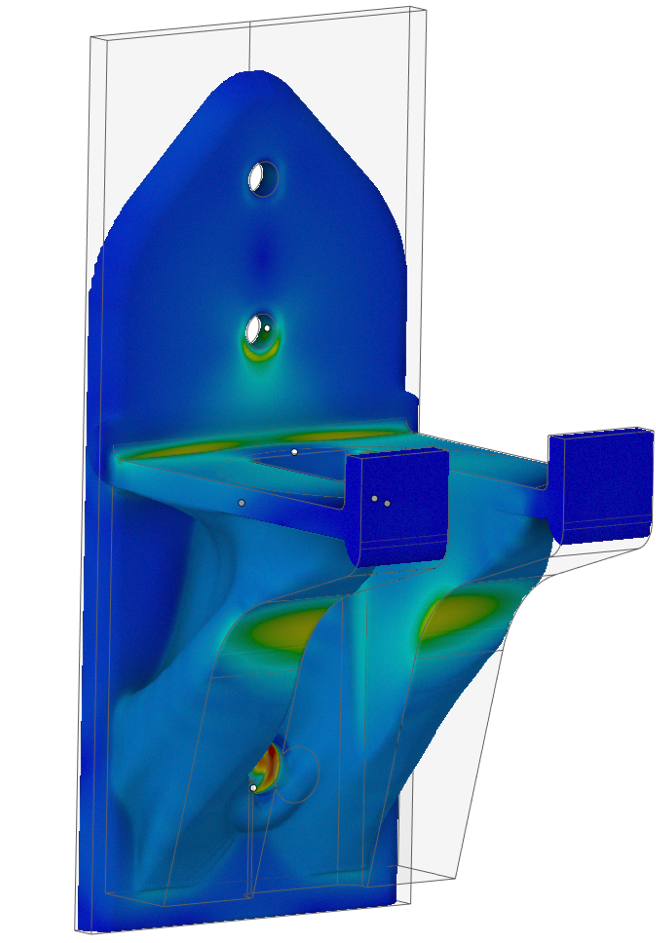
The lower attachment region exhibited the highest stiffness, and the optimization results indicated that this region should retain significant material to maintain structural integrity. In contrast, large portions of the initial solid geometry contributed minimally to stiffness and were removed during optimization.
Key insights included:
- Structural performance was driven more by load path continuity than total material volume
- Efficient geometries emerged directly from physics-based optimization rather than manual reinforcement assumptions
- Significant material reduction was achievable without compromising stiffness
- Simulation provided immediate visibility into structural behavior that would otherwise require iterative prototyping
This analysis established a clear and informed design direction prior to fabrication.
While further refinement using higher-fidelity solvers (such as the MAPDL solver within Discovery or Mechanical) could have been performed, stress levels were well below material yield limits for this application and did not require additional detailed analysis at this stage.
From Optimization to Fabrication
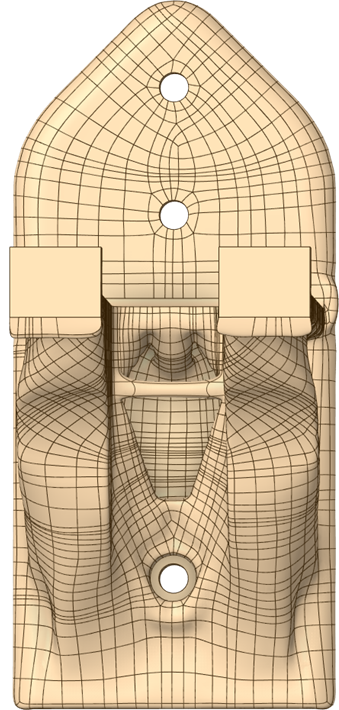
The topology-optimized geometry was exported and refined into a smooth SubD hybrid model to prepare it for additive manufacturing. At this stage, if further design improvements were needed, features such as the Bridge tool in the SubD ribbon could be used to add lateral stiffness.
This refinement process demonstrates the flexibility of integrating simulation-driven geometry directly into manufacturing workflows. Rather than rebuilding the part from scratch in traditional CAD, the optimized structure provided a physics-informed starting point for final geometry development.
Topology Optimization In Conclusion
Topology optimization provides engineers with a powerful method for exploring structural efficiency early in the design process. By allowing physics to guide material placement, engineers can:
- Develop lighter, more efficient structural components
- Reduce unnecessary material usage
- Improve confidence in design concepts before fabrication
- Accelerate early-stage design exploration
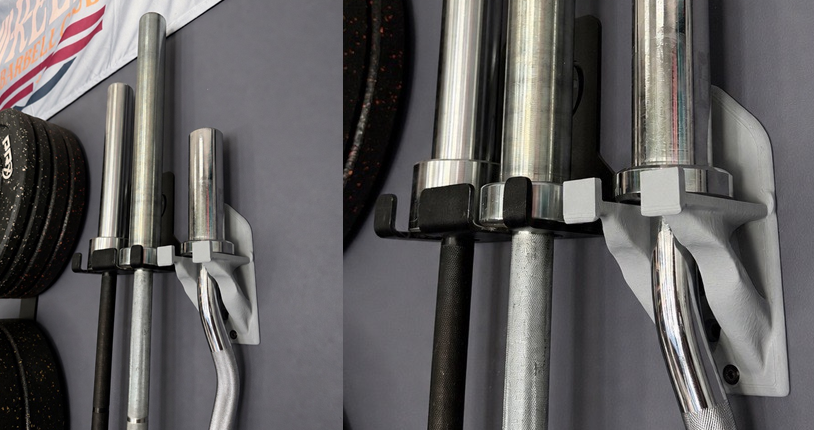
While this example involves a relatively simple bracket, the same methodology applies to far more complex applications—including aerospace structures, industrial equipment, and additively manufactured components where performance and efficiency are critical.
Simulation in this context was used to inform and guide geometry development, not to replace risk-based validation or physical testing methods. When applied appropriately, topology optimization enables engineers to better understand structural behavior and make more informed design decisions.

Zac Reed
Strategic Account Engineer, SimuTech Group
Zac Reed is a Strategic Account Engineer at SimuTech Group, where he helps customers connect Ansys simulation tools with practical engineering workflows. His work includes supporting simulation-driven design, early-stage concept development, and optimization workflows that help engineers evaluate performance, reduce material usage, and improve confidence before fabrication.