 Contact Us
Introduction to Passive Cooling
Passive cooling is a central safety feature in many small modular reactor (SMR) designs, but demonstrating that an SMR passive cooling system can reliably remove decay heat requires more than confirming that natural circulation occurs.
The harder question is whether engineers can predict—with sufficient confidence—how that passive cooling system will actually behave.
When a reactor shuts down, fission stops rapidly, but heat generation does not. Radioactive fission products continue to decay and release energy into the fuel. In the representative reactor analyzed by SimuTech Group CFD Staff Engineer Sasha Bakker, a 200 MW thermal core still produces approximately 4 MW of decay heat at a 2% decay-heat condition.
Without operating pumps, that heat must still move away from the core.
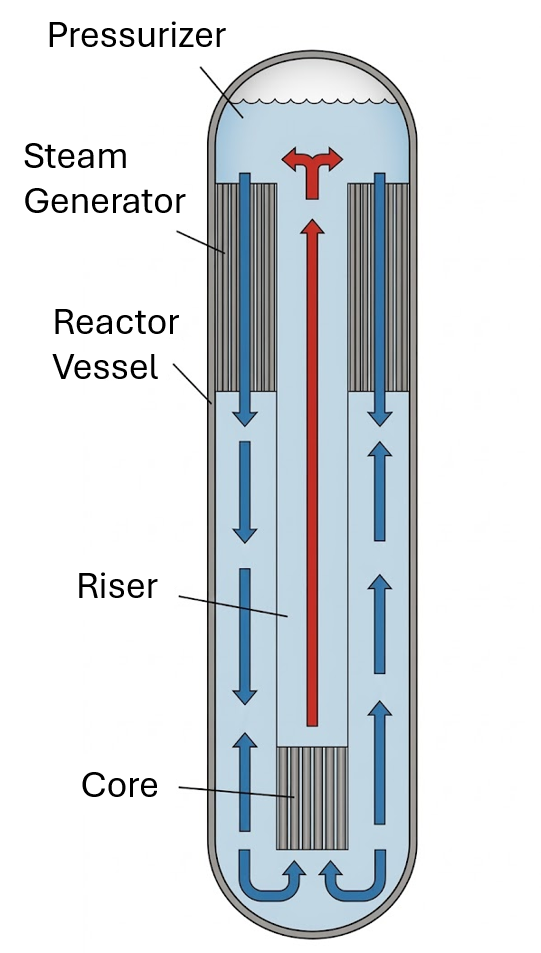
Natural circulation provides the mechanism. Water heated in the core becomes slightly less dense and rises. After transferring heat through the steam-generator region, the cooler, denser water descends through the vessel and returns to the core. The resulting density difference creates a buoyancy driving head that can sustain circulation without a mechanical pump.
On the secondary side, passive heat removal can rely on natural circulation as well. Steam generated as heat leaves the primary system rises toward a condenser connected to an elevated water pool, condenses, and returns under gravity. The pool ultimately acts as the heat sink.
The basic physics sounds straightforward. Predicting what happens inside the reactor vessel is considerably more complicated.
A one-dimensional system model can estimate how much flow a buoyancy-driven loop might generate. It cannot fully reveal how coolant distributes through a three-dimensional vessel, whether recirculation develops, where flow becomes uneven, or whether apparently symmetric behavior hides an inherently unsteady flow structure.
Those distinctions became particularly clear in three questions raised following Bakker’s CFD study.
How Porous Media Resistance Affects SMR Passive Cooling Predictions
One of the first questions engineers should ask about a reduced-order CFD model is not whether it produced a convincing flow visualization. It is which assumptions most strongly control the result.
In the representative SMR model, regions such as the reactor core and steam generator were modeled using porous media rather than resolving every individual flow passage. This is an efficient and appropriate approach when the primary objective is understanding vessel-scale circulation. The porous regions preserve the overall hydraulic resistance while avoiding the computational cost of explicitly modeling every channel.
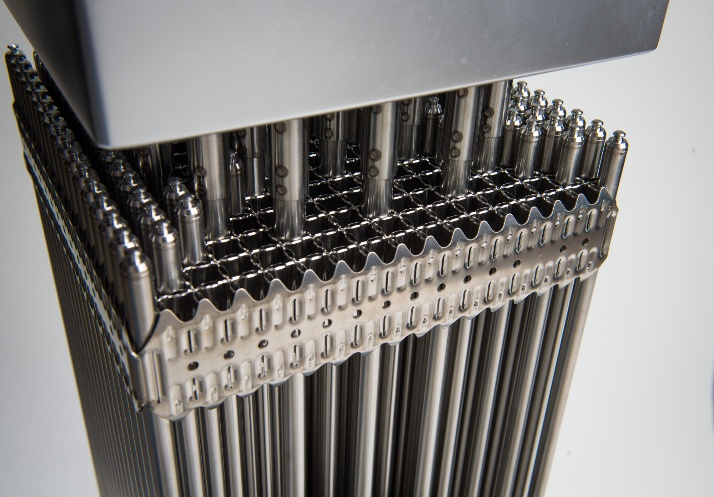
The tradeoff is uncertainty in the resistance coefficients themselves.
Because natural circulation is created by a relatively small buoyancy driving head, there is no large pump pressure available to overpower errors in system resistance. The circulation rate settles where the buoyancy driving force and hydraulic resistance balance.
That makes porous-media resistance one of the most important parameters in the model.
Bakker identified it as the largest unquantified uncertainty in the representative reactor analysis. The specific circulation rate should be directly sensitive to the assumed resistance coefficients, because the porous zones provide much of the system’s overall flow resistance.
The qualitative flow structure, however, may be more robust.
For example, recirculation in the lower vessel is driven substantially by geometry: coolant has to reverse direction within a confined space before returning toward the core. Adjusting resistance may change the magnitude of the flow without eliminating the geometric mechanism that creates that circulation pattern.
This distinction is important when interpreting CFD results.
A simulation can provide strong insight into how an SMR passive cooling system behaves while still requiring additional sensitivity analysis before engineers place the same confidence in an exact velocity or mass-flow value.
For passive-safety studies, uncertainty quantification therefore should not be treated as an optional final check. Sensitivity sweeps of dominant resistance parameters can help establish which conclusions remain stable as uncertain inputs change.
If the Solver Does Not Converge to One Velocity Field, Is the Flow Physical or Numerical?
Natural-circulation CFD introduces another challenge: sometimes a solution that refuses to become perfectly steady is telling you something important about the physics.
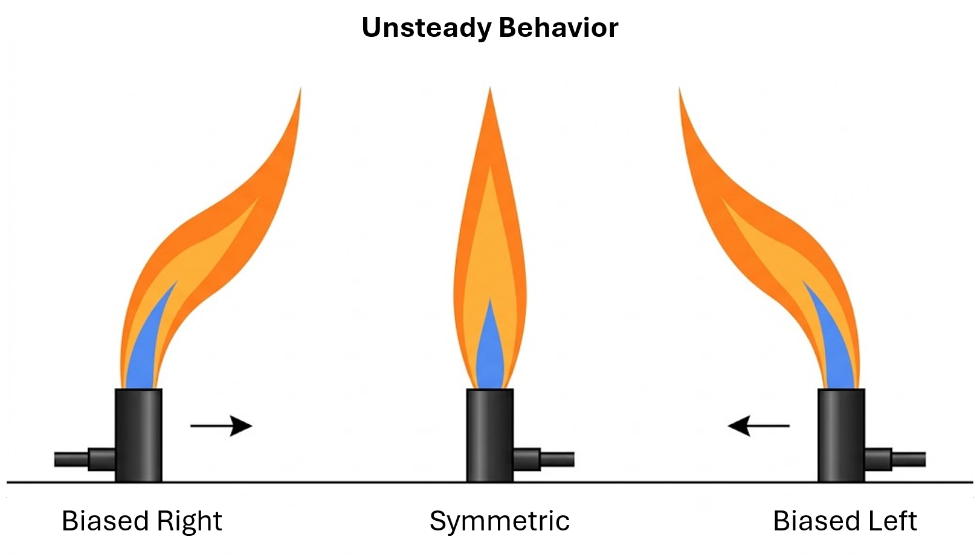
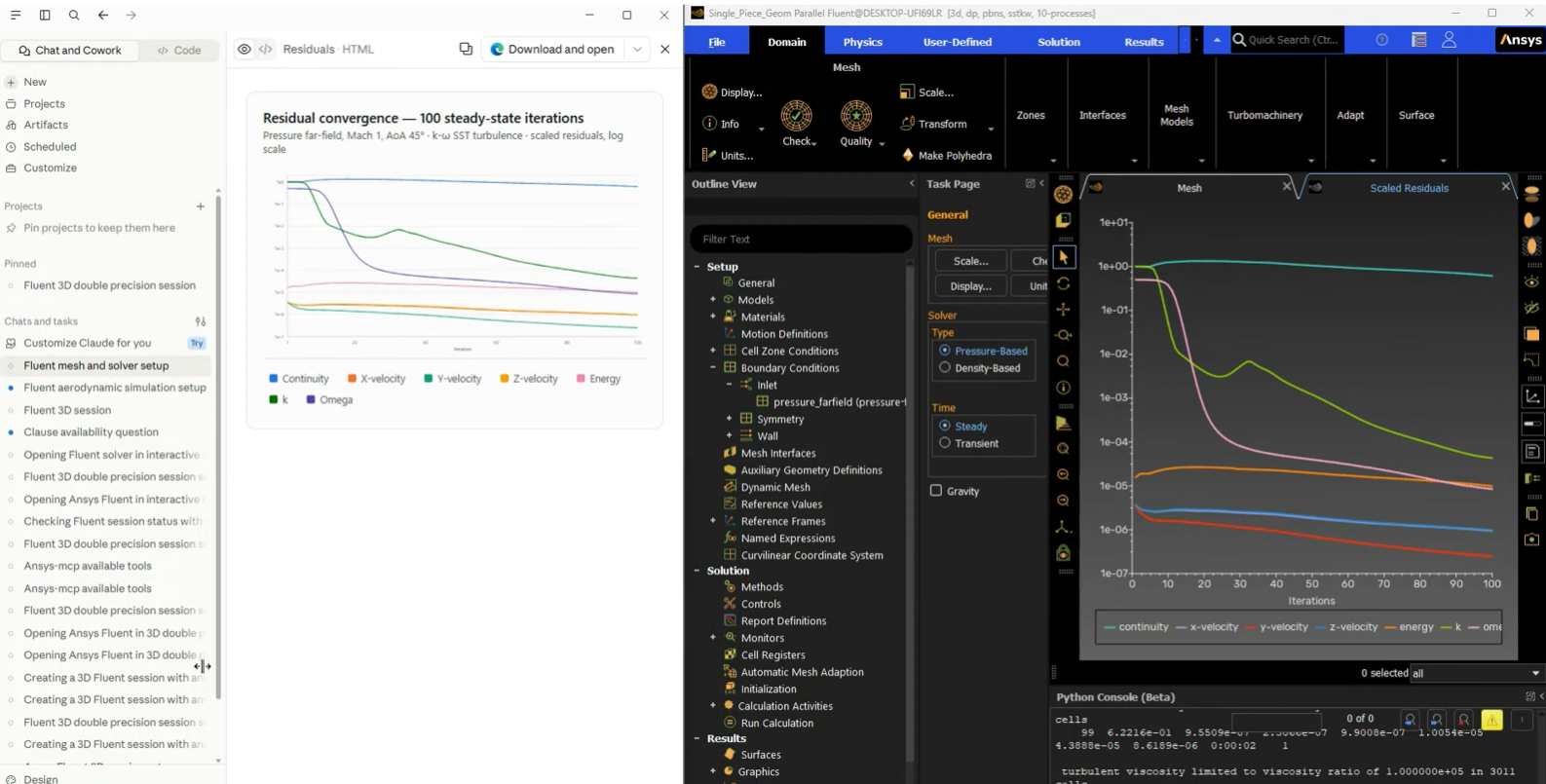
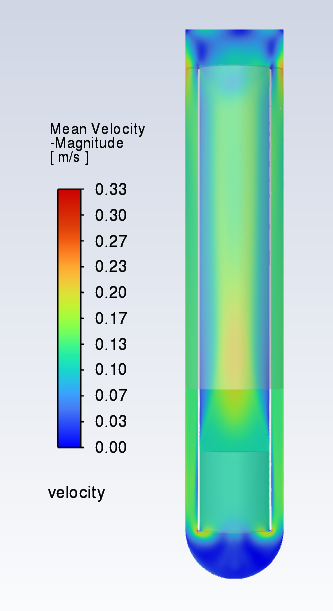
During the initial reactor simulation, the residuals flattened, but the internal velocity field continued to reorganize. A high-velocity region in the riser shifted from one side of the vessel to the other rather than settling permanently into a single symmetric configuration.
It would be easy to label that behavior a convergence problem.
The other solution variables told a different story.
While the velocity distribution oscillated, the temperature field remained stable and the overall energy balance remained essentially closed against the 4 MW heat input. In other words, the global thermodynamic solution remained stable while the internal flow structure moved between different states.
That combination provides an important diagnostic.
If the entire numerical solution were diverging, engineers would expect temperature, energy balance, velocity, and other global quantities to deteriorate together. Instead, only the spatial organization of the velocity field continued to change.
That points toward a physical flow instability rather than a simple solver failure.
The lesson extends beyond SMRs.
Convergence metrics should never be interpreted in isolation. Residuals are useful, but they do not independently prove that a CFD solution is either physically correct or physically steady. Engineers also need to monitor quantities tied directly to the physics of the problem: heat balance, mass flow, temperature distributions, pressure behavior, and the evolution of the flow field itself.
There is another important implication. A steady solver can reveal that an instability exists, but it cannot properly characterize its behavior in physical time.
Statistics collected from a steady-state calculation are averaged over solver iterations, not seconds. A transient simulation is therefore required to determine the actual frequency, amplitude, and time-averaged effect of an oscillating natural-circulation flow.
Recognizing that distinction can prevent engineers from “fixing” a solver behavior that may actually be an important feature of the system being studied.
Why 3D CFD Matters for SMR Passive Cooling Via Natural Circulation
This may be the most consequential question of the three.
When the oscillating velocity field is averaged, the resulting circulation pattern appears broadly symmetric. An axisymmetric model could reproduce a similar-looking mean result with substantially lower computational cost.
So why perform the full three-dimensional simulation?
Because an axisymmetric model would produce symmetry partly because symmetry was imposed on it from the beginning.
The 3D solution showed that the instantaneous flow did not necessarily remain symmetric. Instead, the high-velocity region could move through the riser even though the long-term average appeared balanced.
An axisymmetric representation cannot discover that behavior. Neither can a one-dimensional system model. Both eliminate asymmetric modes by construction.
That matters whenever local behavior matters.
Imagine placing a single temperature or velocity sensor in the riser. If the internal circulation shifts spatially over time, that measurement could rise or fall simply because the flow structure moved relative to the sensor. An engineer looking only at the measurement might conclude that something in the reactor operating condition had changed even though the overall heat load and circulation remained essentially constant.
Three-dimensional CFD exposes that distinction between global stability and local variability.
This is one of the most valuable roles of high-fidelity simulation in passive-safety analysis. Its purpose is not simply to create a more detailed version of a system-level answer. It can reveal physical behavior that a lower-dimensional model is structurally incapable of representing.
That does not make simpler models obsolete.
A one-dimensional loop calculation remains an efficient way to estimate overall natural-circulation flow and understand the balance between buoyancy and friction. Axisymmetric models can also be valuable when their assumptions are consistent with the expected physics.
The important question is whether the dimensional simplification removes a behavior engineers need to evaluate.
Building Confidence Before Predicting the Reactor
High-fidelity simulation becomes far more useful when it is anchored to a problem where the answer is already known.
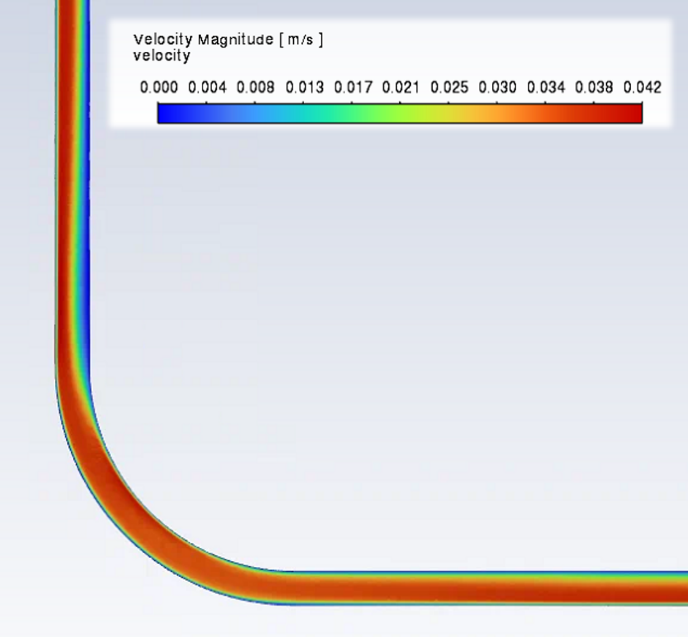
Before applying the CFD methodology to the representative reactor, Bakker compared it against a published single-phase natural-circulation experiment. The objective was to determine whether the simulation could reproduce the tightly coupled physics governing buoyancy-driven flow: temperature-dependent density, hydraulic resistance, heat transfer, and the resulting circulation rate.
The validation reproduced the measured loop mean temperature and heater temperature difference to within approximately one-tenth of a degree and captured the experimental trend to within about 4% across a threefold change in heating power.
That validation does not prove that every subsequent reactor prediction is correct.
What it does establish is that the modeling approach can reproduce the underlying natural-circulation physics under measured conditions before it is used to investigate a configuration where equivalent experimental data may not exist.
That distinction is critical.
CFD credibility does not come from model complexity alone. It comes from combining appropriate physics, defensible assumptions, validation against available evidence, sensitivity analysis, and an understanding of what the chosen model can—and cannot—predict.
Passive Safety Is a System Behavior, Not a Single Number
The central question in passive reactor cooling is often expressed simply: Can natural circulation remove the decay heat after loss of power?
But proving the safety of SMR passive cooling requires more than calculating one circulation rate.
Engineers need to understand where coolant travels, how evenly it distributes, which resistances control the flow, whether local recirculation develops, whether the flow is inherently transient, and whether reduced-order assumptions suppress important three-dimensional behavior.
The analysis also has clear limits. The reactor study represented a quasi-steady 4 MW decay-heat condition rather than the complete cooldown history. Porous media retained global hydraulic resistance but not individual-channel behavior. The secondary system was represented by its heat-removal effect rather than explicitly modeled, and the steady formulation could identify an unsteady flow structure without resolving its physical time evolution.
Those limitations point naturally toward the next engineering questions: sensitivity studies for porous resistance, transient simulation of the oscillating flow, coupled secondary-side modeling, and analysis across progressively lower decay-heat conditions to determine whether natural circulation remains established as the buoyancy driving head weakens.
That progression is ultimately what simulation contributes to passive-safety engineering.
The goal is not simply to produce an answer that says natural circulation works. It is to build a traceable body of evidence explaining why it works, where uncertainty remains, and which physical behaviors must be understood before engineers can rely on it.
See SMR Passive Cooling CFD in Action
Want to explore these concepts in greater depth? Watch our on-demand webinar, Proving Passive Safety: CFD for Natural-Circulation Cooling in SMRs, where SimuTech Group CFD Staff Engineer Sasha Bakker demonstrates how Ansys Fluent can be used to model buoyancy-driven natural circulation, evaluate three-dimensional flow behavior, validate the methodology against benchmark data, and investigate passive cooling in a representative reactor design.

Sasha Bakker
CFD Staff Engineer, SimuTech Group
Sasha Bakker is a CFD Staff Engineer at SimuTech Group who develops multiphysics simulations involving computational fluid dynamics, heat transfer, and structural analysis. Her experience includes modeling electrochemical cells, chemical reactors, and other complex engineering systems. She holds an M.S. in Computational Science and Engineering from Georgia Tech and a B.S. in Physics with a minor in Mathematics from the University of Massachusetts Amherst.