 Contact Us
Introduction
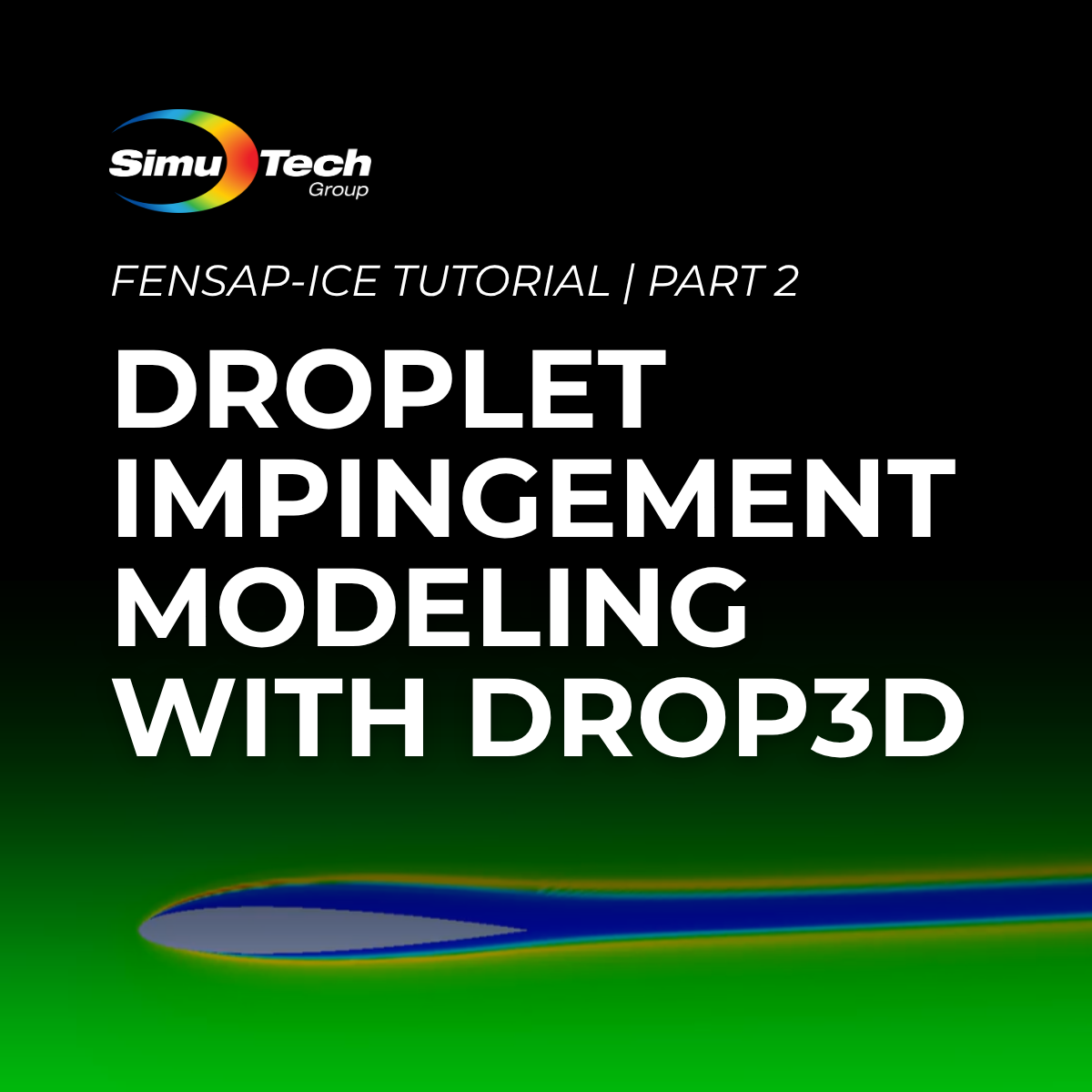
The DROP3D module within FENSAP-ICE computes supercooled droplet trajectories using the resolved airflow field. The droplet cloud is modeled using an Eulerian type system of equations, where the coupling with the airflow field is made through force source terms.
Video Walkthrough: Droplet impingement setup and collection efficiency analysis using DROP3D.
Governing Equations and Modeling Assumptions
The compressible Reynolds-Averaged Navier–Stokes equations are solved with the full energy equation enabled. Turbulence modeling is required to capture boundary layer development and stagnation heating effects. The flow is treated as steady-state for this configuration.
Reference Conditions
Freestream velocity: 103 m/s
Static temperature: 265 K
Angle of attack: 4°
Boundary Conditions
Far-field conditions are applied at the inlet. Airfoil surfaces are modeled as no-slip walls with prescribed temperature to enable surface heat transfer calculations. Symmetry boundaries require no additional configuration.
Convergence and Validation Considerations
Residual reduction, lift stabilization, drag stabilization, and wall heat flux consistency should be verified before proceeding to droplet modeling. Surface roughness will have a significant impact on surface heat transfer.
Modeling Pitfalls
Incomplete refining the mesh on the leading edge where the ice will occur leads to a high variability in the surface convective heat transfer, which decreases the accuracy of the icing simulation.
→ Next: “Part 3: Predicting Ice Accretion on Airfoils Using ICE3D in FENSAP-ICE“

Simon Bourgault-Côté, PhD
Staff Engineer Analyst – Fluids, SimuTech Group
Simon is a simulation engineer specializing in aircraft icing and multiphysics CFD. He holds a PhD in Mechanical Engineering from Polytechnique Montréal, where his research focused on numerical methods and algorithms for predicting in-flight ice accretion on aircraft surfaces. Simon has contributed to several peer-reviewed publications on icing simulation and works with engineering teams to apply advanced tools such as Ansys Fluent and Ansys FENSAP-ICE to complex multiphase and multiphysics problems, including aircraft icing and aerothermal analysis.