
 Contact Us
A survey of 1,000 Americans and 200 technical professionals finds that closeness to AI data center infrastructure, more than knowledge of it, predicts who welcomes a data center next door.
For most of their history, data centers went up quietly in industrial parks. Planning staff approved them, and almost no one else noticed. That era is over. Residents now pack hearings to ask about water tables and power rates, and a building type that barely registered with the public has become one of the most argued-over things a town can approve.
The industry’s standard answer has been explanation. If people understood what these facilities do, the thinking goes, the opposition would fade. That theory is easy to test and rarely tested. Knowing about a technology and standing close to it are different experiences, and anyone hoping to build here needs to understand the difference.
SimuTech Group surveyed 1,000 U.S. adults and 200 technical professionals about AI data centers. The survey covered what the facilities do, whom respondents trust to talk about them, and what it would take to earn local support.
Key Takeaways
- Americans would vote new data centers down. Given a local ballot measure, 39% of Americans would vote to pause or ban new AI data center construction, while 14% would vote to allow it.
- Support climbs with closeness to the work. Among technical professionals who work directly on data centers or AI infrastructure, 78% would support a data center near their community, compared with 33% of technical professionals whose work is unrelated.
- Everyday use pulls in the same direction. Americans who use AI tools regularly are nearly three times as likely as rare users to support a local data center (40% vs. 14%).
- Knowing what a data center does doesn’t win support. Americans who correctly identified a data center’s function would vote to pause or ban construction at more than twice the rate (49%) of those who held a mistaken belief (23%).
- The public distrusts the voices doing most of the talking. Americans distrust government officials (59%) and major tech companies (51%) on AI infrastructure, and they place the most trust in independent scientists (48%) and engineers and technical experts (42%).
- Lower power bills top the public’s terms. Americans rank lower local electricity costs first (69%) among the factors that would raise their support, yet 22% say no amount of annual compensation would change their opinion.
Most Americans Would Vote No
Data center approvals used to stay inside planning departments. Proposals now draw organized opposition, and the decision increasingly feels like one residents expect to weigh in on themselves. We asked Americans how they would respond if a proposal reached their own community, first as a feeling and then as a ballot measure.
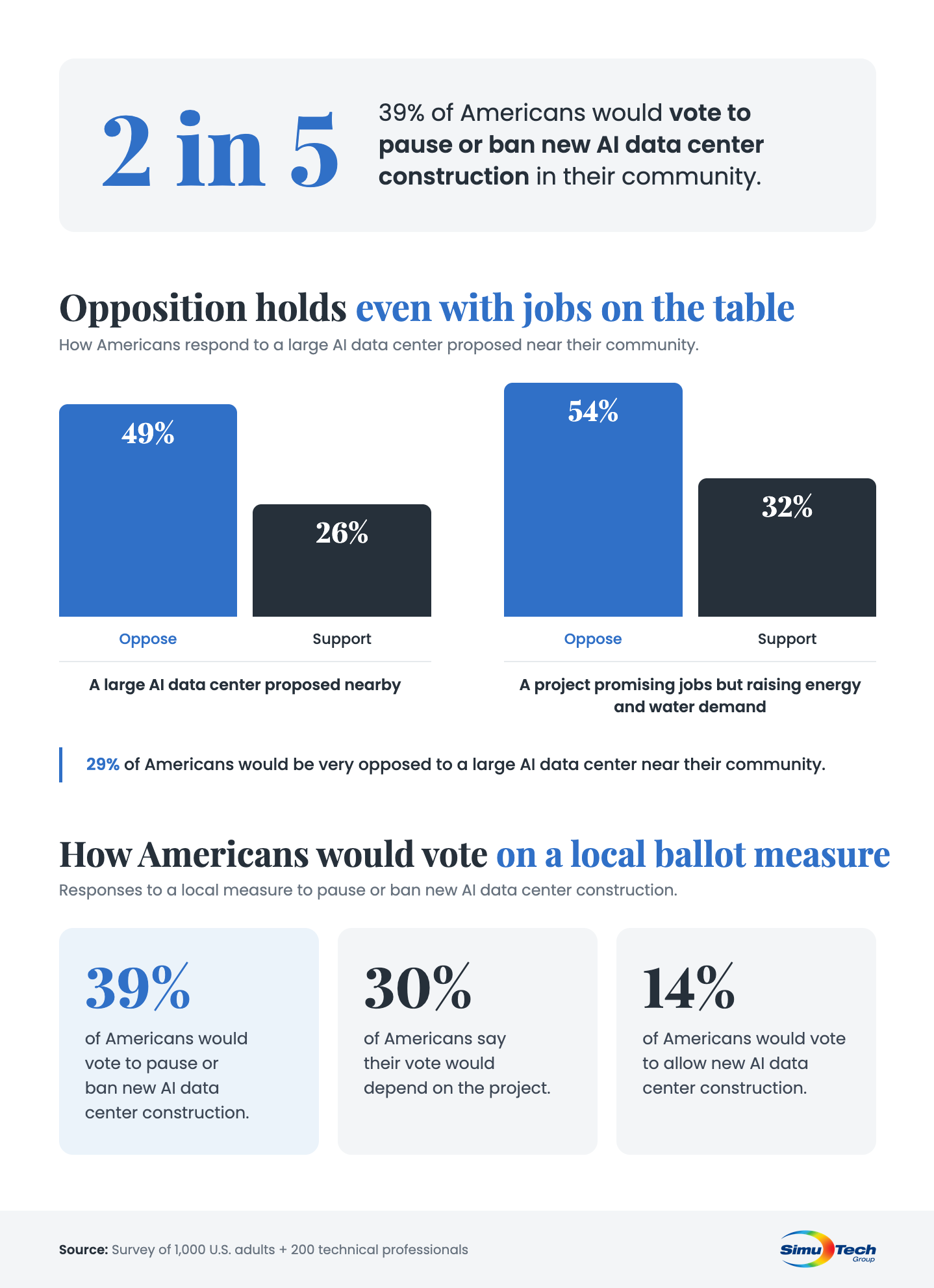
Asked how they would vote on a local measure to pause or ban new AI data center construction, 39% of Americans chose a pause or ban. Only 14% would vote to allow new construction, and 30% said their vote would depend on the specific project.
Americans feel much the same when a proposal lands close to home. Nearly half (49%) would oppose a large AI data center proposed near their community, including 29% who would be very opposed, while 26% would support one. The economic pitch doesn’t rescue the deal, either. When a project promised major investment and jobs but also raised local energy and water demand, 54% of Americans said they would still reject it, against 32% who would back it.
Boomers are the firmest no, with 47% voting to pause or ban construction, the highest share of any generation.
The Closer the Work, the Stronger the Support
The obvious comparison pits the people who build this infrastructure against the people who live near it, and on the surface that gap is wide. The technical professionals in our research make that comparison possible, and most of them (70%) work directly on AI infrastructure or on the systems that support it.
The more revealing split runs through that group itself, between technical professionals who work on data centers every day and those whose work never touches them.
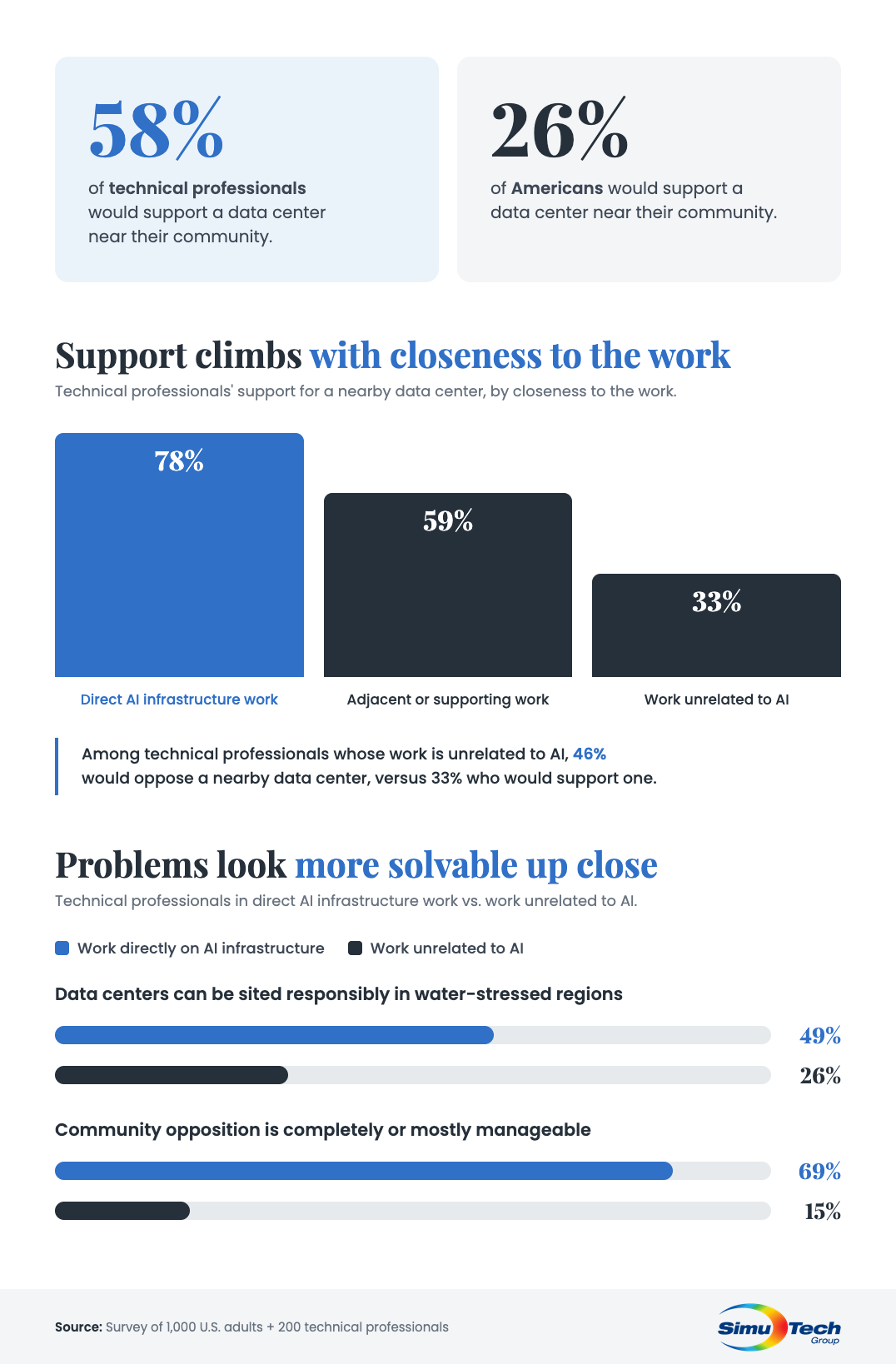
Technical professionals are more than twice as likely as the public to support a data center near their community (58% vs. 26%). That average hides a steep gradient. Among technical professionals who work directly on data centers or AI infrastructure, 78% would support a nearby project and 9% would oppose one. Support falls to 59% among those who work on adjacent or supporting systems. Among technical professionals whose work is unrelated to data centers or AI, it drops to 33%, and opposition (46%) outpaces it.
Technical professionals also judge the problems as more solvable the closer they sit to them. Of those working directly on this infrastructure, 49% say data centers can be sited responsibly in water-stressed regions with advanced cooling and water recycling, and 69% call community opposition completely or mostly manageable. Among colleagues in unrelated technical work, those figures fall to 26% and 15%.
On one question, technical professionals answer alike whatever their distance from the work. Between 77% and 80% at each level of involvement agree that AI infrastructure is driven more by corporate profit than by public benefit. The people closest to data centers see the profit motive as plainly as anyone. They also see problems they believe they can solve.
Most Americans will never work inside a data center, but millions use what these buildings produce every day. Regular use of AI tools works as a kind of proximity of its own.
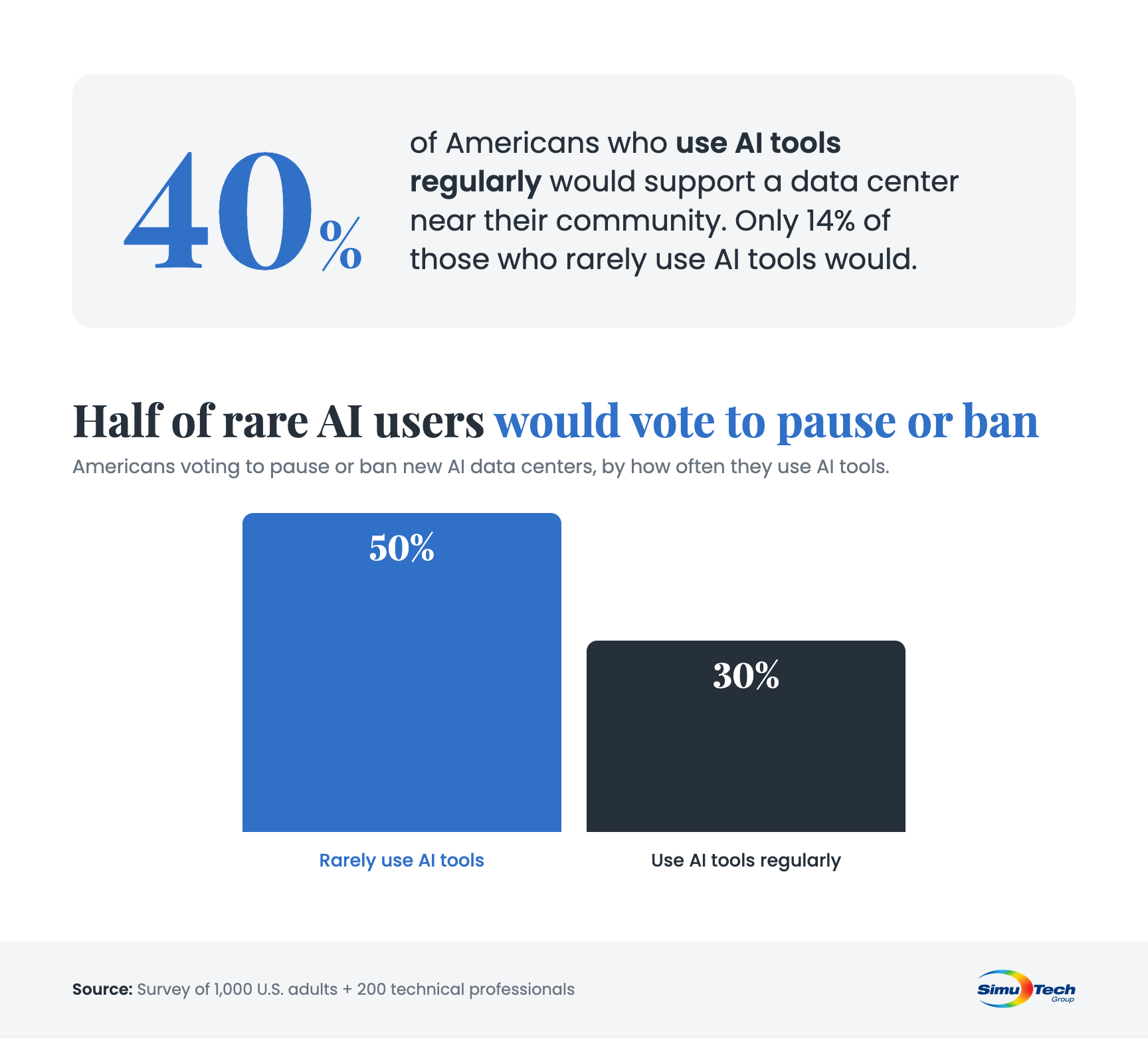
Americans who use AI tools regularly are nearly three times as likely as rare users to support a data center near their community (40% vs. 14%). On the ballot, the pattern flips. Half of rare users (50%) would vote to pause or ban new construction, compared with 30% of regular users.
Knowing What a Data Center Does Doesn’t Win Support
If distance explains the divide, the industry’s favorite remedy should work. Explain the technology clearly, the reasoning goes, and resistance softens. We asked Americans to pick the description that best matches what AI data centers primarily do, then compared their answers with how they said they would vote.
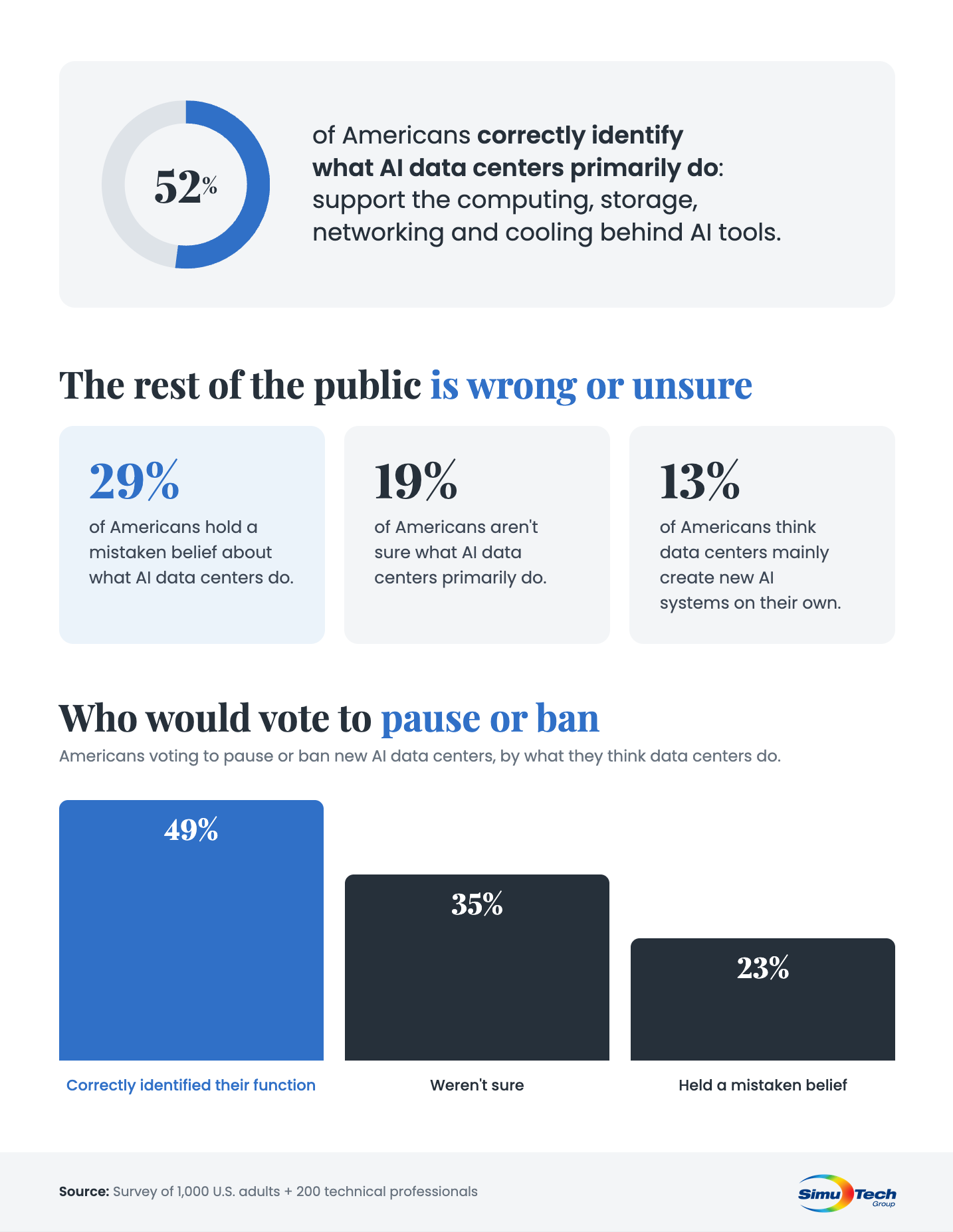
Just over half of Americans (52%) correctly identify what AI data centers primarily do, which is support the computing, storage, networking and cooling behind AI tools and services. Another 19% aren’t sure, and 29% hold a mistaken belief, including 13% who think data centers mainly create new AI systems on their own.
Americans who know the right answer aren’t any friendlier at the ballot box. Those who correctly identified a data center’s function would vote to pause or ban new construction at a rate of 49%, more than double the 23% among Americans holding a mistaken belief. Respondents who weren’t sure landed in between, at 35%.
Many of the Americans opposing data centers know exactly what the buildings do and have decided they don’t want one nearby. Developers counting on better explainers to change that will be disappointed.
The Least-Trusted Voices Are Doing the Talking
When an AI data center proposal reaches a community, the case for it usually comes from the developer, and the decision comes from local officials. Americans hear the least from the people they would most like to hear from. We asked both groups how much they trust each of several voices when the subject is AI infrastructure and data centers.
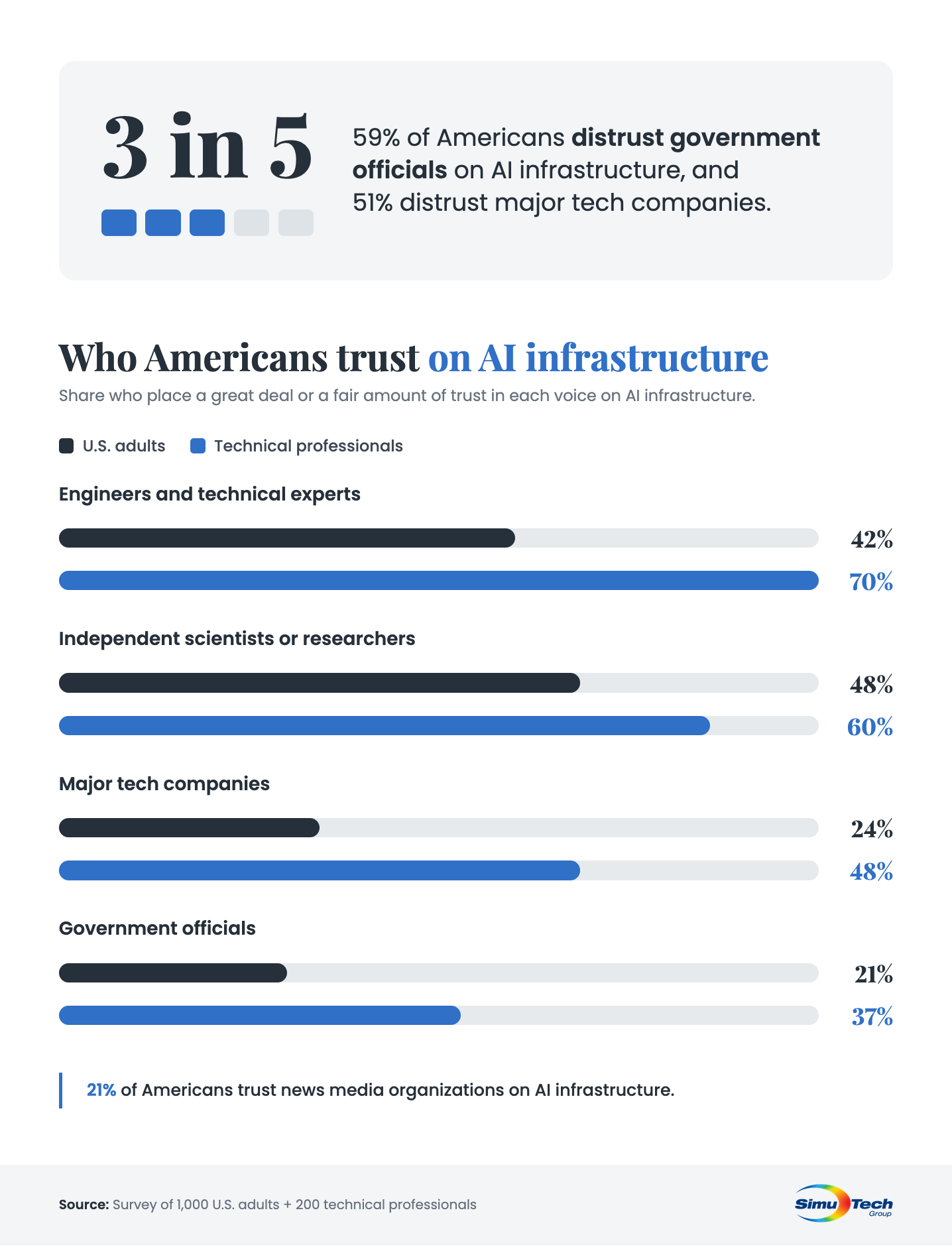
Americans reserve their trust for the people furthest from the sales pitch. Independent scientists or researchers earn a great deal or a fair amount of trust from 48% of the public, and engineers and technical experts earn it from 42%. Major tech companies (24%), government officials (21%) and news media organizations (21%) trail far behind. Americans also distrust the officials and companies most involved in approvals, with 59% placing very little or no trust in government officials and 51% saying the same of major tech companies.
Technical professionals put the same two groups at the top. Engineers and technical experts earn trust from 70% of them, and independent scientists earn it from 60%. Major tech companies are trusted by 48%, and government officials fare worst at 37%.
Both groups trust the same voices. Those voices rarely lead the public conversation about what gets built.
The Public’s Terms Read Like a Project Brief
Opposition this broad could look like a dead end for the industry. Americans’ answers point somewhere more useful, a specific list of conditions a developer could actually meet.
We asked Americans how a range of developer commitments would affect their support for a data center proposed near their community.
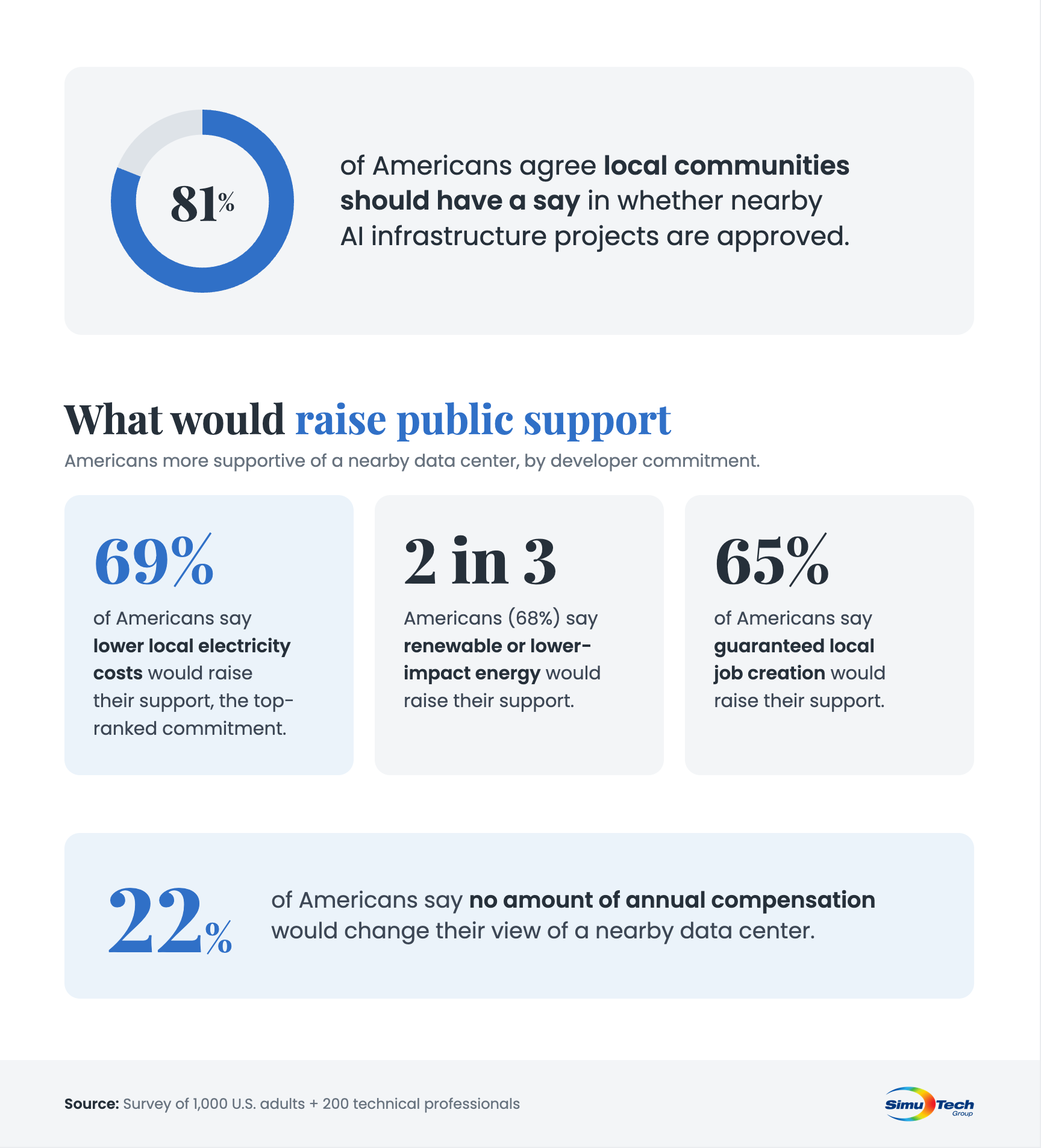
Americans rank lower local electricity costs first, with 69% saying that commitment would make them much or somewhat more supportive of a nearby project. Clear public reporting on energy, water use, cooling systems and environmental impact (68%) and the use of renewable or lower-impact energy (68%) follow closely. Investment in local roads, schools or infrastructure (67%) and guaranteed local job creation (65%) come next.
Americans also want a say in the outcome. Most (81%) agree local communities should have a say in whether nearby AI infrastructure projects are approved. Their terms have limits. When asked what annual compensation would make them more comfortable with a nearby data center, 22% said no amount would change their opinion, and only 3% said they would support one without any compensation.
Cost is the demand with the sharpest edge. If data centers push local electricity rates up, someone has to cover the difference, so we asked both groups who that should be.
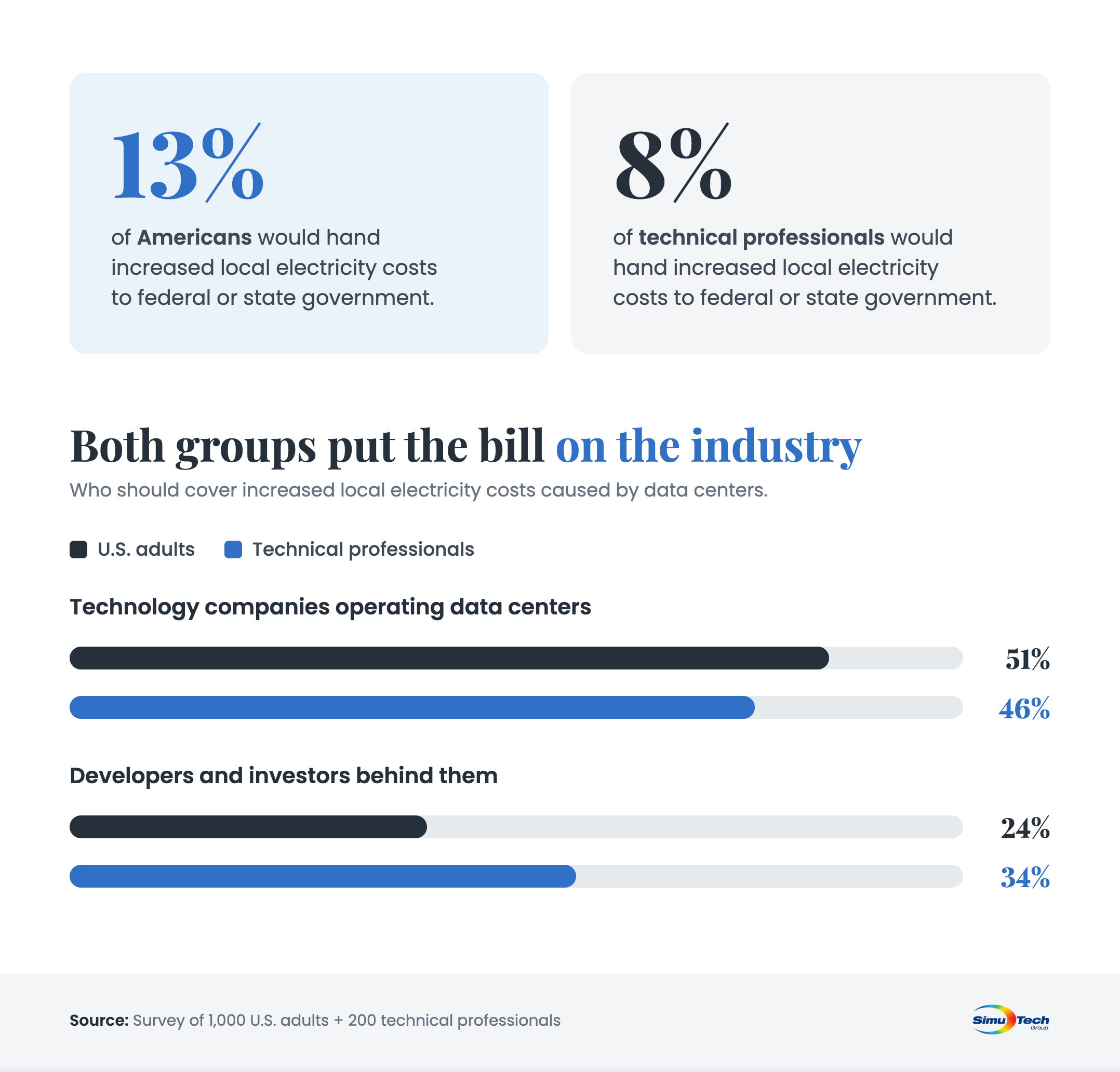
Americans and technical professionals agree the bill belongs to the industry. Half of Americans (51%) say the technology companies operating data centers should cover increased local electricity costs, and another 24% name the developers and investors behind them. Technical professionals divide that responsibility differently, with 46% naming operators and 34% naming developers and investors, but they land in the same place. Just 13% of Americans and 8% of technical professionals would hand the bill to federal or state government.
Where the Data Center Debate Goes From Here
The divide over data centers runs on distance. People who work inside the problem see engineering questions with engineering answers. People far from it see a building arriving uninvited, and understanding what happens inside that building hasn’t made them any more willing to host one.
We think developers will get further by showing their work than by explaining it. The water and power modeling behind a site proposal, the kind of cooling and thermal analysis engineers already run during design, can be published and opened to scrutiny before a vote instead of summarized in a press release after one. The engineers and scientists Americans trust can stand in front of the community in place of the spokespeople they don’t.
The buildout isn’t slowing, and the communities in its path have stated their terms plainly. Developers who meet those terms and bring the people doing the technical work into the room have the best chance of building with a community’s consent instead of over its objections.
Build a More Efficient, Reliable Data Center with Engineering Simulation
AI data center design requires balancing performance, energy efficiency, cooling demands, and infrastructure reliability. SimuTech Group helps engineering teams evaluate thermal performance, optimize cooling strategies, and identify potential challenges using Ansys CFD, thermal simulation, and multiphysics analysis. Our experts can help you make informed design decisions and develop more efficient, resilient infrastructure.
Contact us today to discuss how simulation can support your next data center project.
Full Results
Here are the complete results for every question we asked both groups, shown with the exact survey wording. Combined figures cited in the article are calculated before rounding.
Methodology
SimuTech Group commissioned two parallel surveys of 1,000 U.S. adults and 200 technical professionals to examine the gap between public sentiment and technical perspectives on AI data center infrastructure. The general population survey reached a representative sample of U.S. adults, with results analyzed across generations (Gen Z, millennials, Gen X, baby boomers) and gender. The technical professionals survey reached respondents working in engineering and technical fields, including information technology, manufacturing and industrial operations, infrastructure, and data center operations. Demographic segmentation was not conducted for this audience due to sample size, though results were compared by how directly respondents’ work involves AI infrastructure: 81 work directly on data centers or AI infrastructure, 59 work on adjacent or supporting systems, and 46 do technical work unrelated to data centers or AI. Because these subgroups each fall below 100 respondents, their results should be read as directional. Both surveys covered familiarity and understanding of data centers, support for or opposition to local projects, institutional trust, environmental and economic concerns, and views on what would build public confidence. Percentages reflect self-reported, unweighted data and may sum to more than 100% when multiple selections were allowed.
About SimuTech
SimuTech is the largest Ansys Channel Partner in North America, serving more than 4,000 clients with engineering simulation software, technical support, training, consulting and physical testing. Its engineers use simulation to work through the structural, thermal and fluid-dynamics problems at the heart of building data centers responsibly, the same challenges this research examines. With more than 40 years of engineering experience, SimuTech helps teams bring better-designed, more efficient products to market faster.
Fair Use Statement
The findings and data on this page may be shared freely for noncommercial purposes. If you reference this research, please attribute it to SimuTech Group and include a link back to this page so readers can access the original study in full.