
 Contact Us
A SimuTech Group survey of 1,000 recent flyers finds travelers will accept AI and automation in aviation once it proves itself, as long as a human pilot can still take the controls.
Aircraft manufacturers and researchers have explored reduced-crew flight operations, including concepts that would allow one pilot to rest during cruise while another remains at the controls. European regulators tested that idea, and in June 2025 the researchers they commissioned concluded that reduced-crew cruise operations cannot currently be shown to match the safety of a two-pilot flight deck. In the U.S., regulators are moving faster closer to the ground. The Federal Aviation Administration has proposed rules that would make beyond-visual-line-of-sight drone flights, including package delivery, a routine part of American airspace, and the proposal drew more than 1 million public comments.
To better understand how travelers feel about sharing the sky and the cockpit with AI, SimuTech Group surveyed 1,000 U.S. adults who had flown on a commercial airline within the past five years. Respondents weighed in on cockpit automation, in-flight emergencies, what they would pay to keep two pilots aboard and drones over their own neighborhoods. Their answers draw a consistent line between the jobs Americans will hand to a machine and the ones they won’t.
Aviation Automation Survey Key Takeaways
- Americans want a backup, with 73% saying a human pilot able to take control would make them more willing to fly on a heavily automated plane. Proof also beats perks, as a multi-year safety record (59%) sways travelers more than a significantly cheaper ticket (49%).
- Travelers are comfortable with automation (61%) when it assists two human pilots, and their comfort falls with every pilot removed, to 41% with one pilot, 38% with a pilot monitoring from the ground and 33% with no pilot at all. Among those surveyed, 44% are very uncomfortable with a fully autonomous passenger plane.
- In severe turbulence, 79% of Americans would trust a human pilot more than AI to respond safely, and 76% would in an emergency landing. Fewer than 1 in 10 would trust AI more in any scenario tested, and 68% are extremely or very worried that AI could make the wrong decision during an emergency.
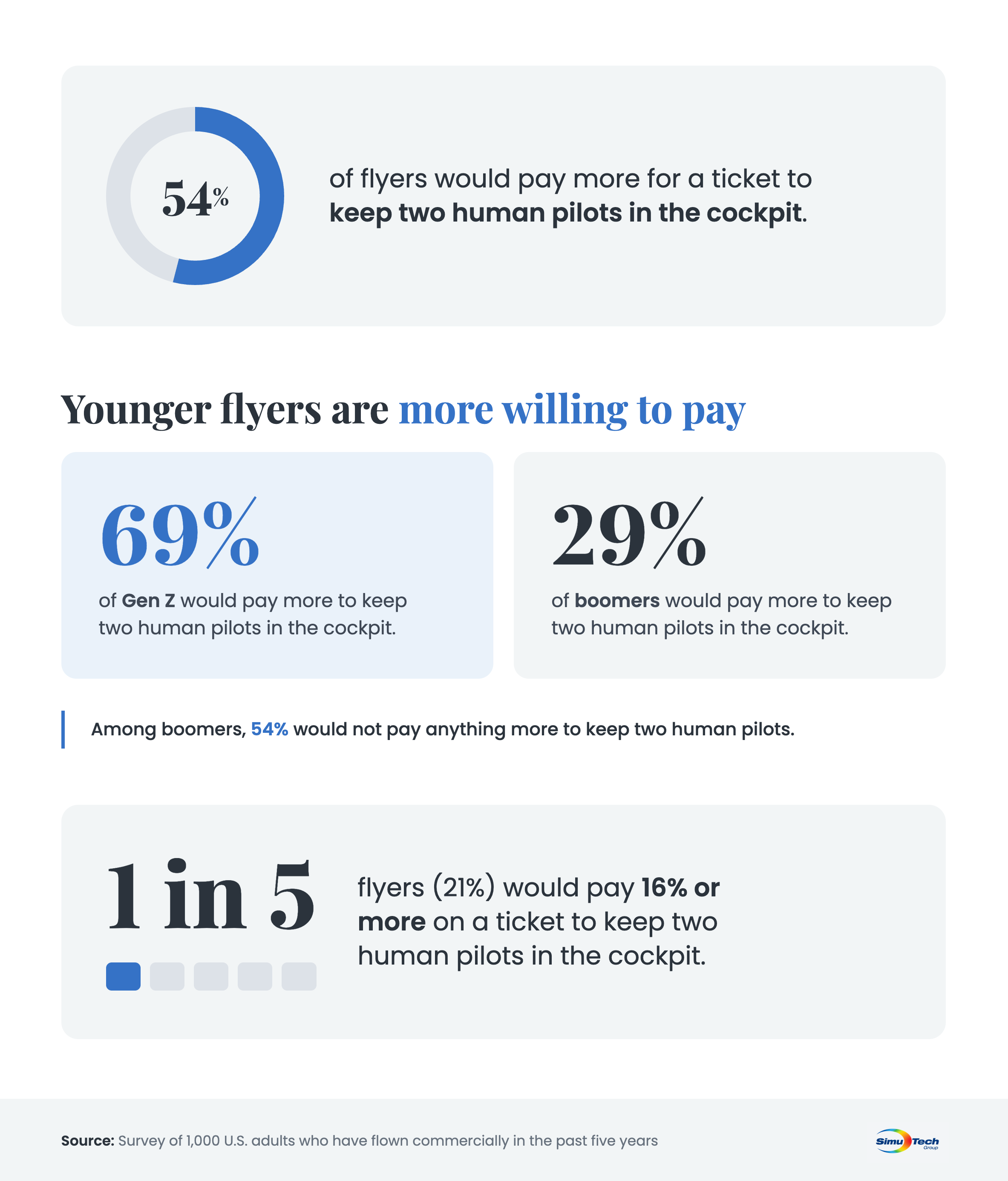
- Travelers would pay to keep two pilots in the cockpit, with 54% willing to spend more on a ticket and 1 in 5 (21%) willing to pay 16% or more. The generation most opposed to pilotless planes is the least willing to pay, as 29% of boomers would pay extra, compared to 69% of Gen Z.
- More Americans say their trust in U.S. commercial aviation has grown (36%) than declined (22%) over the past two years. The catch is cost, with 51% saying the overall cost of flying has gotten worse and 52% saying the same about fees for bags and seats.
- Drone delivery wins support from 67% of Americans, but only 3% want it without limits, and 65% would still rather have a human deliver urgent medication.
What It Would Take to Get Americans on an Automated Plane
Ask travelers what would get them onto an airliner that largely flies itself, and their answers fall into a clear order. Perks sit near the bottom. People want evidence first, and above all they want someone on the flight deck who can take over if the software falters. They care how engineers gather that evidence, too.
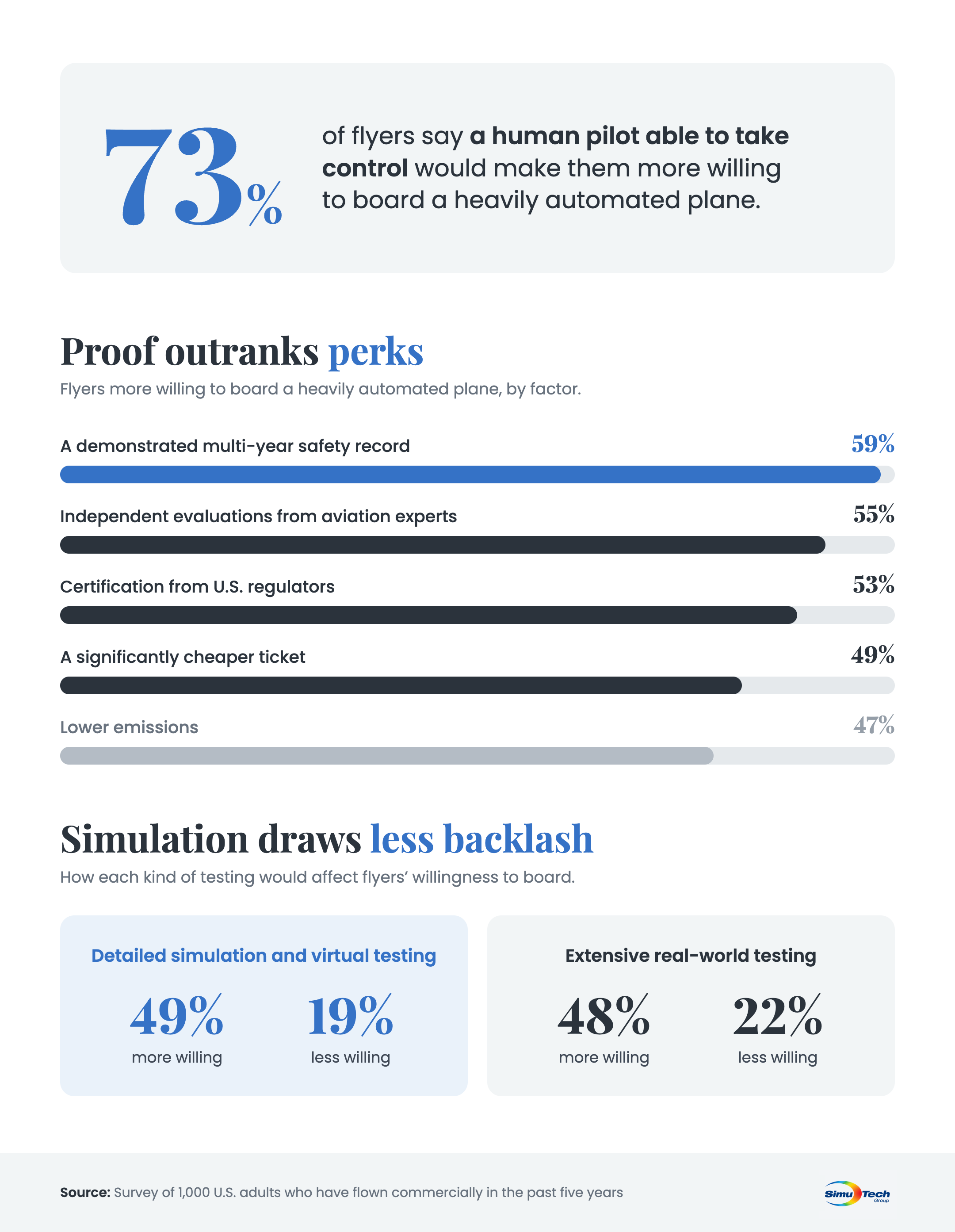
Travelers rank a human pilot able to take control first, with 73% saying it would make them more willing to fly on a heavily automated plane, 14 points ahead of anything else on the list. Survey respondents put proof in the next tier, led by a demonstrated multi-year safety record (59%), followed by independent evaluations from aviation experts (55%), evidence the technology outperforms human pilots (55%), clear information from the airline about how the aviation automation technology works and was tested (54%) and certification from U.S. regulators (53%). Travelers rank convenience next, with a faster flight at 52% and a lower risk of delays or cancellations at 49%. They put perks last, as a significantly cheaper ticket (49%) and lower emissions (47%) barely move them, likely because passengers think about price only after they trust the aircraft.
Testing produces the one real twist. Travelers respond almost identically to both kinds of testing on the positive side: 49% say detailed simulation and virtual testing would make them more willing to fly, and 48% say the same about extensive real-world testing. They split on the downside, as 22% say real-world testing would make them less willing, the strongest backlash of any factor tested, compared to 19% for simulation. Many respondents may hear “real-world testing” as testing with passengers aboard, and they would rather engineers prove a system virtually before it carries anyone. Boomers push back hardest, with 35% saying real-world testing makes them less willing, compared to 26% of Gen X, 17% of Gen Z and 12% of millennials, while 58% of millennials and 53% of Gen Z say simulation would make them more willing, compared to 34% of boomers.
Men and women value the human backup at close to the same rate (75% vs. 72%), but every other proof point persuades fewer women. Certification from U.S. regulators, for example, moves 61% of men and 45% of women. That 16-point gap suggests many women want more than an official stamp before they will trust an automated cockpit.
Trust in Automation Drops With Every Pilot Removed
Most Americans have made peace with software on airplanes. They accept systems that work in the background, flagging maintenance needs and catching mechanical trouble before it grows. Their unease starts in the cockpit itself. Every seat at the controls that goes empty makes it worse.
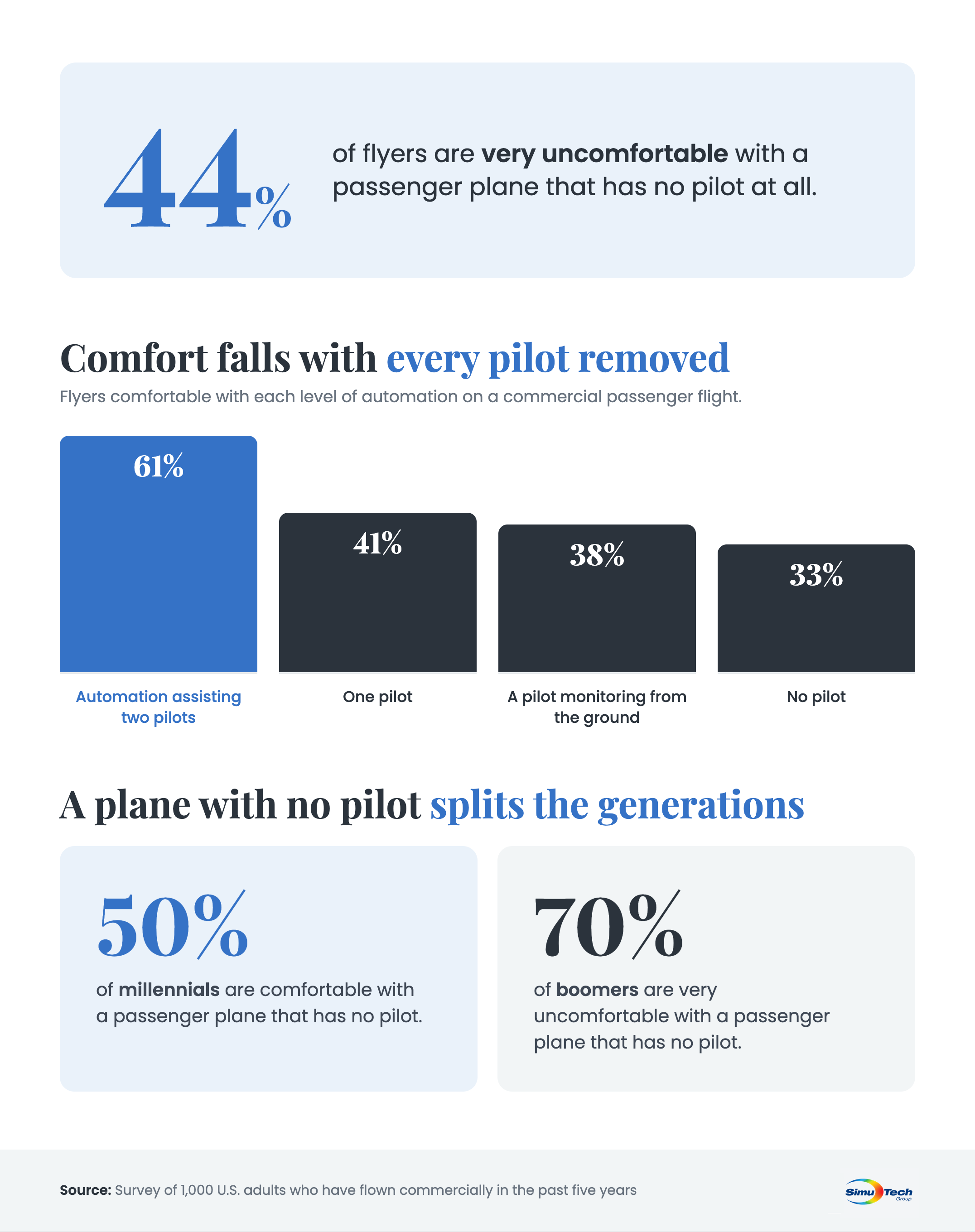
Travelers are comfortable with aviation automation systems that work behind the scenes: 54% of survey respondents are comfortable with systems monitoring aircraft maintenance needs and 54% with systems predicting mechanical problems before they occur. They are most comfortable (61%) when automated systems assist two human pilots who remain responsible for the aircraft. Take away one pilot that share falls 20 points to 41%. Respondents find little reassurance in a pilot monitoring from the ground (38%), and just 33% are comfortable with a plane that has no pilot at all, while 44% are very uncomfortable with it, by far the largest “very uncomfortable” share of any automation level tested.
Travelers also notice who is doing the flying. With two pilots still in the cockpit, 43% are comfortable with AI handling many flight tasks, well below the 61% comfortable with automation that assists those same pilots, and 31% are uncomfortable. Women make the distinction most sharply. More women are uncomfortable (39%) than comfortable (35%) with AI handling many flight tasks under two pilots, while men lean the other way (52% vs 23%).
Once pilots start leaving, the generations split apart. A single-pilot cockpit is comfortable for 55% of millennials and 45% of Gen Z, compared to 33% of Gen X and 23% of boomers. With no pilot at all, 50% of millennials and 42% of Gen Z remain comfortable, versus 20% of Gen X and 12% of boomers, and 70% of boomers are very uncomfortable with the idea. Boomers have flown their entire lives with two pilots up front, and many may consider that crew part of what makes flying safe. Men and women diverge almost as sharply: 50% of men are comfortable with a single pilot compared to 32% of women, and 53% of women are very uncomfortable with a fully autonomous plane compared to 34% of men.
Aviation Automation Survey: Americans Want a Human at the Controls
Routine cruise is one thing. Severe turbulence or a failing engine is another, and those are the moments travelers picture when they imagine software at the controls. In a crisis, people want judgment they recognize. They also want it from someone who has every capacity to land the plane safely, because that person is on board too.
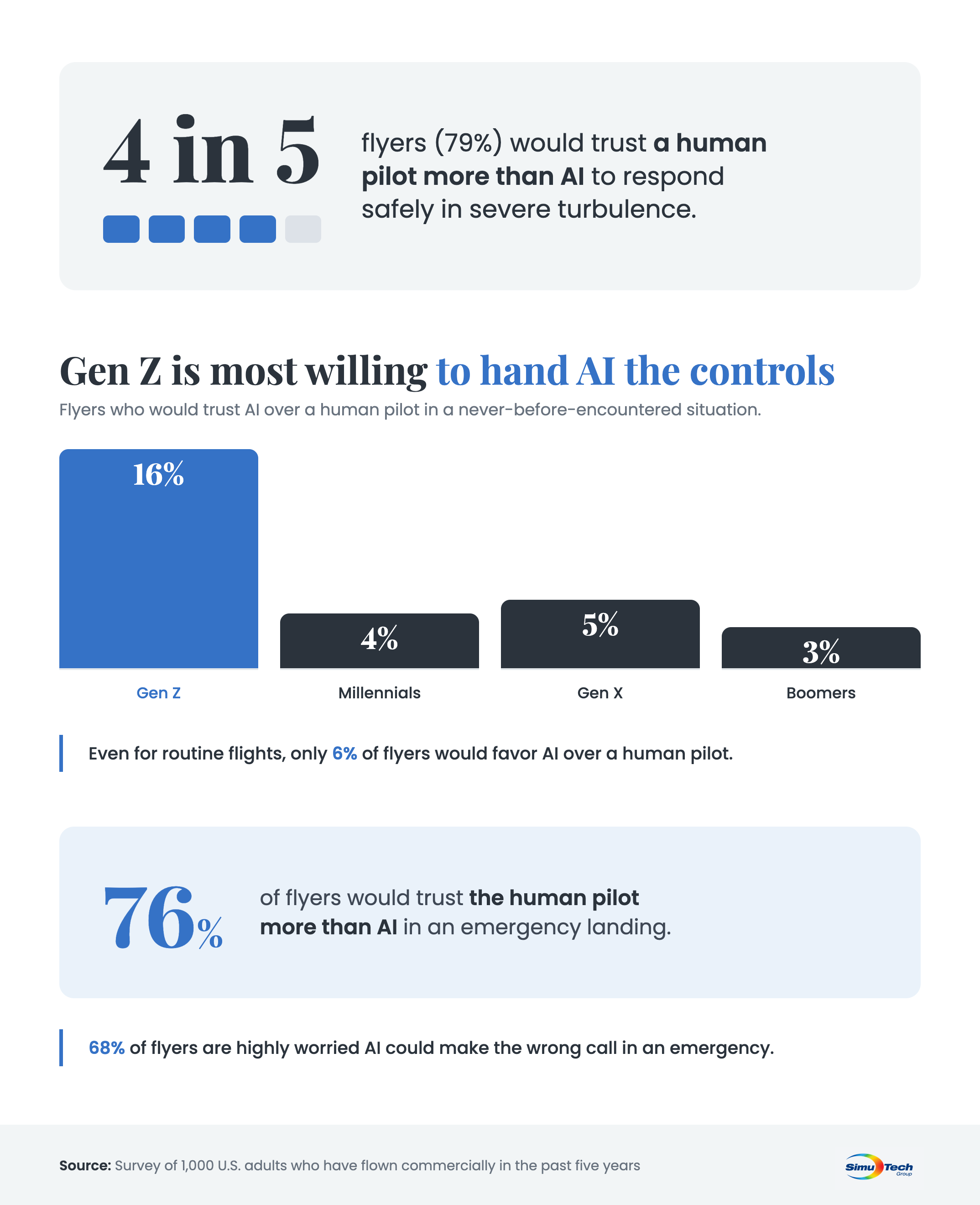
Respondents sided with the human pilot in every scenario tested. They trust the human most during severe turbulence (79%) and an emergency landing (76%), followed by extreme weather (74%), a situation the automated systems had never encountered (73%), and an engine failure (72%). Fewer than 1 in 10 would trust AI more in any of them, and even for routine flight under normal conditions, only 6% would favor the machine, while 19% would trust a human and AI equally. Men and women agree on the emergency landing, with 76% of each trusting the human pilot more, despite their sharp split on automation elsewhere.
Gen Z gives the most surprising answer. Facing a situation the aircraft’s automated systems had never encountered, 16% of Gen Z would trust AI more than a human, compared to 4% of millennials and 3% of boomers. By definition, that scenario falls outside anything the system was built or tested to handle. Gen Z’s confidence may reflect a generation raised to expect software that adapts on the fly.
The worries line up with the same high-stakes moment. Travelers rank AI making the wrong call in an emergency as their top concern (68%), and they place too little human oversight of critical decisions and AI behaving unpredictably in unfamiliar situations in a tie for second (66% each). Older travelers focus on oversight, with 74% of boomers and 71% of Gen X worried, compared to 63% of Gen Z and 59% of millennials. Generations split differently on cyber threats: Gen Z worries most about hacking (66%), and Gen X leads on GPS jamming (69%), while 61% of all respondents worry about each. Women are more worried than men about every risk tested, led by AI making the wrong decision (73% vs. 63%) and too little human oversight (73% vs. 60%).
Increasing Trust and Increasing Prices
After several years of unsettling aviation headlines, you might expect travelers to be losing faith in flying. Our aviation automation survey, completed by the people who actually fly, tell a different story. Their frustration lands somewhere else, on the price of a ticket and everything added to it.
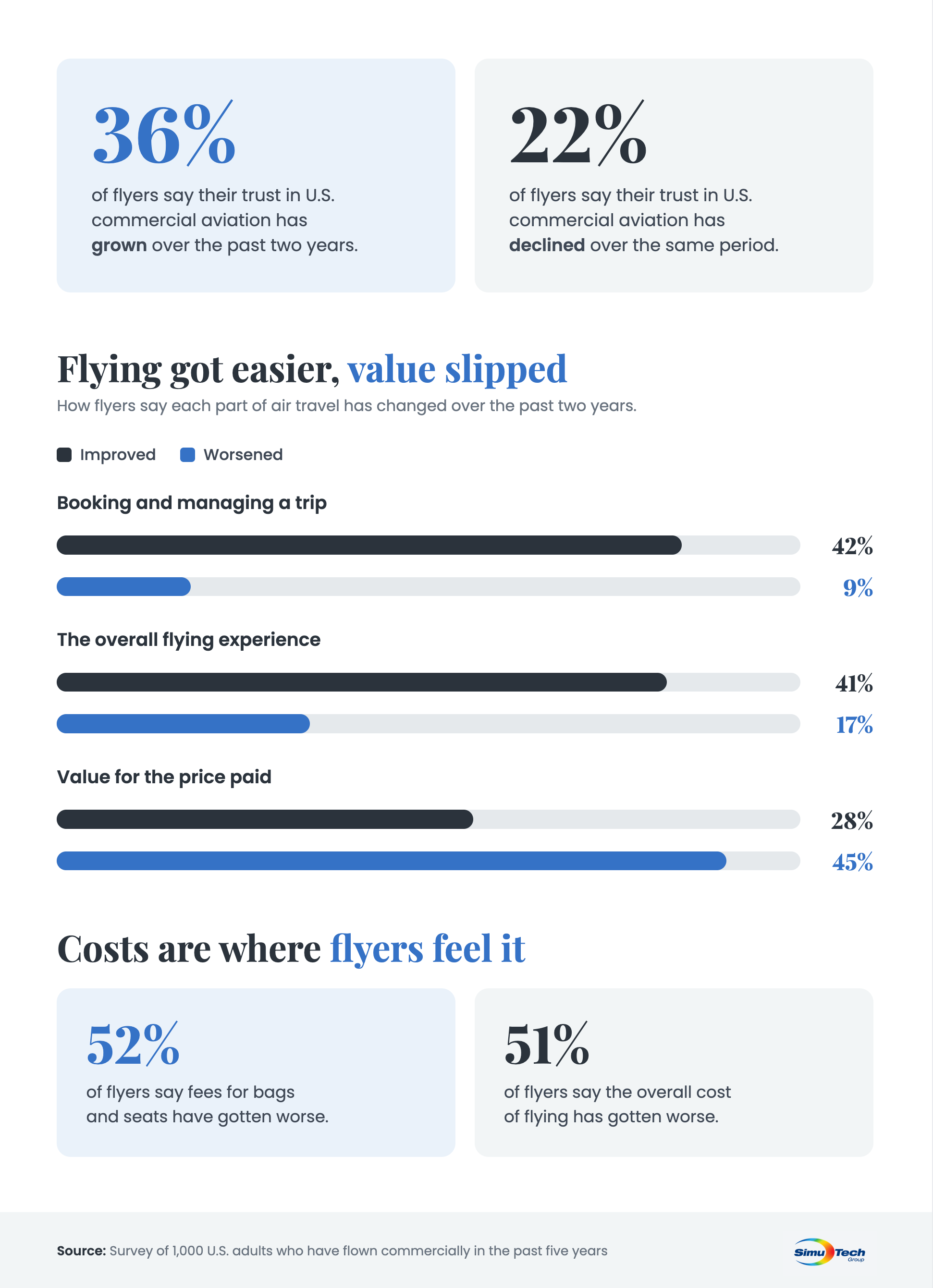
More travelers say their trust in U.S. commercial aviation has increased over the past two years (36%) than decreased (22%), and 41% say it has stayed about the same. Younger travelers drive the gain, with 54% of Gen Z and 45% of millennials reporting more trust, compared to 21% of Gen X and 16% of boomers. Gen X and boomers are the only generations where more say trust has declined than grown (24% vs 21% for Gen X, 31% vs. 16% for boomers), perhaps because older travelers have decades of flying to measure recent disruptions against. Men report the bigger lift (44% increased, compared to 28% of women), while women split evenly at 28% each way.
Respondents also rate the flying experience itself more positively, with 41% saying it has improved and 17% saying it has worsened. They name booking and managing a trip as the clearest bright spot (42% improved, 9% worsened), likely thanks to airline apps that let passengers rebook and check in from a phone. Wallets tell a harsher story. The overall cost of flying has gotten worse for 51% of travelers, and fees for bags and seats have worsened for 52%. On value for the price paid, 45% say it has slipped and 28% say it has improved.
Boomers feel the squeeze hardest, as 73% say the cost of flying has worsened, along with 61% of Gen X, compared to 42% of millennials and 36% of Gen Z. Gen Z stands alone as the only generation where more say cost has improved (43%) than worsened. Women feel the pinch more than men on overall cost (56% vs. 46%) and on fees (58% vs. 47%). Airlines have built real goodwill with younger flyers, and how they introduce AI into the cockpit will decide whether they keep it.
Americans Welcome Automation Where the Stakes Are Low
Look past the cockpit and the same instinct shows up wherever automation is headed, from the cabin to the drone over the backyard. According to the aviation automation survey, Americans are open to machines handling routine work. They draw the line at anything urgent or fragile. When the stakes rise, they want a person accountable for the outcome.
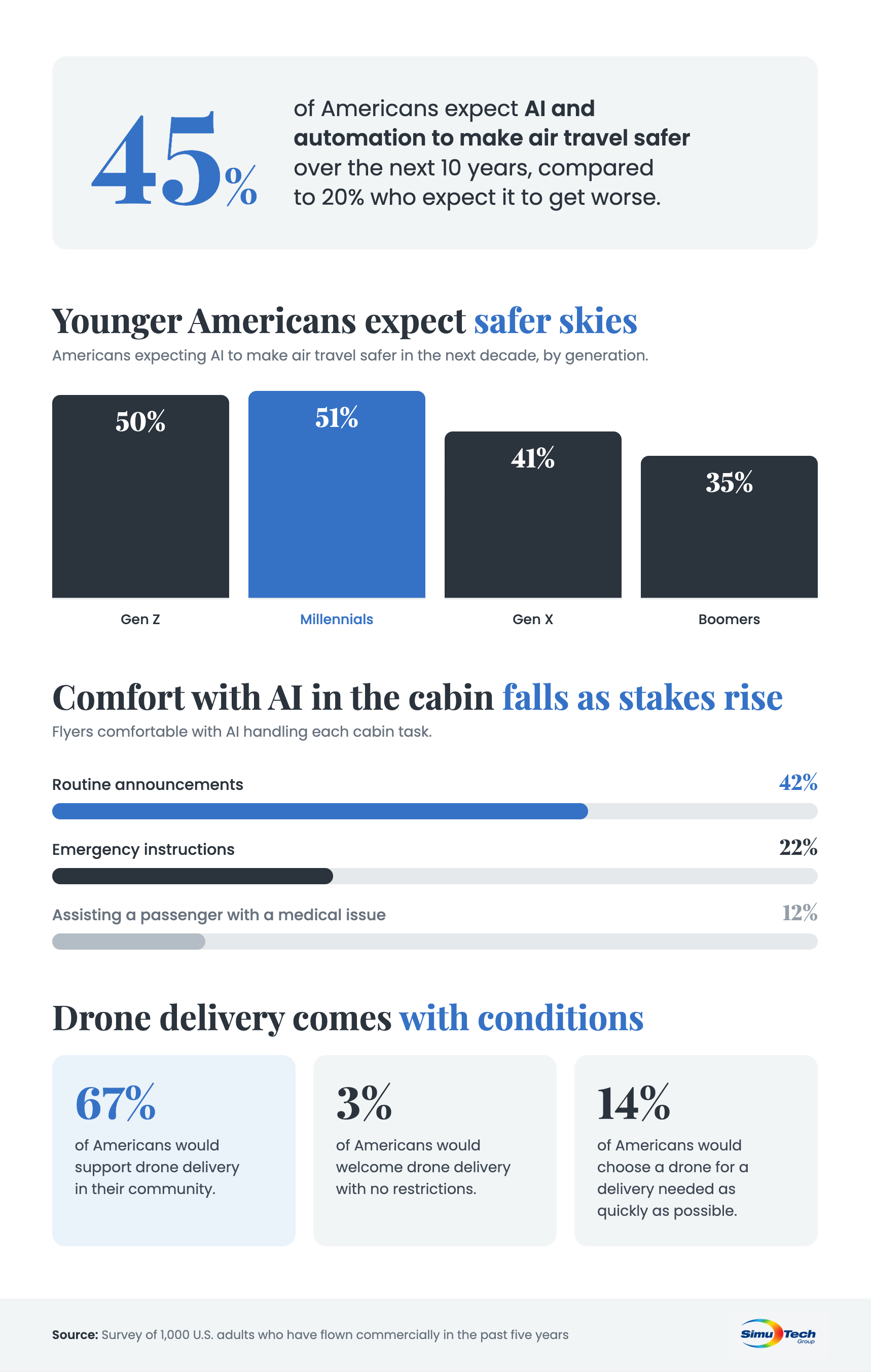
Americans are cautiously optimistic about the decade ahead. Among those surveyed, 45% expect AI and automation to make air travel safer over the next 10 years, compared to 20% who expect it to get worse, and 40% expect fewer delays and cancellations, with the same share expecting better aircraft maintenance and reliability. Half of millennials (51%) and Gen Z (50%) expect safer flying, compared to 41% of Gen X and 35% of boomers. Customer service is the lone exception, the only area where more respondents expect decline (34%) than improvement (30%). Travelers seem to suspect automation will handle machines better than it handles people.
Inside the cabin, comfort tracks the stakes. AI making routine announcements suits 42% of travelers. Emergency instructions are another matter (22%), and AI assisting a passenger with a medical issue ranks last among the cabin tasks tested, at 12%. Boomers supply the twist. They are the most comfortable generation with AI announcements (55%), nearly double Gen Z (29%), possibly because recorded announcements already feel like a normal part of flying.
Drone delivery follows the same rule. Among those surveyed, 67% would support it in their community, but only 3% would welcome it with no restrictions. Most supporters attach conditions: 39% want limits on where and when drones fly, and 25% reserve them for urgent or essential deliveries. When it comes to what lands on the porch, people still prefer a human for fragile items (69%), high-value purchases (68%), urgent medication (65%) and restaurant meals (64%). Even for a delivery needed as quickly as possible, only 14% would choose a drone, and boomers hold the line hardest, with 80% preferring a human for high-value purchases, compared to 66% of Gen Z.
Survey Says: Aviation Automation Has to Earn Its Seat in the Cockpit
The aviation automation survey results are clear: Americans have drawn a clear line, and it runs through the cockpit door. They will welcome software that predicts a failing part or reads a routine announcement. When a flight turns dangerous, they want a person in charge, along with proof that the technology beside that person was tested hard before anyone boarded.
For aircraft makers and airlines, that sets the order of operations. Passengers will likely extend trust only after engineers produce evidence, gathered through rigorous validation of the software and control logic behind automated systems long before those systems carry anyone, and only if airlines share that evidence openly. The engineering teams that can show their work, from the first virtual test through certification, will hold the strongest hand when the conversation turns to fewer pilots.
The flying public already pictures the cockpit of the future as a partnership. The technology that earns its place there will be the kind that makes the two humans up front even better at their jobs.
Advance Aviation Safety and Reliability with Engineering Simulation
Developing automated flight systems requires rigorous evaluation of performance, reliability, and safety across a range of operating conditions. SimuTech Group helps aerospace engineering teams use Ansys simulation tools to evaluate structural and aerodynamic performance, investigate complex operating scenarios, and support design validation. Our experts provide simulation software, technical support, and consulting services to help teams make informed engineering decisions throughout development.
Contact us today to explore how engineering simulation can support your next aerospace or advanced air mobility project.
Methodology
SimuTech Group surveyed 1,000 U.S. adults via Pollfish who had flown on a commercial airline within the past five years, including 64% who had flown within the past 12 months, to understand how Americans feel about the growing role of AI and automation in commercial aviation. The survey examined trust in the U.S. commercial aviation system, changes in the flying experience, comfort with different levels of cockpit automation, trust in human pilots vs. AI across flight scenarios, top concerns about AI in aviation, willingness to pay for two human pilots, and attitudes toward emerging technologies such as AI-assisted cabin services, electric air taxis, and drone delivery. Results were analyzed across demographic segments including generation (Gen Z, Millennials, Gen X, Baby Boomers) and gender. Results are post-stratified where available. Percentages reflect self-reported data and may sum to more than 100% when multiple selections were allowed.
About SimuTech Group
SimuTech Group is North America’s largest Ansys partner, providing simulation software, engineering consulting, training and physical testing to more than 5,000 engineering teams in aerospace, energy, manufacturing and medical device development. Headquartered in Rochester, New York, SimuTech helps aerospace and advanced air mobility teams use high-fidelity simulation to validate flight-critical systems and shorten the road to certification.
Fair Use Statement
You are welcome to share the findings from this study for noncommercial purposes. If you do, please credit SimuTech Group and link back to this page so readers can view the full research.