 Contact Us
Introduction to Ansys Fluent Coal Combustion Simulation
Coal combustion remains a critical process across power generation, industrial heating, cement production, metallurgical operations, and waste-to-energy systems. Whether the goal is increasing thermal efficiency, reducing emissions, or evaluating alternative solid fuels, engineers need tools capable of accurately capturing the complex interaction between particle physics, chemical reactions, and heat transfer.
Ansys Fluent provides a comprehensive coal combustion workflow that combines the Coal Calculator, Species Transport, Radiation, and Discrete Phase Modeling (DPM) capabilities into a single simulation environment. By coupling gas-phase combustion with particle-level devolatilization and char oxidation, engineers can gain detailed insight into fuel performance before a system is ever built or modified.
In this article, we’ll walk through a representative set of pulverized coal combustion simulations and highlight the key modeling approaches, setup considerations, and post-processing tools available in Fluent.
Why Coal Combustion Is Challenging to Simulate
Unlike gaseous fuels, coal combustion is not a single-step chemical reaction. As coal particles enter a furnace, they undergo a series of physical and chemical transformations that occur over different timescales and depend heavily on local temperature, oxygen concentration, turbulence, and particle size. Typical coal combustion involves:
- Particle heating
- Moisture evaporation
- Devolatilization
- Gas-phase volatile combustion
- Char oxidation
- Ash formation and transport
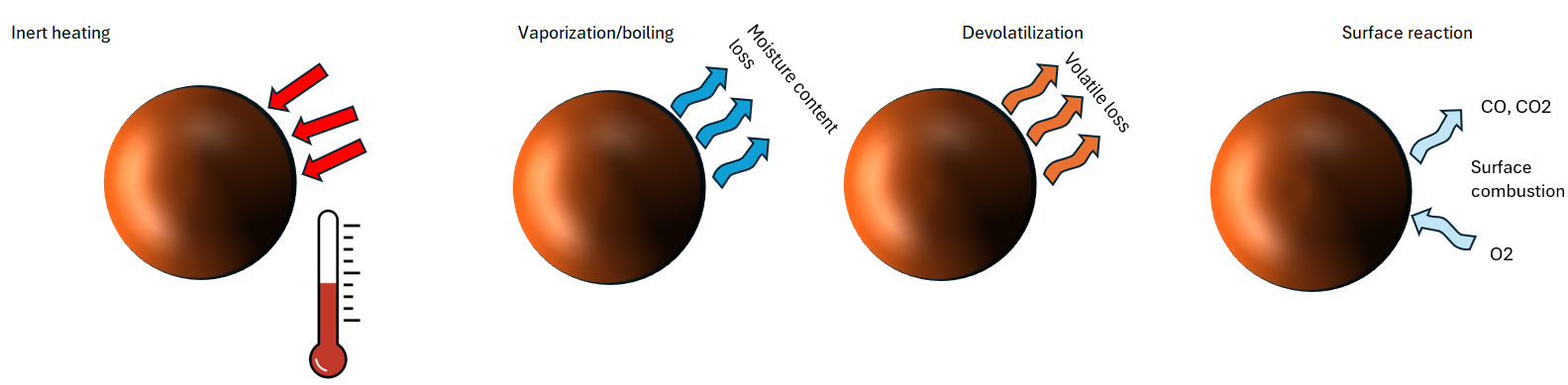
Because these phenomena can occur simultaneously and interact with one another, traditional hand calculations are often insufficient for understanding real-world furnace behavior. Computational fluid dynamics (CFD) provides a means of visualizing and quantifying these processes throughout the combustion chamber.
The Role of the Ansys Fluent Coal Calculator
One of the most powerful tools available in Fluent is the Coal Calculator, which simplifies the process of creating realistic coal combustion models. Instead of manually defining every reaction and species, engineers can characterize a fuel using information commonly available from laboratory testing. Note that the coal calculator can also be leveraged for other types of particles that involve carbon combustion and devolatilization, such as biocarbon.
Particle Characterization
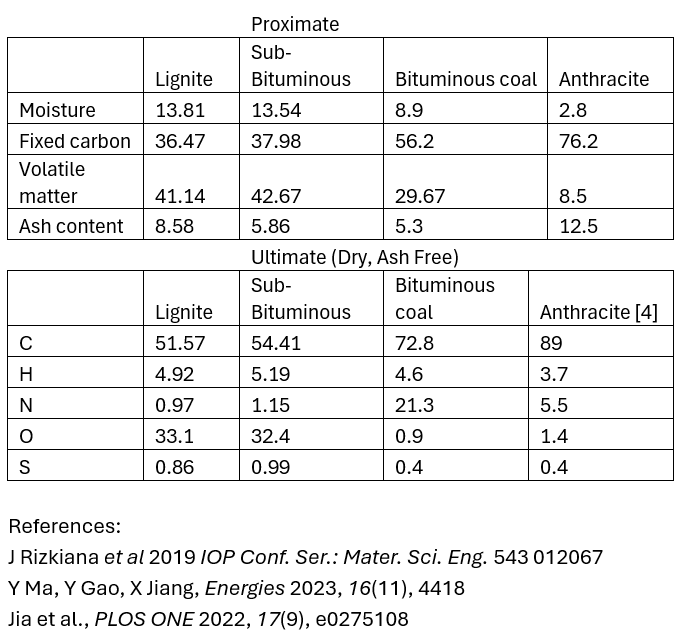
The proximate and ultimate analyses provide the fuel characterization data required to define each coal type in the combustion model. Proximate analysis describe how the fuel behaves during heating and combustion, and is defined by the following parameters:
- Moisture content
- Volatile matter
- Fixed carbon
- Ash content
Ultimate analysis defines the elemental composition used to generate the volatile species and reaction chemistry in Fluent. The main elements are usually the following:
- Carbon (C)
- Hydrogen (H)
- Oxygen (O)
- Nitrogen (N)
- Sulfur (S)
In the CFD-DPM models discussed here we will evaluate the burning performance of four types of coal particles, using the properties shown in the two tables below:
One parameter that is frequently overlooked is the High-Temperature Volatile Yield. Laboratory proximate analysis is typically performed at temperatures below actual combustion temperatures. As a result, measured volatile matter may underpredict what is released under true furnace conditions. The High-Temperature Volatile Yield parameter allows engineers to adjust volatile release to better reflect real operating environments. This capability can improve agreement between simulation predictions and experimental results while providing a more realistic representation of fuel behavior.
Using these inputs, Fluent automatically generates the equivalent volatile species and combustion reactions required by the simulation. This approach substantially reduces setup effort while helping maintain consistency with published fuel characterization data.
Building the Ansys Fluent Coal Combustion Model
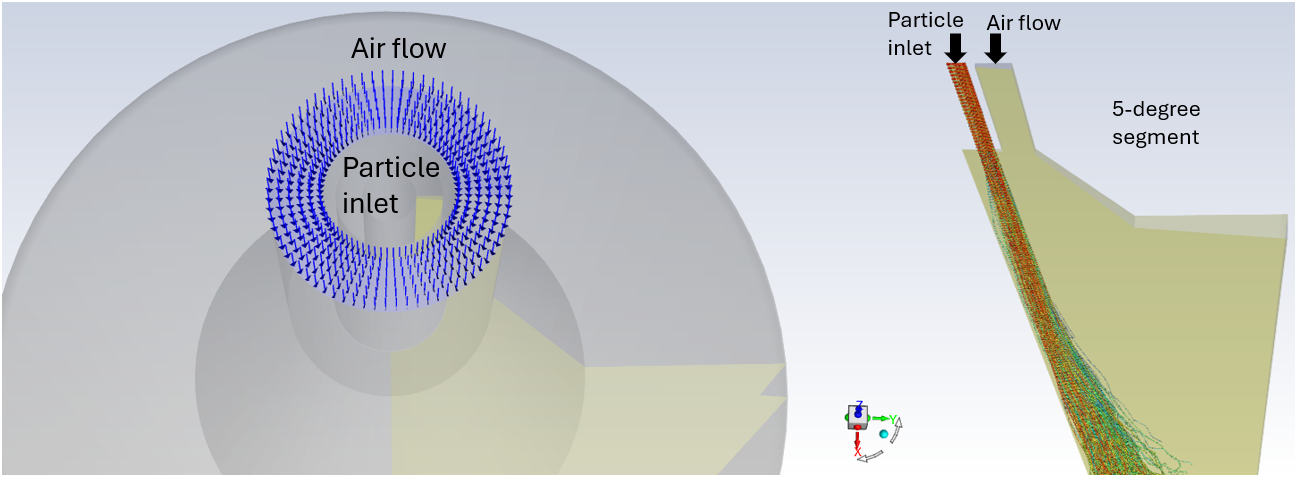
In this blog, we will consider a furnace where pulverized coal is injected from the top and transported downward by a carrier gas stream. Hot combustion air enters through surrounding annular passages, creating the conditions necessary for ignition and sustained combustion. To reduce computational requirements, only a 5-degree wedge of the full furnace geometry is modeled. Because the system is rotationally symmetric, this approach preserves the important flow and combustion physics while significantly reducing solution time.
Turbulence Modeling
Combustion systems are highly turbulent, making turbulence modeling essential. For this example, the standard k-ε turbulence model with standard wall functions provides a robust and computationally efficient approach for predicting flow mixing within the furnace.
Radiation Modeling
Radiation is often the dominant heat-transfer mechanism in high-temperature combustion systems. The P1 radiation model enables Fluent to estimate radiative heat transfer throughout the furnace while maintaining reasonable computational cost.
Species Transport and Chemistry
Gas-phase chemistry is modeled using Fluent’s Species Transport framework. The simulation employs the Finite-Rate / Eddy-Dissipation approach, which evaluates both:
- Arrhenius chemical kinetics
- Turbulence-driven mixing limitations
The controlling reaction rate is determined by whichever mechanism is slower at a given location within the flow field. This allows the model to capture situations where chemistry limits combustion as well as situations where turbulent mixing becomes the controlling factor.
Representing Volatile Release and Combustion
A critical aspect of coal combustion is predicting how volatiles are released from the particle and how they subsequently react in the gas phase.Fluent supports multiple reaction mechanisms.
One-Step Mechanism
The volatile species combusts directly to final products such as:
- CO₂
- H₂O
- SO₂
Two-Step Mechanism
The combustion pathway is separated into:
- Volatiles → CO
- CO → CO₂
The two-step approach often provides greater insight into flame structure and intermediate species concentrations, particularly when carbon monoxide formation is of interest.
Modeling Coal Particles with DPM
Coal particles are introduced through Fluent’s Discrete Phase Model (DPM). Unlike gas-phase species, individual particles are tracked as they travel through the furnace, allowing engineers to monitor:
- Particle trajectories
- Temperature evolution
- Moisture loss
- Volatile release
- Surface combustion
- Burnout behavior
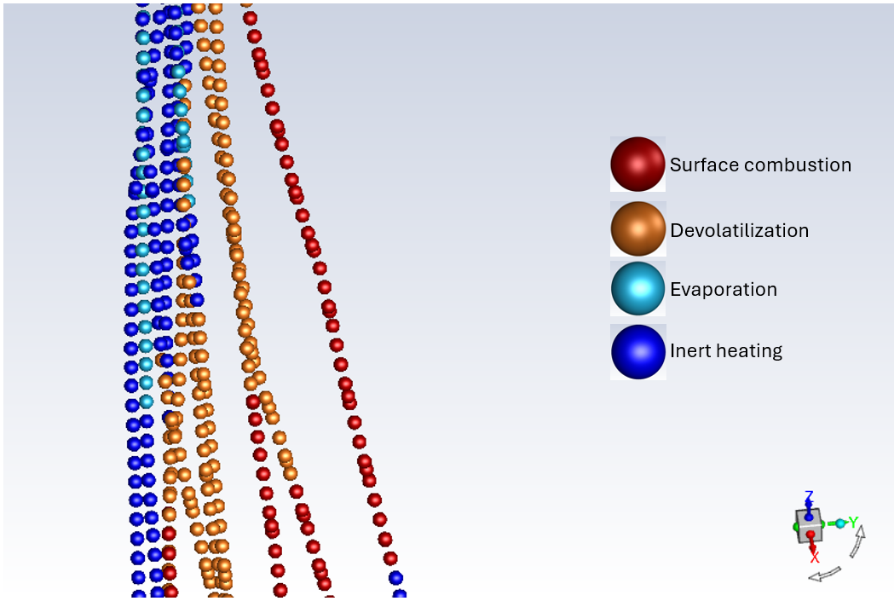
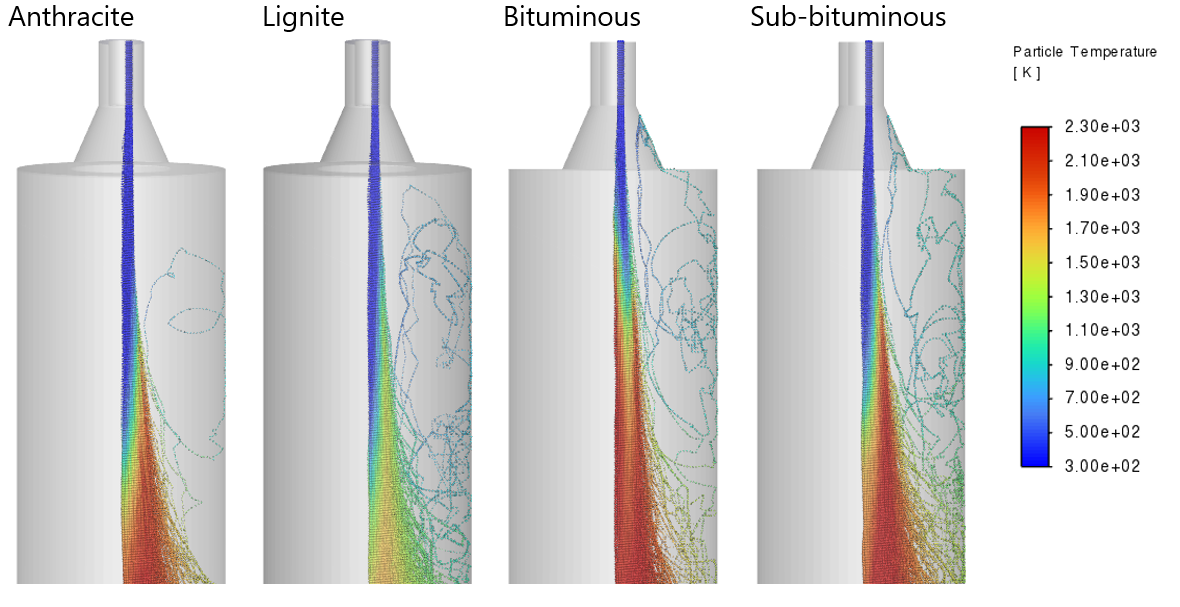
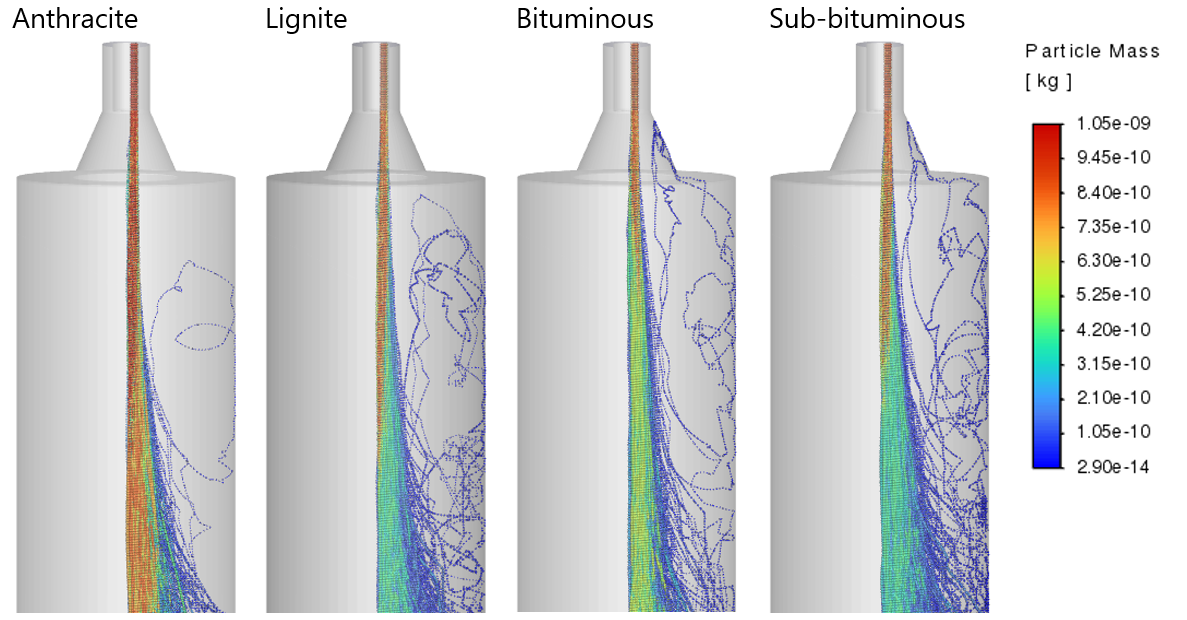
We can see in this example that as particle descend through the furnance, they undergo different stages, which is a function of their temperature and properties.
Particle Size Distribution
Real coal streams contain particles of varying sizes. The simulation uses a Rosin-Rammler distribution, which allows users to specify:
- Minimum diameter
- Maximum diameter
- Mean diameter
- Distribution spread
This approach produces a more realistic representation of industrial pulverized-fuel systems than assuming all particles have a single diameter.
Additional Particle Physics
Several additional DPM models can be incorporated, including:
- Particle rotation
- Turbulent dispersion
- Moisture evaporation
- Wet combustion effects
- Two-way phase coupling
- Particle-particle collision (DEM)
These features improve the accuracy of particle trajectory and combustion predictions.
Devolatilization and Char Oxidation
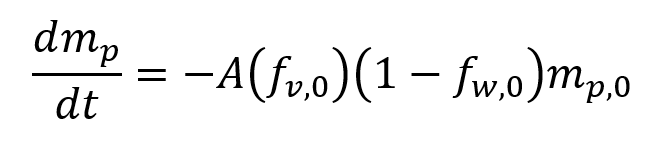
Once heated, coal particles begin releasing volatile compounds and transition toward char combustion. Devolatilization occurs once the particle temperature exceed both boiling point and vaporization temperature, and the mass of the particles is larger than the non-volatiles:

Where fv,0 and fw,0 correspond to the mass fraction of volatiles and evaporating material (if wet combustion is turned on).
Fluent provides several devolatilization options, including the following:
- Constant-rate models: this simple model uses a constant (A) to define the rate of devolatilization:
Single-rate kinetic models: this model assumes a first-order kinetic rate (k):

- Competing-rate kinetic models: more complex model that implements two Arhenious rates that control devolatilization over different temperatures ranges.
Similarly, multiple char combustion approaches are available depending on the desired level of detail. Engineers can choose the appropriate model based on available experimental data, expected operating conditions, and project objectives.
Simulating Real Furnace Operating Conditions
Accurate boundary conditions are essential for meaningful combustion predictions. In this example:
- Air Stream: The primary combustion air enters at elevated temperature of 500 K with approximately 21% oxygen. The airflow rate is intentionally larger than the particle feed rate to ensure sufficient oxidizer is available for combustion.
- Coal Stream: Coal is introduced with a carrier gas through a dedicated inlet. The carrier gas helps transport particles into the furnace and influences early-stage heating and devolatilization.
- Furnace Walls: Wall temperatures and emissivity values are specified to represent heat losses and radiative exchange with the surroundings. Proper wall treatment is often one of the most important factors in accurately predicting furnace temperature profiles.
Evaluating Simulation Convergence
Before analyzing results, engineers must verify that the solution has converged. Several monitoring strategies are used, including outlet temperature monitoring, internal temperature plane monitoring, mass balance verification, energy balance verification, and residual tracking. Stable monitor values provide confidence that the combustion process has reached a steady-state solution.
Visualizing Coal Combustion Behavior
One of the greatest advantages of using Ansys Fluent as our CFD tool for this coal combustion project is the ability to visualize processes that would otherwise be difficult or impossible to measure experimentally.
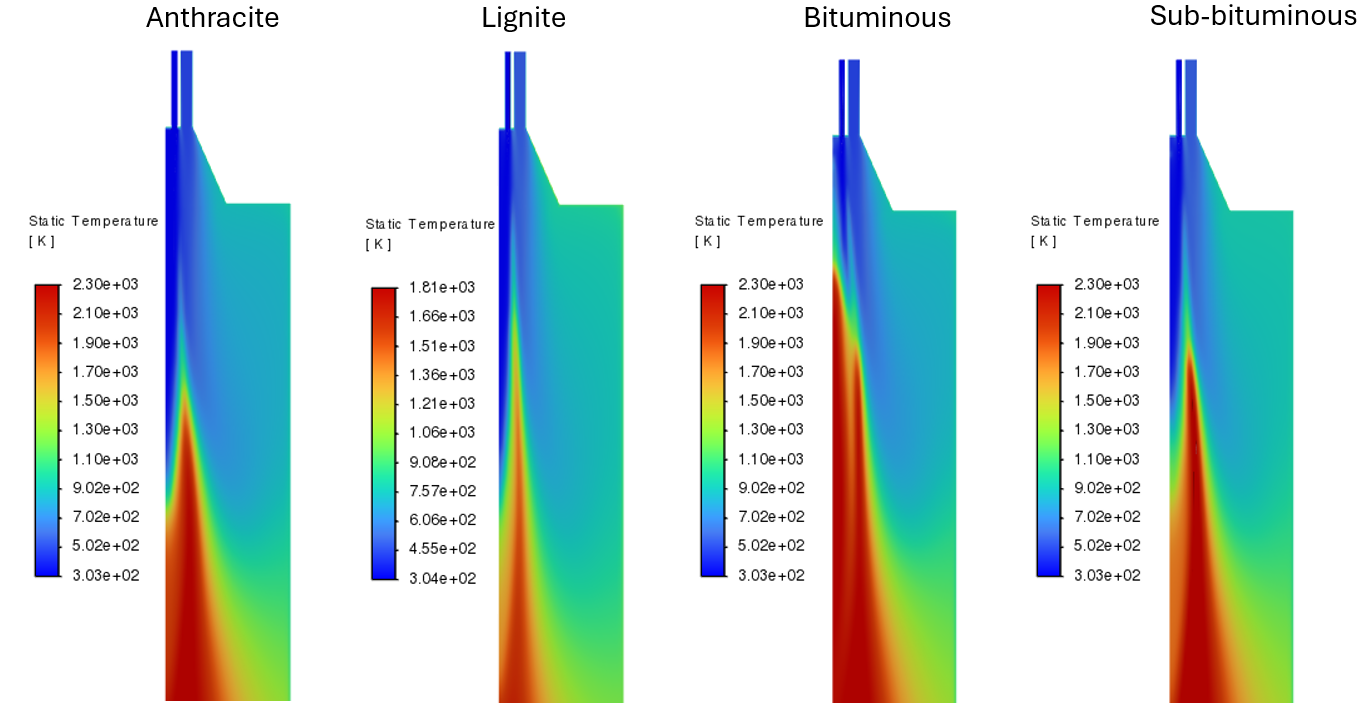
- Temperature contours can reveal ignition locations, peak combustion zones, heat-transfer patterns, areas of incomplete combustion.
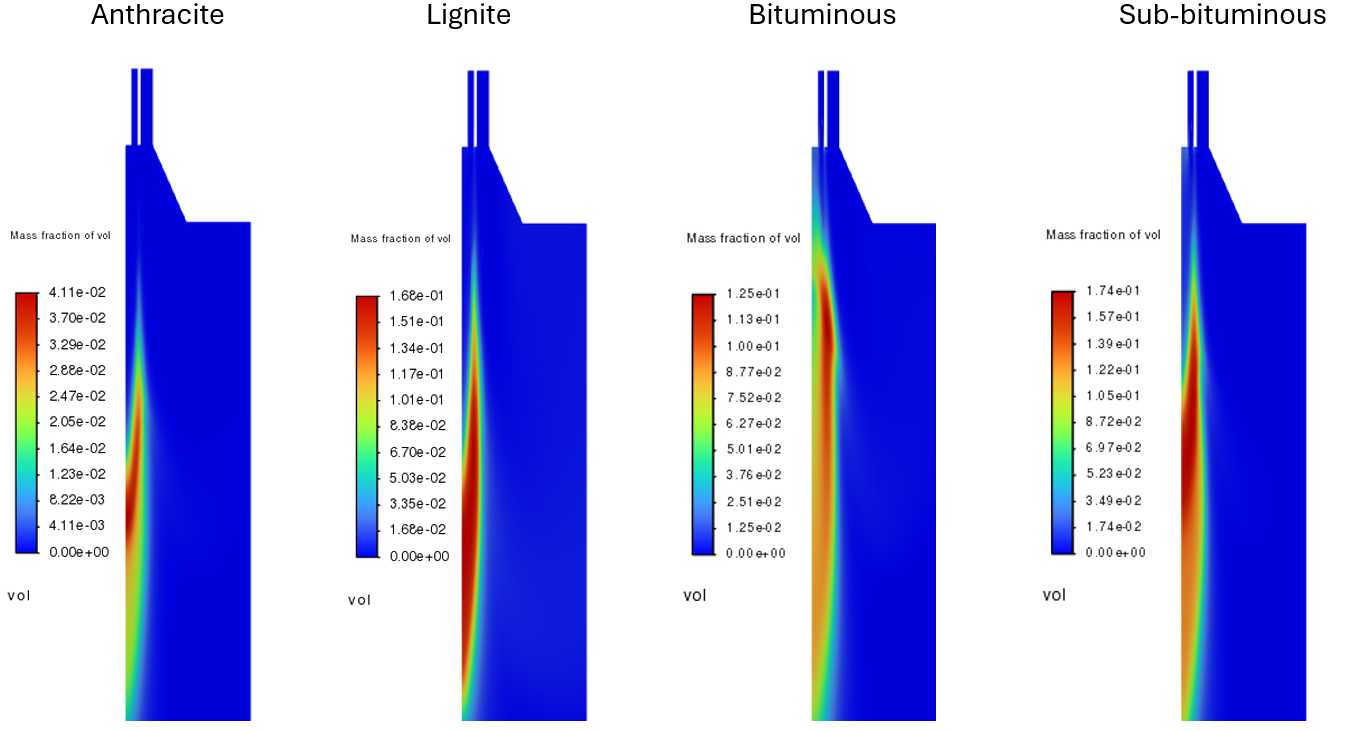
- Species Concentrations: Fluent makes it possible to track oxygen consumption, volatile release, carbon monoxide formation, carbon dioxide production, and water vapor generation.
Reaction Rates
Reaction-rate contours can identify where volatile combustion dominates and CO oxidation occurs. It can also help identifying if heat release is confined to a region or more spread out. It can also be used to detect wheter mixing limitations affect performance. Such insights are often difficult to obtain through physical testing alone.
Measuring Burnout Performance
Particle burnout is one of the most important performance indicators in coal-fired systems. Using DPM particle tracks, engineers can visualize:
- Particle temperature
- Remaining mass
- Char fraction
- Volatile fraction
- Combustion stage
The temperature profile and mass of particles is shown in the figures below, where we can inspect where in the system particles undergo significant surface combustion. Note that while only a segment of the geometry is modeled with the DPM, the walls for the whole geometry is shown here.
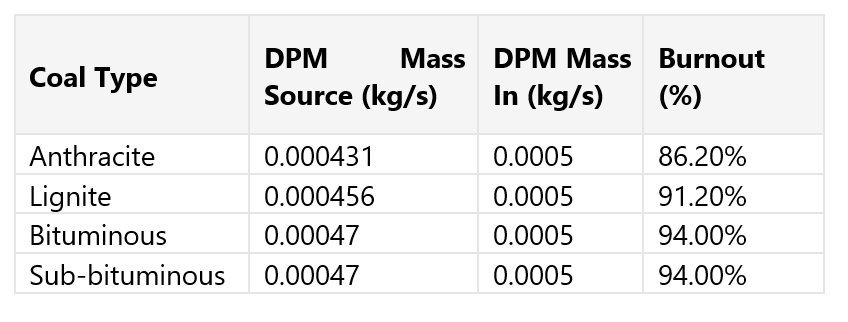
The burnout results compare the fraction of the injected coal particle mass consumed in the furnace for each coal type, based on an identical DPM mass inlet of 0.0005 kg/s. The DPM mass source values show that bituminous and sub-bituminous coals achieve the highest conversion, each reaching approximately 94% burnout, followed by lignite at 91.2%. Anthracite shows the lowest burnout at 86.2%, indicating that its higher fixed-carbon content and lower volatile fraction make it more resistant to complete combustion under the same operating conditions. Overall, the results reveal that coal rank and fuel composition strongly influence particle conversion, residence-time requirements, and the amount of unburned material exiting the furnace.
These types of analyses help engineers determine whether operating conditions, residence times, and burner configurations are achieving the desired combustion performance.
Analyzing Particle Size at the Outlet
Fluent also provides particle sampling and histogram tools that allow engineers to evaluate the characteristics of particles exiting the system. This information can be used to assess, particle burnout efficiency, remaining unburned fuel, ash transport behavior and the effects of fuel sizing. Such studies are particularly valuable when comparing alternative fuels, burner modifications, or operating conditions.
The Solution: Ansys Fluent Coal Combustion Simulation
Coal combustion involves a complex combination of particle physics, chemical reactions, turbulence, radiation, and heat transfer. Ansys Fluent 2025 R2 provides an integrated workflow capable of capturing all these phenomena within a single simulation environment.
By combining the Coal Calculator, Species Transport, Radiation, and Discrete Phase Modeling technologies, engineers can predict volatile release, char burnout, temperature distribution, reaction rates, and overall combustion performance with a high degree of confidence.
Whether you’re evaluating boiler performance, optimizing industrial furnaces, investigating alternative solid fuels, or improving combustion efficiency, Fluent provides the tools needed to transform fuel characterization data into actionable engineering insight.
Ready to Put Ansys Fluent to Work on Your Combustion Challenges?
SimuTech Group’s CFD experts can help you build, validate, and optimize Ansys Fluent models for coal combustion, alternative solid fuels, industrial furnaces, boilers, and other reacting-flow applications. From fuel characterization and particle modeling to heat transfer, emissions, and burnout performance, our team can help turn complex combustion physics into actionable engineering insight.

Tiago Lins
Staff Engineer Analyst – Fluids, SimuTech Group
Tiago Lins is a Staff Engineer Analyst at SimuTech Group, where he supports customers with advanced fluid dynamics simulation workflows and practical Ansys software expertise. His work helps engineering teams apply simulation more effectively across complex modeling, analysis, and validation challenges, including CFD, multiphysics workflows, and simulation-driven product development.