 Contact Us
Flownex control components give engineers a complete library of analog, digital, and PID elements for managing industrial system processes. This blog covers the Flownex control library, external software integration, and a data center thermal management example that demonstrates Flownex control in action.
Challenges in Controlling Industrial Systems
Controlling industrial systems requires handling dynamic and transient conditions across complex fluid networks. Key challenges include:
- Fluid network design: Designing and sizing components within large thermofluid systems while balancing energy efficiency.
- Transient simulation: Simulating scenarios such as water hammer and surge propagation is difficult but necessary for safety analysis.
- Control integration: Integrating PLCs, developing control philosophies, and managing data compatibility across subsystems adds complexity.
- PID tuning: Tuning PID controllers to minimize mechanical movements while meeting performance targets requires iterative analysis.
- Risk and maintenance: Ensuring safety through risk analysis while supporting predictive maintenance and cost reduction across the system.
These challenges highlight the necessity for advanced simulation and analysis tools to ensure the efficient, safe, and reliable operation of industrial systems. The Flownex Simulation Environment is an effective tool for addressing various issues related to industrial system control across industries.
Flownex Control Library for Industrial System Simulation
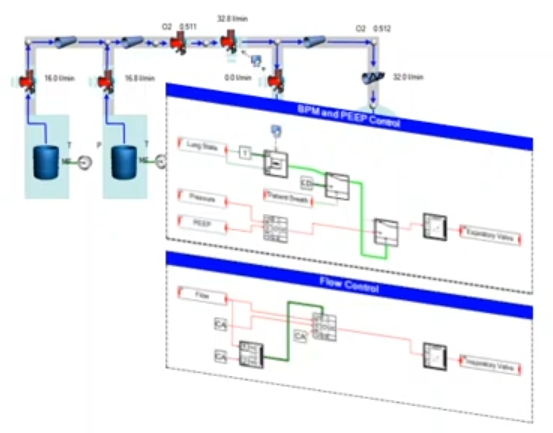
Flownex is an engineering software designed to analyze large thermofluid systems, including power cycles, auxiliaries, and turbomachinery. It enables users to calculate essential parameters such as mass flow, pressure, and temperature within these systems. The software features a wide range of industry-standard components and fluid models, complemented by an extensive library of control elements integrated with the flow model. Moreover, Flownex can be linked with external software like Ansys Fluent and Mechanical, Matlab, SixSigma, and also to Excel, Mathcad, and Python in order to incorporate custom codes.
Flownex provides both steady-state and transient solvers, along with a library of control components for simulating the management of both analog and digital control systems. This capability enables simulation of the entire process, including the control system, to accurately assess the system’s overall performance. Furthermore, Flownex is designed to meet NQA1 and ISO9001 standards, ensuring high-quality compliance.
The control library configuration consists of:
- Analog components: Controllers, filters, inputs and outputs (IO), math functions, switches
- Digital components: Counters, IOs, logic gates, switchers, timers
- Converters: Digital to analog, analog to digital, integer to double
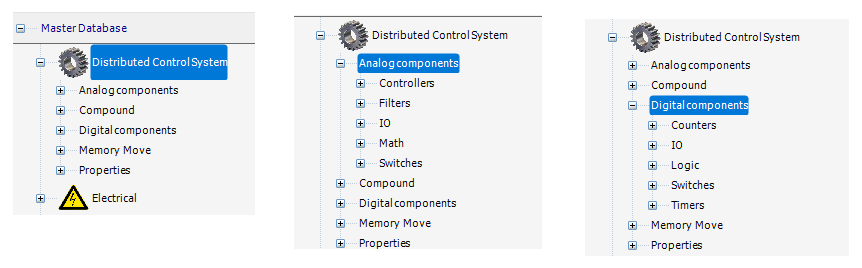
Table 1. Control components, analog components, and digital components in Flownex
Analog Control Components
Analog control components typically include PID controllers, which facilitate proportional, integral, and differential control, as well as filters and switches for comparing various inputs.
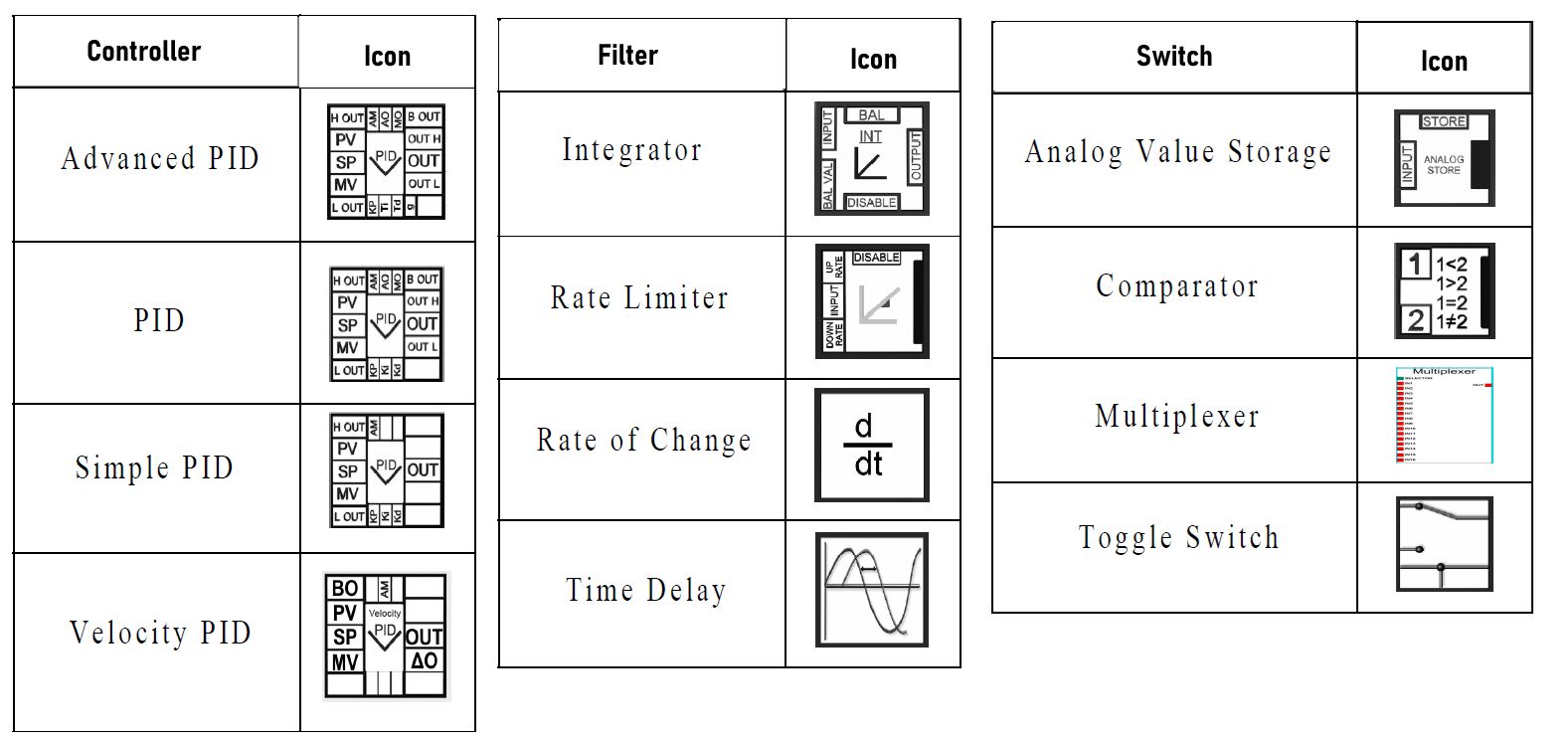
Table 2. Analog components: controllers, filters, switches
Digital Control Components
Digital control components commonly include counters, which track incremental values from 0 to a specified maximum, logic gates such as AND and OR, switches, and timers. The AND logic gate determines the lowest value among all inputs and outputs 0 if any input is 0. The OR logic gate outputs 1 if any input is 1 and outputs the highest value among all inputs. Timers are used to set the time for specific actions.
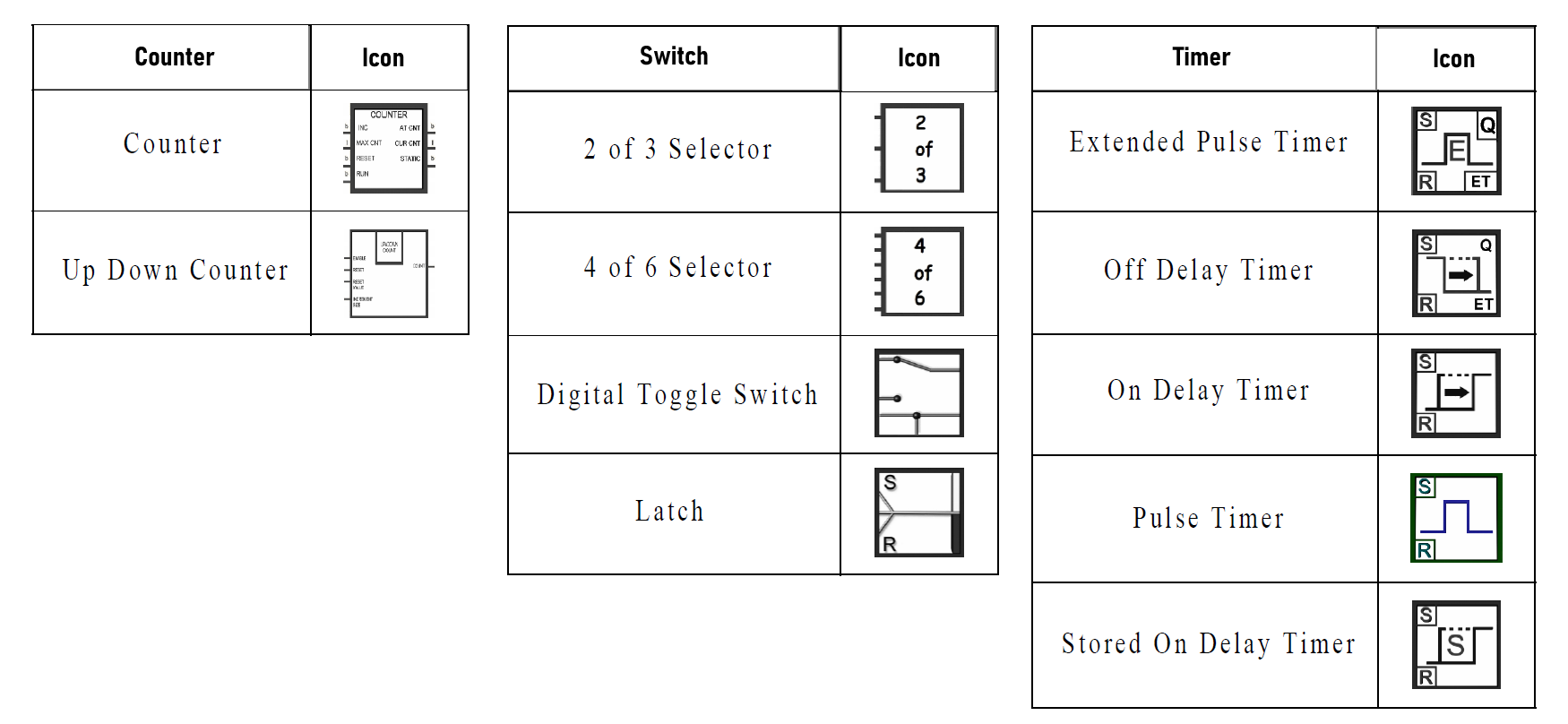 Table 3. Digital components: counters, switches, and timers
For a full list of each control component’s functionality, including input and output data, connectable inputs and outputs, execution counts, and configuration tables, please refer to the Flownex DCS Library Manual.
Why Flownex Control Components Matter for Industrial Applications
Flownex control components provide an advanced solution for modern industrial control systems. These components are designed to deliver precise, reliable control, which is crucial for achieving the accuracy required in various applications. By utilizing the sophisticated features of Flownex control components, industrial facilities can enhance operational efficiency, minimize errors, and effectively manage critical processes. This leads to improved outcomes and increased overall system reliability.
Integrating Flownex Control with External Software
Flownex can control industrial systems and processes by integrating with third-party software such as MATLAB Simulink and OPC servers to synchronize control parameters and enhance control simulation and the integration of custom code. It also includes a library of utilization elements for creating custom human-machine interfaces (HMIs).
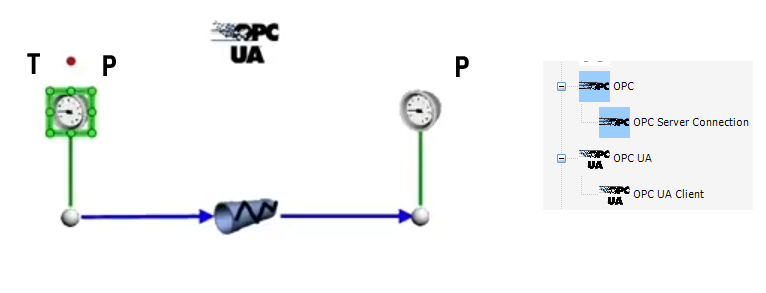
Flownex has recently enhanced connectivity with OPC UA servers via the OPC UA Client to exchange data between Flownex and OPC UA servers, enabling real-time data access and information processing. The Flownex OPC client facilitates the exchange of Flownex inputs and outputs with tags on an OPC-standard server.
Data Center Thermal Management Example Using Flownex Control
Effective thermal management is essential for IT infrastructure. Flownex control systems manage cooling, airflow, and heat to ensure that components operate within their specified limits. This system integrates with management systems for real-time monitoring, enhancing energy efficiency while reducing costs. However, if the main power fails and the generator trips, major components such as chillers, fans, and pumps that are not connected to an uninterruptible power supply (UPS) may reset to their initial conditions. This can hinder their ability to provide adequate cooling. To address this issue, we need to implement control systems that prevent an increase in the temperature of the chilled water used to cool supplied air, and to monitor and manage other factors such as server temperatures.
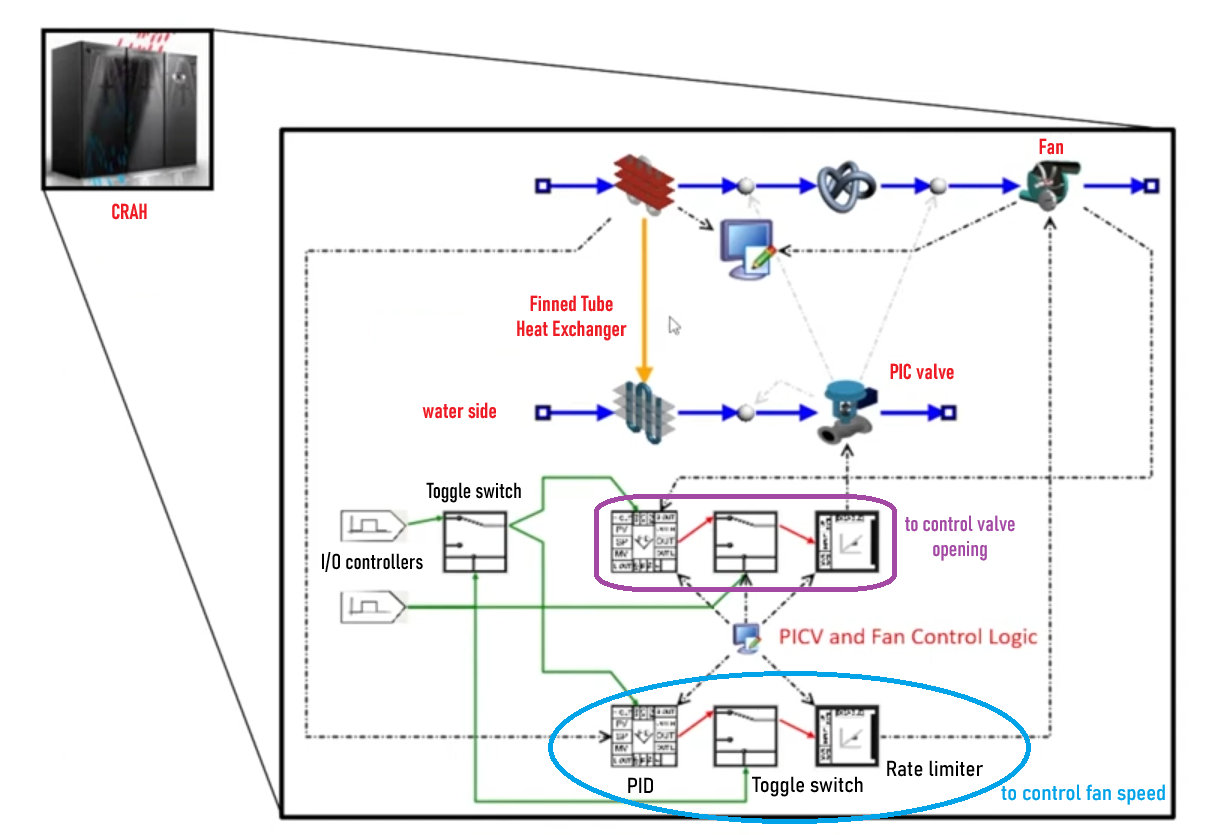
In this example, a Computer Room Air Handling (CRAH) network is used for cooling the data center. The Flownex control components, including PIDs, toggle switches, and rate timers, are utilized in two control logic systems:
1. The first system controls the fan speed, which in turn adjusts the air temperature returning to the CRAH.
2. The second system regulates the valve opening on the water side of the network. This valve opening, or flow set point, is used to control the chilled water temperature.
The script performs the calculations and connects the two control systems.
Working with Flownex for industrial system control or thermal management simulation? SimuTech Group’s CFD and thermal consulting engineers work with Flownex, Ansys Fluent, and system-level simulation tools. For more on thermal simulation, see our article on battery cold plate design exploration using Ansys Discovery CFD. Learn more about Ansys Fluent or contact us to discuss your project.