
 Contact Us
Introduction to Initial Conditions in Simplorer
Correctly defining the initial state of a circuit is essential for obtaining accurate simulation results in Simplorer. Improper or undefined initial conditions can introduce non-physical transients, DC offsets, and incorrect steady-state behavior.
Transformer Example
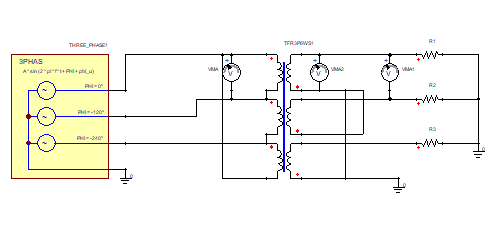
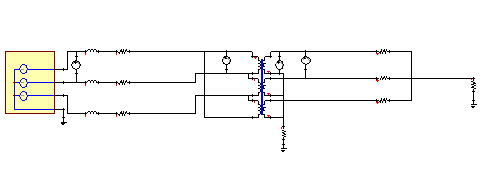
Consider the simple three-phase Delta–Y transformer configuration shown below.
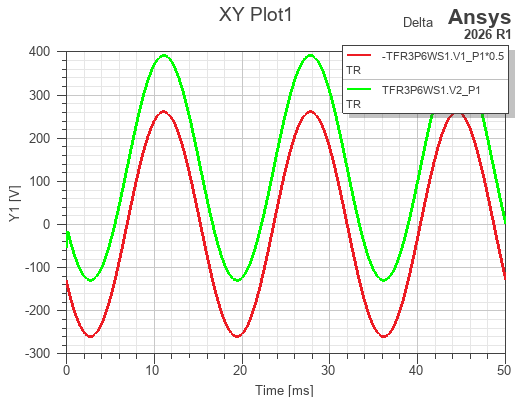
When the initial currents of the primary and secondary transformer windings are left undefined, an unexpected DC bias appears in the secondary voltage waveform.
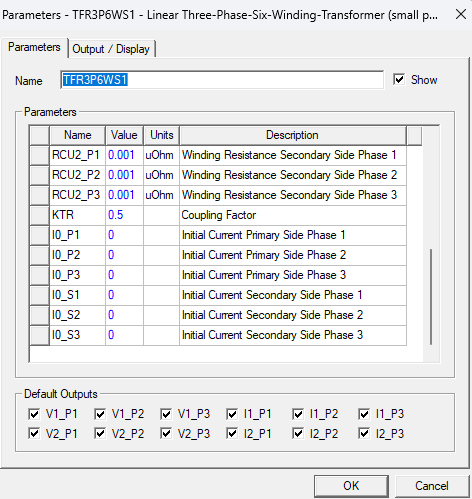
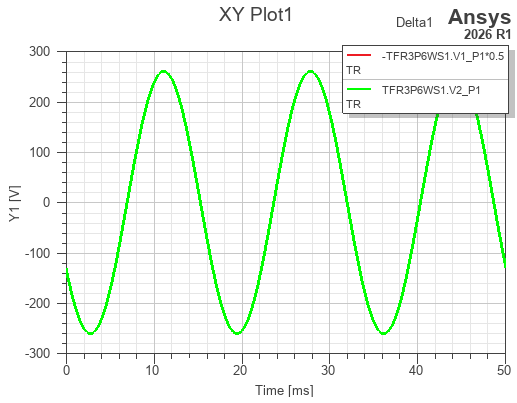
By defining the appropriate initial currents for the transformer windings, the DC bias is eliminated and the expected steady-state waveform is restored.
Circuits with Additional Inductors
The importance of proper initialization becomes even more evident when additional inductive elements are included in the circuit.
If the initial current of an inductor is not set to the circuit’s intended operating condition, both the primary and secondary voltages may deviate significantly from their expected behavior, resulting in inaccurate simulation results.
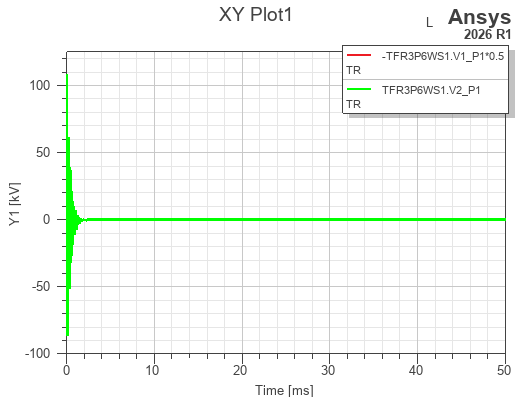
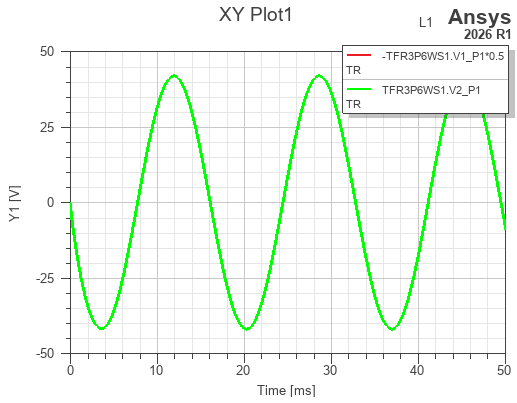
After assigning appropriate initial currents to all inductive elements, the simulated voltages converge to the expected waveforms.
Capacitor Initial Conditions
The same principle applies to capacitive elements. When a circuit contains energy-storage components such as capacitors, their initial voltages should also be specified whenever the operating point is known.
If capacitor initial voltages are left undefined, the simulator must assume default starting conditions, which can introduce artificial transients and distort the circuit response during the initial portion of the simulation.
By properly defining:
- Initial currents for transformer windings
- Initial currents for inductors
- Initial voltages for capacitors
the simulation starts from a physically meaningful state and produces more accurate transient and steady-state results.
Simplorer Initial Conditions: In Conclusion
Accurate initialization of all energy-storage elements is critical for reliable circuit simulation in Simplorer. Undefined initial conditions can lead to DC offsets, incorrect transient responses, and misleading steady-state waveforms. Whenever possible, users should specify the initial currents of inductive components and the initial voltages of capacitive components to ensure the simulation begins from the intended operating point and yields physically correct results.
Get More from Ansys Electronics Simulation
SimuTech Group helps engineering teams build accurate, efficient circuit and system simulation workflows using Ansys software. Connect with our engineers for guidance on model setup, initialization, solver behavior, and results interpretation.

Zoe Zhu, M.A.Sc., Electrical Engineering
Senior Staff Engineering Analyst, SimuTech Group
Zoe has been an Electrical Engineer and Analyst at SimuTech Group, an Ansys Certified Apex Channel Partner, since 2016, specializing in computational electromagnetics. Before coming to SimuTech, she served as an Electrical Engineer at KSR International Inc. and held roles at Delphi and Hammond Power Solutions, contributing to electromagnetic analysis. She holds a Bachelor of Engineering from Xi’an Jiaotong University and a Master of Applied Science in Electrical Engineering from McMaster University.