 Contact Us
Introduction TAU Mesh for APhi Solver Accuracy
The APhi solver is more sensitive to mesh symmetry than the magnetostatic solver. Since the TAU mesher generally produces more symmetric meshes, it is recommended to use TAU mesh when solving APhi problems.
To demonstrate the impact of mesh quality, a simple coil model excited by 2 × 10⁶ ampere-turns was analyzed.
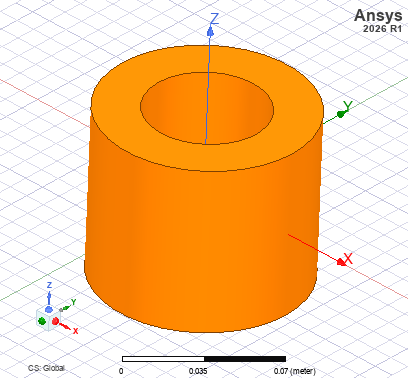
Using the magnetostatic solver, the magnetic flux density at the origin (0, 0, 0) was:
- TAU mesh: 21.55 T
- Classic mesh: 21.81 T
The difference between the two results is less than 1.5%, indicating that both meshes provide comparable accuracy in the magnetostatic solution.
The meshes generated by the magnetostatic solver were then imported into the APhi solver. The resulting magnetic flux densities at the origin were:
- TAU mesh: 21.73 T
- Classic mesh: 17.57 T
The APhi result obtained with the TAU mesh closely matches the magnetostatic solution, while the result obtained with the classic mesh shows a significant deviation.
Mesh Comparison: TAU Mesh vs Classic Mesh
The figures below show that the TAU mesher provides a higher-quality representation of curved surfaces. This improved geometric fidelity leads to better mesh symmetry and more accurate APhi results.
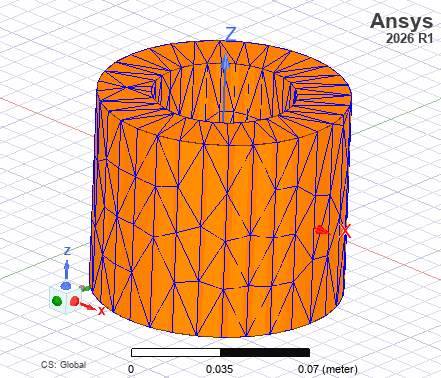
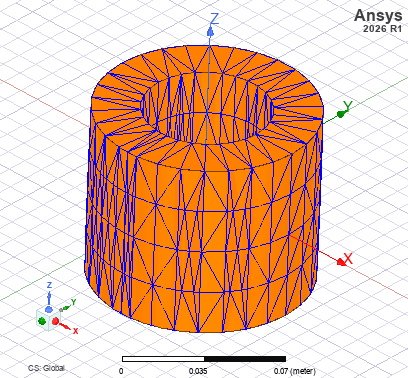
To improve the accuracy of the classic mesh, the initial mesh was refined by adjusting the mesh refinement slider. After refinement, the APhi solver produced a flux density of 21.27 T, which is much closer to the expected value.
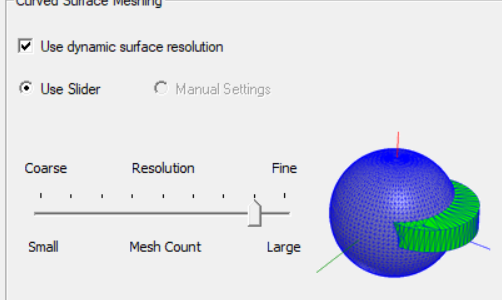
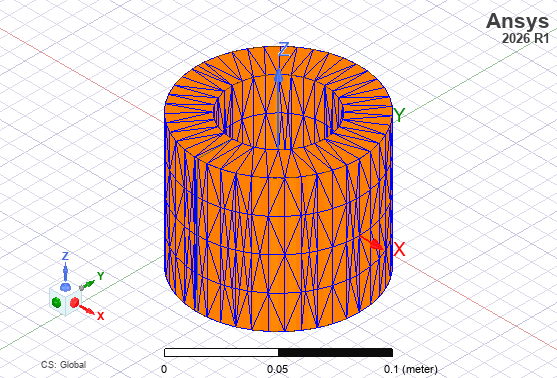
Refined Classic Mesh
The refined mesh significantly improves the APhi solution; however, it requires additional mesh density and computational resources.
TAU Mesh for APhi Solver Recommendations
For APhi simulations, especially models containing curved surfaces, we recommend using the TAU mesher. The TAU mesh provides better symmetry and surface representation, resulting in more reliable and accurate APhi solutions without requiring excessive mesh refinement.
Improve Your Ansys Maxwell Simulation Workflow
SimuTech Group helps engineers select appropriate meshing and solver strategies for accurate electromagnetic simulation. Connect with our team for support with Ansys Maxwell model setup, mesh refinement, solver selection, and results validation.

Zoe Zhu, M.A.Sc., Electrical Engineering
Senior Staff Engineering Analyst, SimuTech Group
Zoe has been an Electrical Engineer and Analyst at SimuTech Group, an Ansys Certified Apex Channel Partner, since 2016, specializing in computational electromagnetics. Before coming to SimuTech, she served as an Electrical Engineer at KSR International Inc. and held roles at Delphi and Hammond Power Solutions, contributing to electromagnetic analysis. She holds a Bachelor of Engineering from Xi’an Jiaotong University and a Master of Applied Science in Electrical Engineering from McMaster University.