 Contact Us
Challenge
When modeling water impingement on heated surfaces, engineers often face multiple operating and geometric parameters that influence flow distribution, surface interaction, and heat transfer performance. Traditional simulation workflows can make systematic studies of these parameters tedious, requiring extensive manual setup, repeated case management, and careful comparison of results across design variations.
FreeFlow provides a simulation environment for setting up and solving particle-based fluid flow and heat transfer problems, while optiSLang enables automated sensitivity studies and surrogate-model-based exploration. Together, they allow engineers to define input and output parameters, execute parametric studies efficiently, and quickly understand how mass flow rate, plate angle, and nozzle-to-plane translation affect thermal performance.
Engineering Solution: FreeFlow and optiSLang
In this blog, we combine FreeFlow simulation setup with optiSLang sensitivity analysis to quantify the effect of each input parameter on temperature and heat transfer outputs. The workflow defines the geometry, boundary conditions, SPH properties, solver settings, and input/output parameters in FreeFlow, then uses optiSLang to generate surrogate models, evaluate coefficients of prognosis and importance, and identify the variables that most strongly drive thermal performance.
In this study, we considered flow impingement of water from a nozzle onto a warm plate. Different parameters were defined.
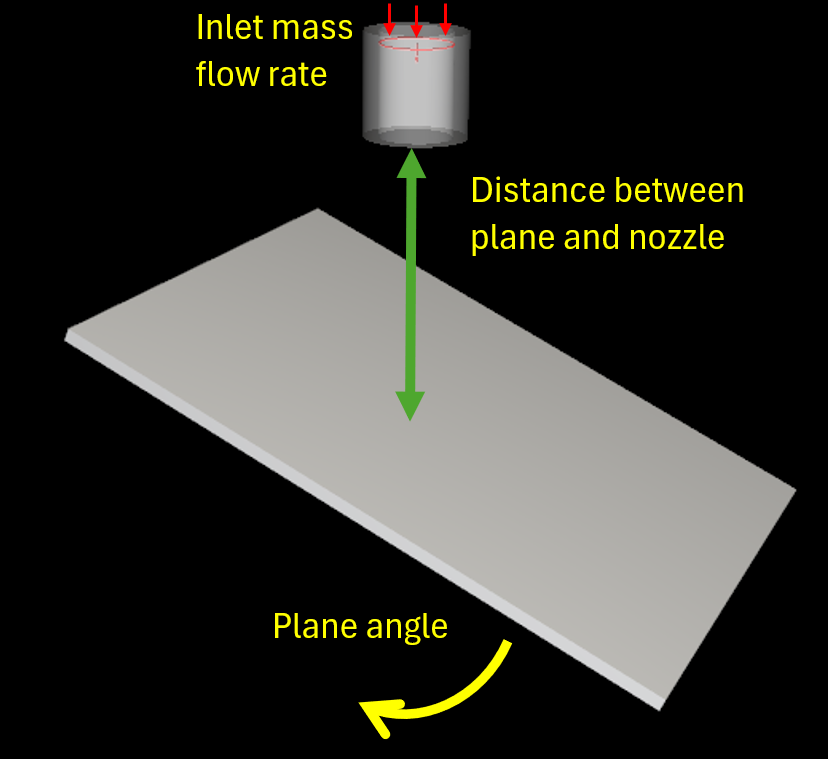
Before moving the model to optiSLang, we must set it up in FreeFlow. We first import the simple geometry generated in Discovery, import the Modules, and set up the boundary conditions, SPH properties and Solver settings. We also need to define the input and output parameters. These will be visible to optiSLang when the simulation file is loaded there.
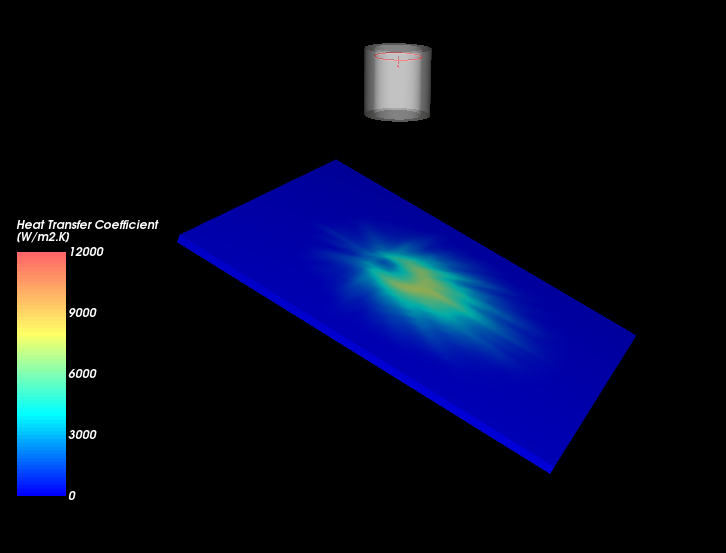
Here, we set up three input parameters, as shown in the schematics of the model above:
- Mass flow rate in ton/h
- Angle of the plane surface
- Translation: controls the distance from nozzle to plane
Note that the geometry was initially set with an angle of 23 degrees and a translation value of -0.11m from nozzle to plane. Because the plane is shifted left of the nozzle, the geometry is asymmetric: there is a longer flow path on the left side and a shorter path on the right.
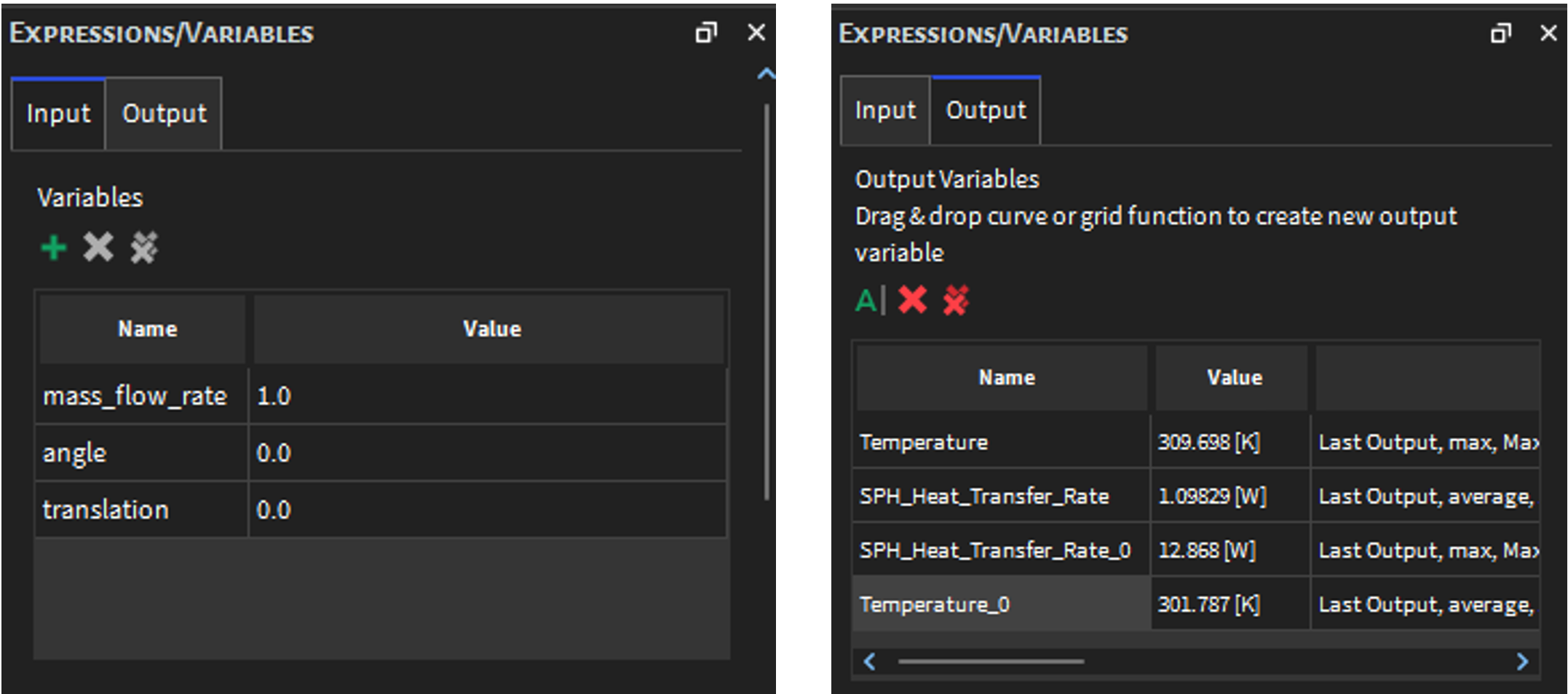
We have also added four output parameters: the liquid temperature (maximum and average), and the heat transfer rate (maximum and average).
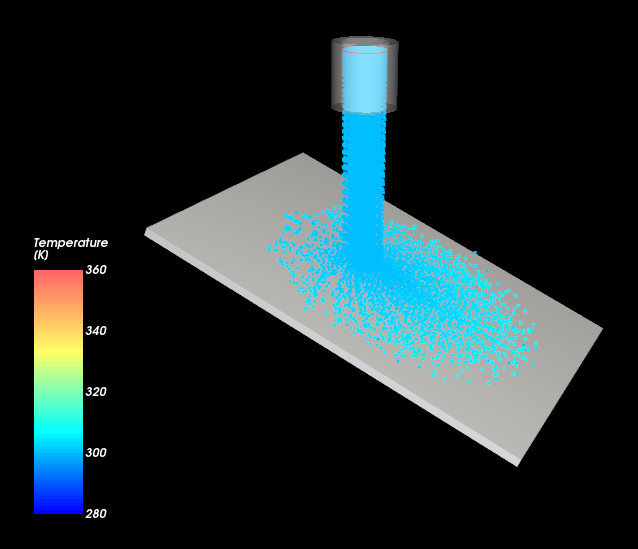
Plane is set a a fixed temperature of 400 K, while the liquid is set at 300 K.
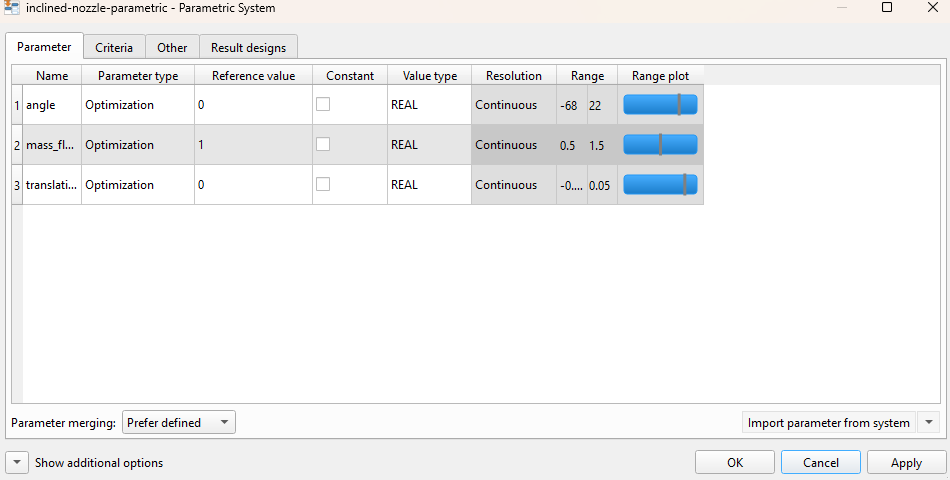
Once the simulation is tested in Standalone FreeFlow, we can safely transition it to optiSLang. We used the Adaptive Metamodel of Optimal Prognosis (AMOP) node in optiSLang. AMOP is an iterative metamodeling approach based on the Metamodel of Optimal Prognosis (MOP), where the design space is refined adaptively by adding new data points where they are most needed. The process behaves similarly to an optimizer: it runs a defined number of solver evaluations over multiple iterations and progressively improves the surrogate model. Convergence is reached when the selected responses achieve the required minimum Coefficient of Prognosis (CoP), indicating that the metamodel has sufficient predictive quality.
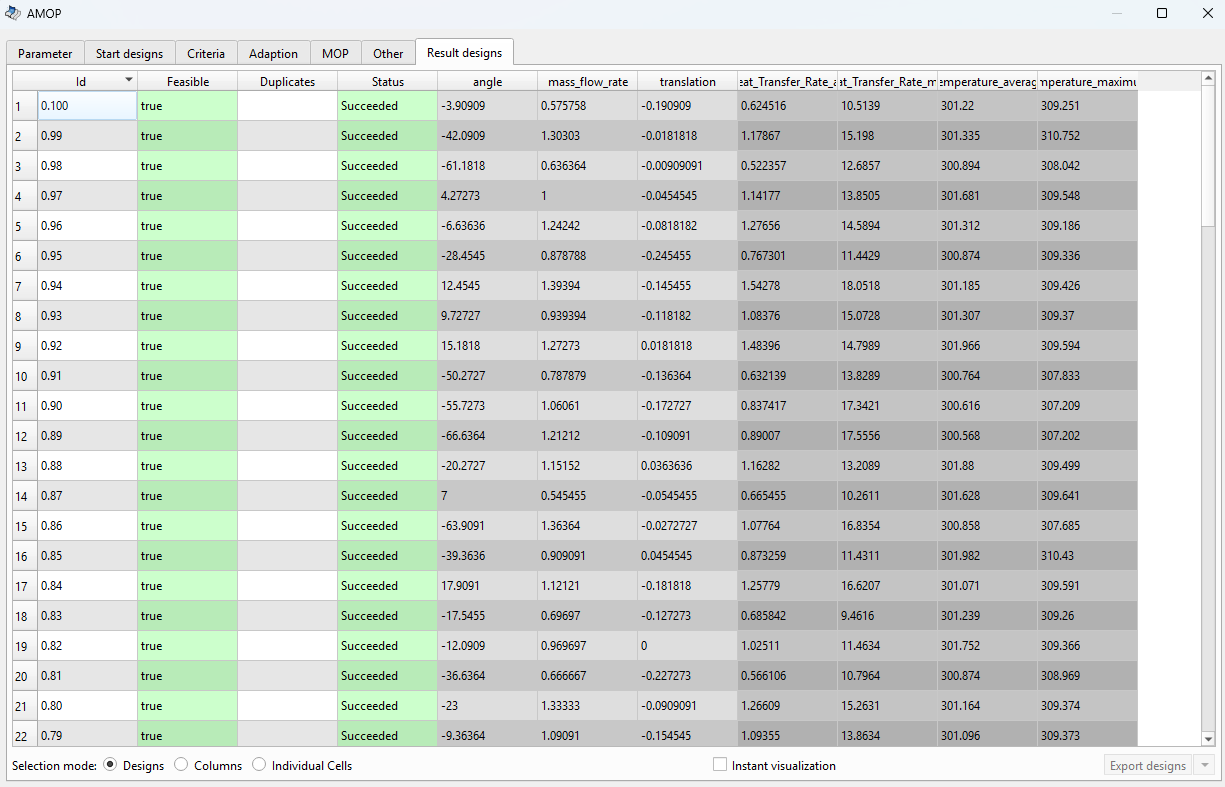
We can verify that the sensitivity analysis is running, and the data already generated:
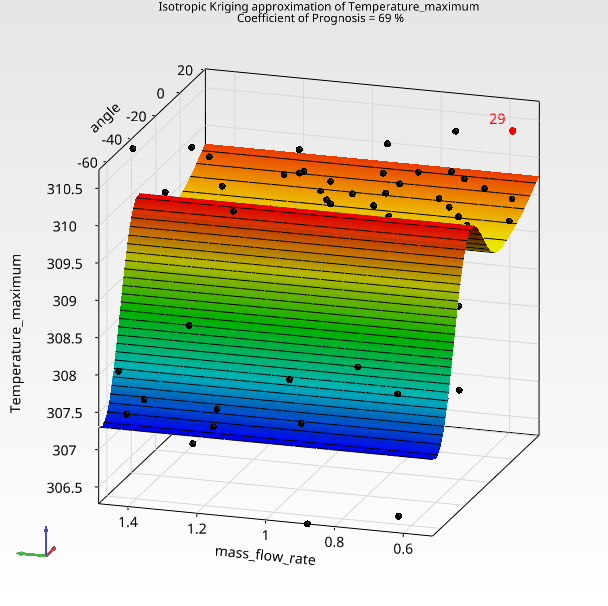
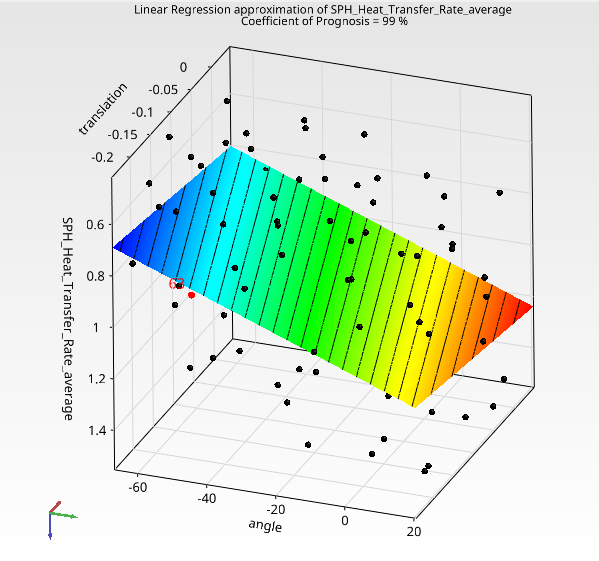
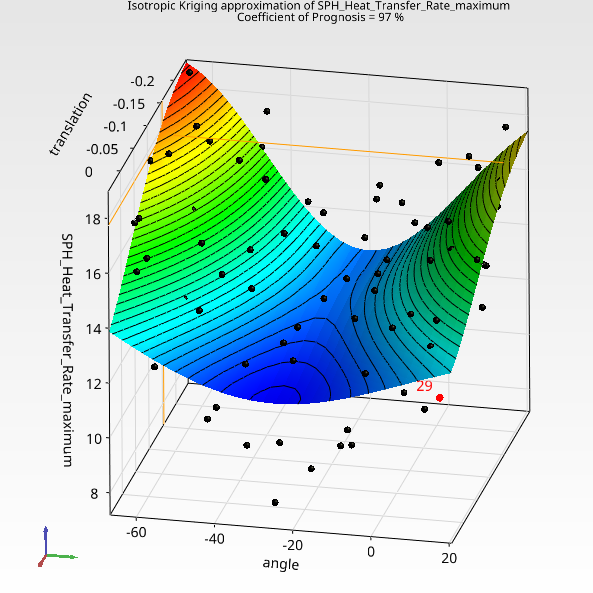
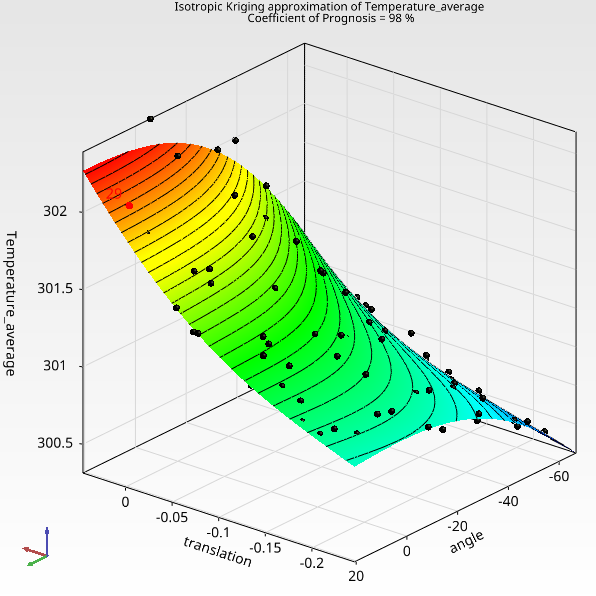
The CoP matrix indicates that the meta-model provides strong predictive capability for most responses, with total CoP values close to 1 for average temperature and both heat transfer metrics, suggesting reliable surrogate behavior for these outputs. Average heat transfer is dominated by mass flow rate, which has the highest individual CoP, while angle and translation contribute only weakly. Similarly, maximum heat transfer depends primarily on mass flow rate, with moderate influence from angle and minimal effect from translation. For temperature, the average temperature is influenced mainly by translation and, to a lesser extent, angle, while mass flow has negligible impact. In contrast, the prediction quality for maximum temperature is lower and depends mainly on angle, indicating that this response may require additional sampling or refinement of the model. The CoP matrix for our FreeFlow and optiSLang study/example can be seen below:
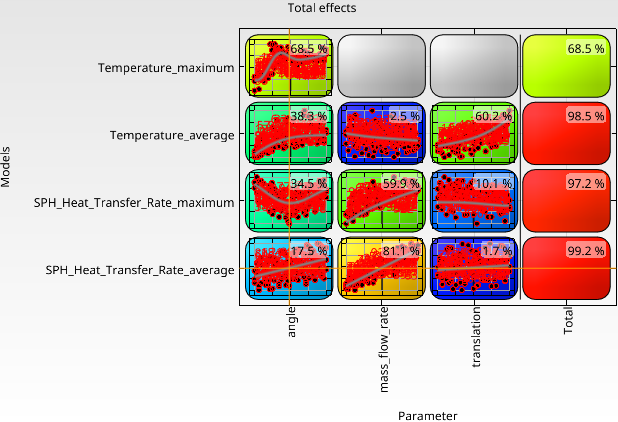
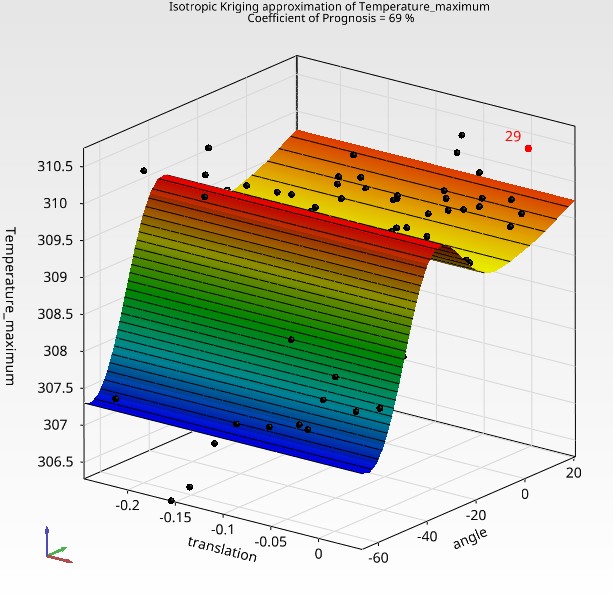
We can also visualize the data plotted in 3D scatter plots with surfaces showing the surrogate models. Here, we plot the relationship of angle and mass flow rates with the output parameters, followed by the impact of translation and angle on the output parameters.
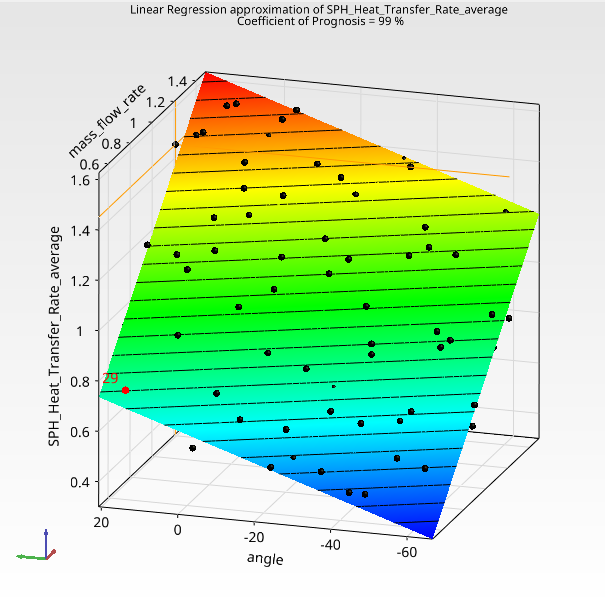
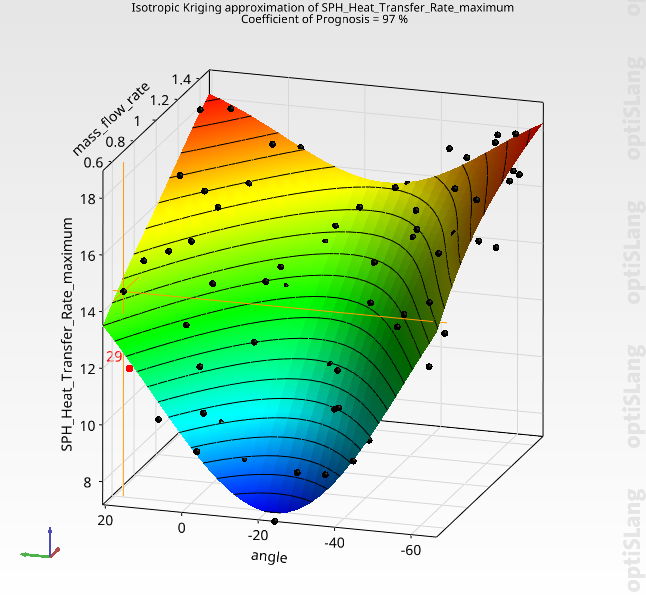
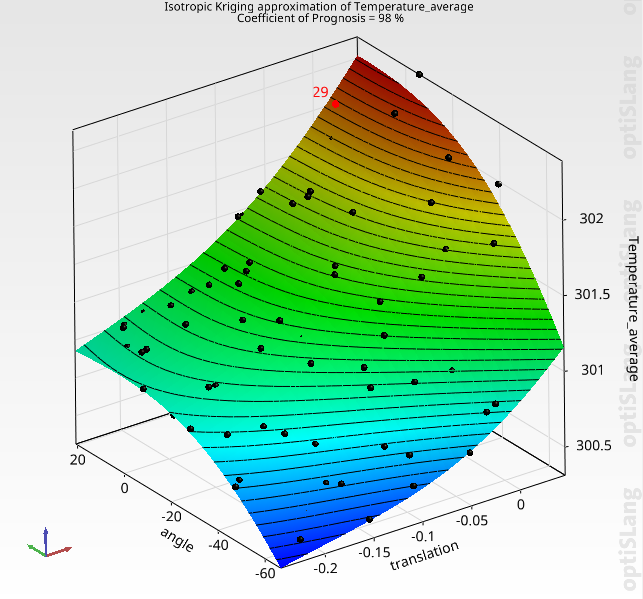
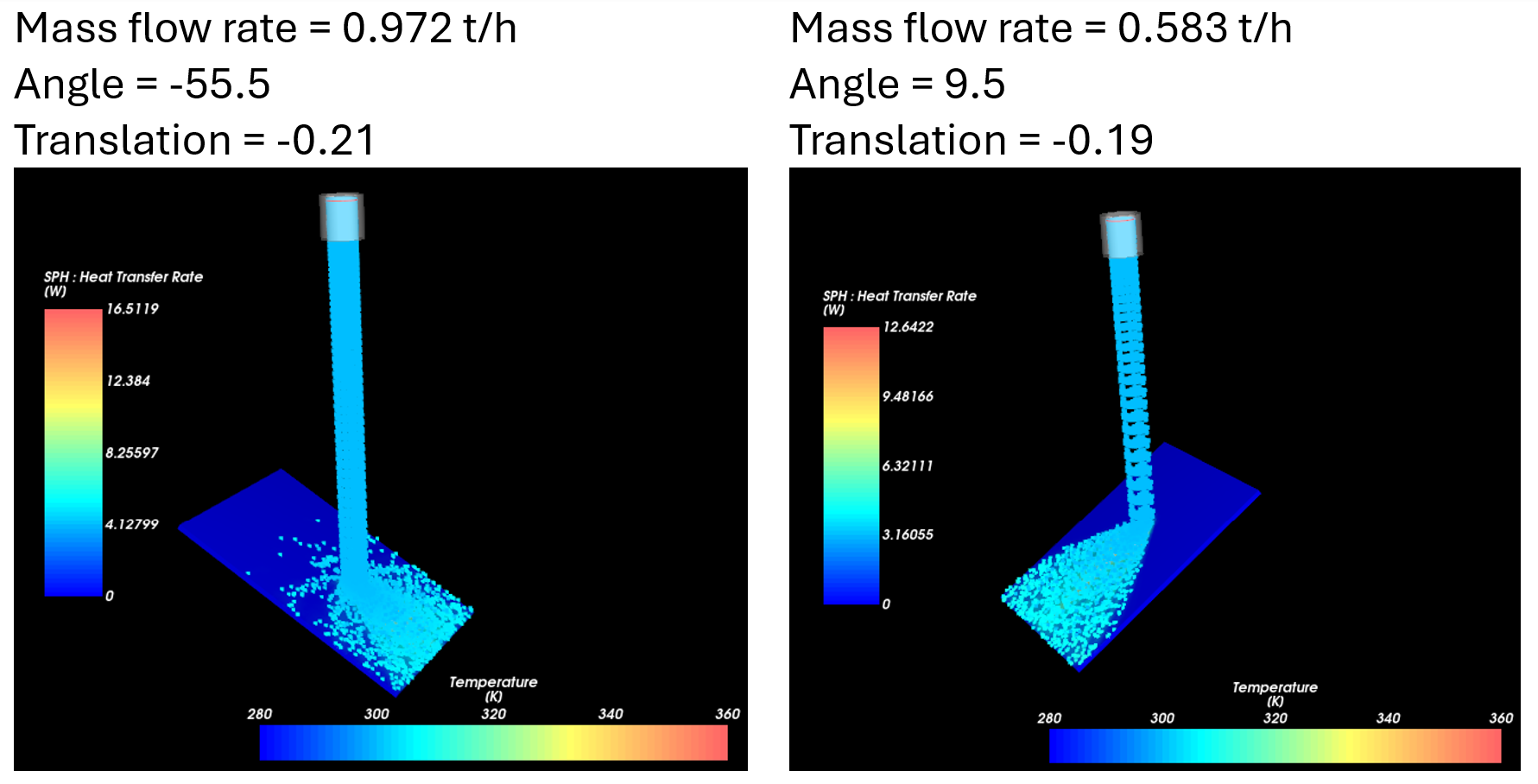
We can also go back to the generated FreeFlow files to verify the results. Here, we can see a sample of two cases with the plane oriented in different angles, and at different mass flow rates.
In optiSLang, we can evaluate the relative importance of each input variable on the predicted effect on the four output parameters using the Coefficient of Importance (CoI) plots.
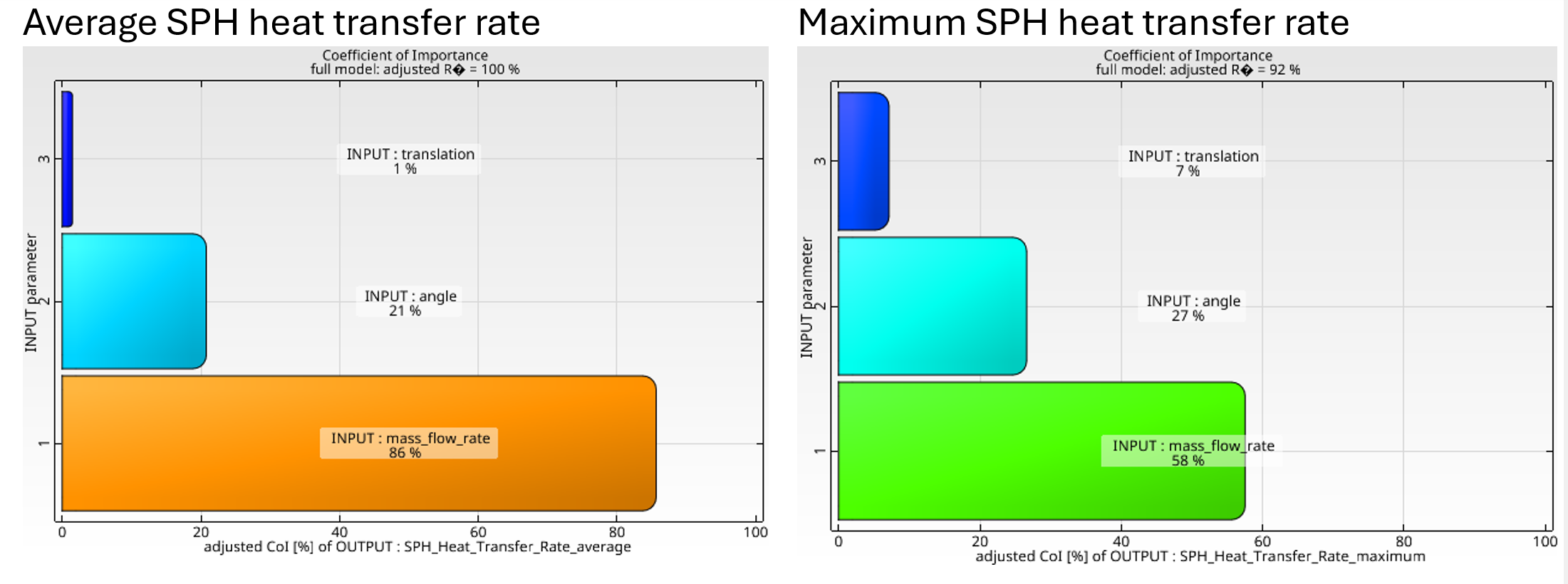
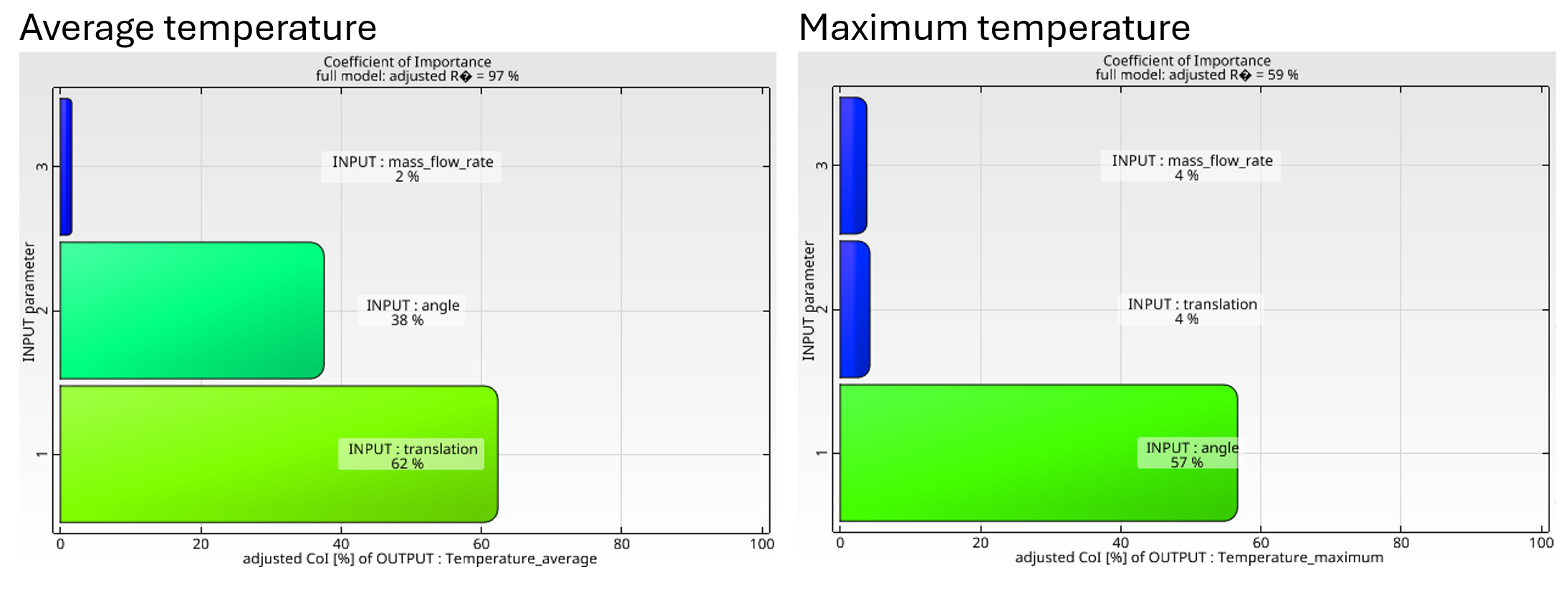
Based these results, we can observe the following of our FreeFlow and optiSLang example:
- Increasing the angle directs the flow over the longer side of the plane, increasing interaction length and mixing, which raises both average and maximum heat transfer rates.
- Decreasing the angle pushes the flow toward the shorter side, reducing contact length and weakening mixing, which lowers both peak and average heat transfer.
- At very high positive angles, gains in heat transfer begin to level off and become more dependent on mass flow rate.
- Translation determines how effectively the jet interacts with the plane; moderate offsets maximize interaction and heat transfer, while large offsets weaken contact and reduce performance.
- Mass flow rate amplifies the geometric effects: higher flow increases both average and maximum heat transfer, especially when the flow is aligned with the longer side.
- At lower flow rates, the difference between long-side and short-side flow paths becomes less significant, and heat transfer remains uniformly lower.
- Maximum heat transfer occurs in regions of strongest local interaction and increases with both higher angle and higher flow rate.
- Average heat transfer follows the same trends but is less sensitive to localized peaks, representing overall system performance.
- Maximum temperature increases slightly in regions with strong mixing and high flow, reflecting localized heating.
- Average temperature remains nearly constant across all cases, indicating that geometric changes mainly redistribute heat transfer locally rather than changing the overall energy level.
Advancing Parametric Simulation Workflows with FreeFlow and optiSLang
Parametric studies with FreeFlow and optiSLang help engineers explore how operating and geometric conditions influence flow behavior and heat transfer performance without manually managing every simulation case. By combining FreeFlow’s particle-based simulation capabilities with optiSLang’s automated sensitivity analysis, AMOP refinement, and surrogate modeling, this workflow provides an efficient way to evaluate “what if?” scenarios and identify the parameters that matter most.
For applications involving jet impingement, cooling, spraying, or liquid interaction with surfaces, this approach offers a practical path to improve design understanding, reduce simulation setup effort, and support more informed engineering decisions. Instead of relying on isolated simulation results, engineers can build a broader performance map and use it to guide optimization, troubleshooting, and future design exploration.
Explore Smarter Simulation and Optimization Workflows
Want to get more from parametric simulation, sensitivity analysis, and design exploration? SimuTech Group can help you build efficient simulation workflows using Ansys tools like FreeFlow and optiSLang to better understand design behavior and accelerate engineering decisions.

Tiago Lins
Staff Engineer Analyst – Fluids, SimuTech Group
Tiago Lins is a Staff Engineer Analyst at SimuTech Group, where he supports customers with advanced fluid dynamics simulation workflows and practical Ansys software expertise. His work helps engineering teams apply simulation more effectively across complex modeling, analysis, and validation challenges, including CFD, multiphysics workflows, and simulation-driven product development.