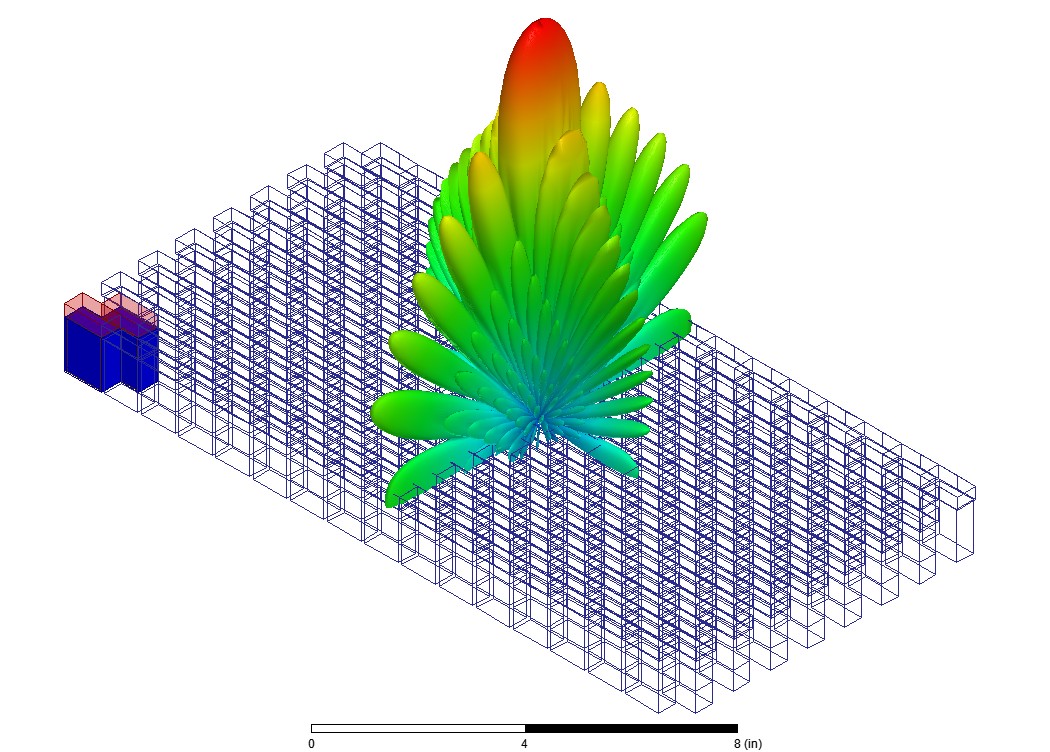
Engineers may use advanced unit cell simulation in Ansys HFSS to model infinite and finite phased-array antennas. This includes all electromagnetic effects, such as mutual coupling, array lattice definition, finite array edge effects, dummy components, and element blanking.
In addition, under any beam scan situation, a candidate array design may analyze the input impedances of all components. Based on element match (passive or driven) far-field and near-field pattern behavior over any scan condition of interest, phased array antennas can be optimized for performance. That is, at the element, subarray, or complete array stage.
Infinite Array Modeling
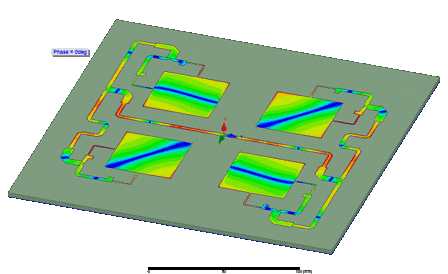
For conditional settings, one or more antenna elements are mounted inside a unit cell frequency in infinite array modeling. To create an infinite number of elements, the cell includes periodic boundary conditions on the surrounding walls to mirror fields. Fortunately, this method is particularly useful for predicting array-blind scan angles, which may occur when array beam steering is used.
In short, this technology enables full array analysis, which includes the prediction of all mutual coupling, scan impedance, element patterns, array patterns, and array edge effects.


 Contact Us